
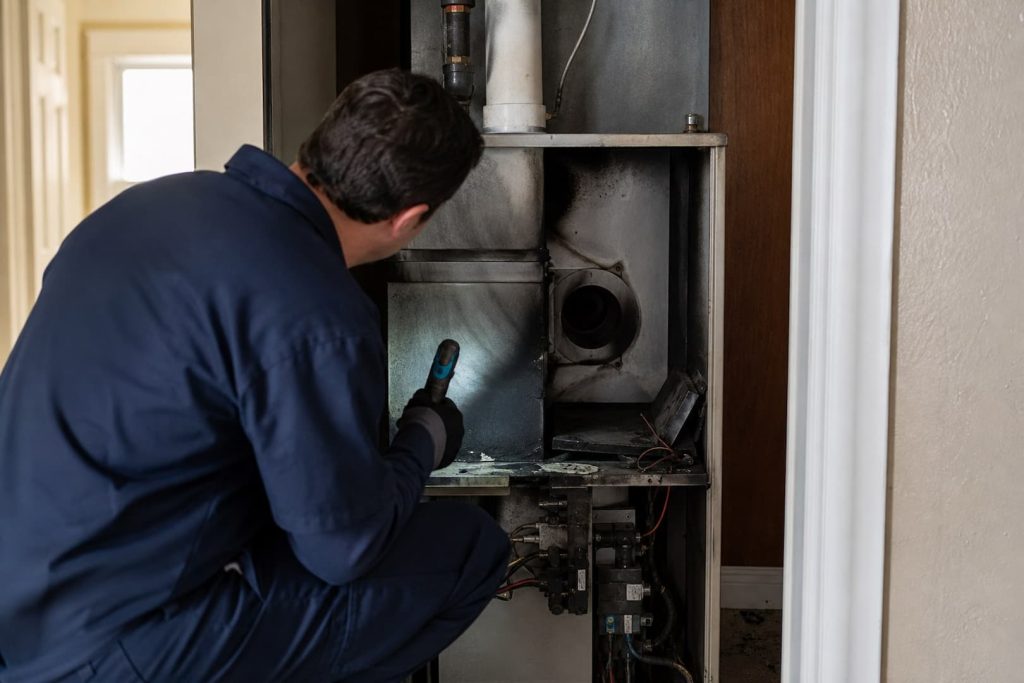
A furnace puffback is an ignition malfunction that can force smoke and soot from an oil-fired heating system into the building. The event may leave a few dark marks near registers or an oily film across walls, ceilings, fabrics and contents. Do not restart or repeatedly reset the burner; shut the system down if that can be done safely and call a qualified heating technician.
Mechanical repair and soot cleanup are separate jobs. The heating contractor finds and corrects the combustion, ignition, fuel or venting problem and determines whether the equipment is safe. A restoration team maps and removes residue from the building after evidence is documented.
Immediate steps
- Stop the heating system safely. Do not keep pressing the reset button or relight equipment.
- Leave for urgent hazards. Smoke, fire, gas or carbon-monoxide alarms, symptoms, or heavy active discharge require emergency response.
- Do not operate central fans. Additional airflow may distribute residue.
- Avoid touching the soot. Oily particles smear into paint, fabric and skin.
- Photograph the pattern. Capture the appliance, registers, wall lines, contents and clean comparison areas.
- Call the heating contractor and insurer. Obtain a written cause and repair record.
- Set clean and dirty pathways. Keep occupants and pets from tracking residue.
What the pattern can reveal
| Pattern | Possible pathway | Inspection priority |
|---|---|---|
| Black marks at supply registers | Distribution system carried smoke | Air handler/furnace, supply ducts and nearby surfaces |
| Lines at baseboards or wall penetrations | Pressure pushed particles through gaps | Wall/floor perimeter and concealed chase routes |
| Soot mainly in mechanical room | Local burner, vent or equipment release | Equipment and adjacent porous material |
| Oily film on horizontal contents | Fine airborne fallout | Room-by-room contents and surface testing |
| Residue after furnace service | Disturbance or incomplete source correction | Heating-system report and new-versus-old evidence |
| Uneven spots on cold walls | Particle deposition at thermal bridges | Broader surface assessment; not necessarily mold |
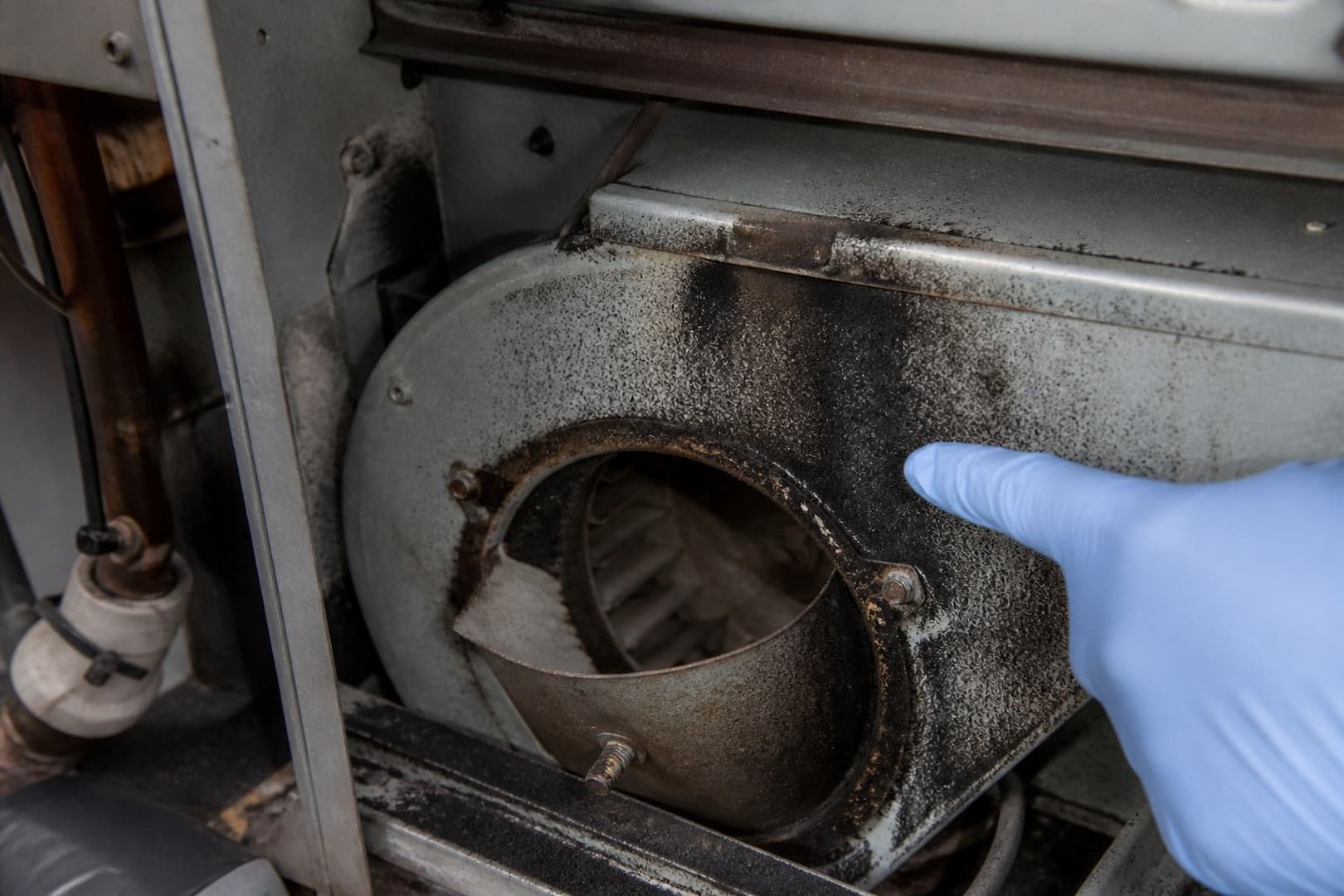
Puffback soot can be oily and difficult to see on dark or patterned surfaces. A white cleaning cloth test may be used by professionals in a controlled area, but indiscriminate wiping creates streaks and removes claim evidence. Photographs need oblique lighting and reference points.
Carbon monoxide and heating safety
A puffback is a combustion warning. Carbon monoxide is colorless and odorless, so the presence or absence of soot smell does not establish safety. Leave the building and call emergency services when alarms sound or occupants have headache, dizziness, nausea, weakness, confusion or other concerning symptoms. Medical professionals evaluate symptoms.
Have fuel-burning equipment, chimney or venting and carbon-monoxide alarms evaluated as appropriate. Restoration workers do not authorize burner operation. Temporary heating must be approved, correctly vented and separated from cleanup controls.
Why DIY wiping often makes it worse
Water and ordinary detergent can spread oily soot into a gray film. Dry chemical sponges may help on selected surfaces, but technique, loading and surface condition matter. Household vacuums can exhaust fine particles. Washing walls before loose material is controlled can create permanent streaking.
Do not use candles, fragrance, ozone or fogging to cover odor while soot remains. Cleaning starts with controlled particulate removal and small method tests, then moves through surfaces according to material and residue.
Professional puffback cleaning
- Map affected rooms, ducts, contents and pathways before disturbance.
- Protect clean areas and establish equipment/worker access.
- Coordinate HVAC shutdown, inspection and repair.
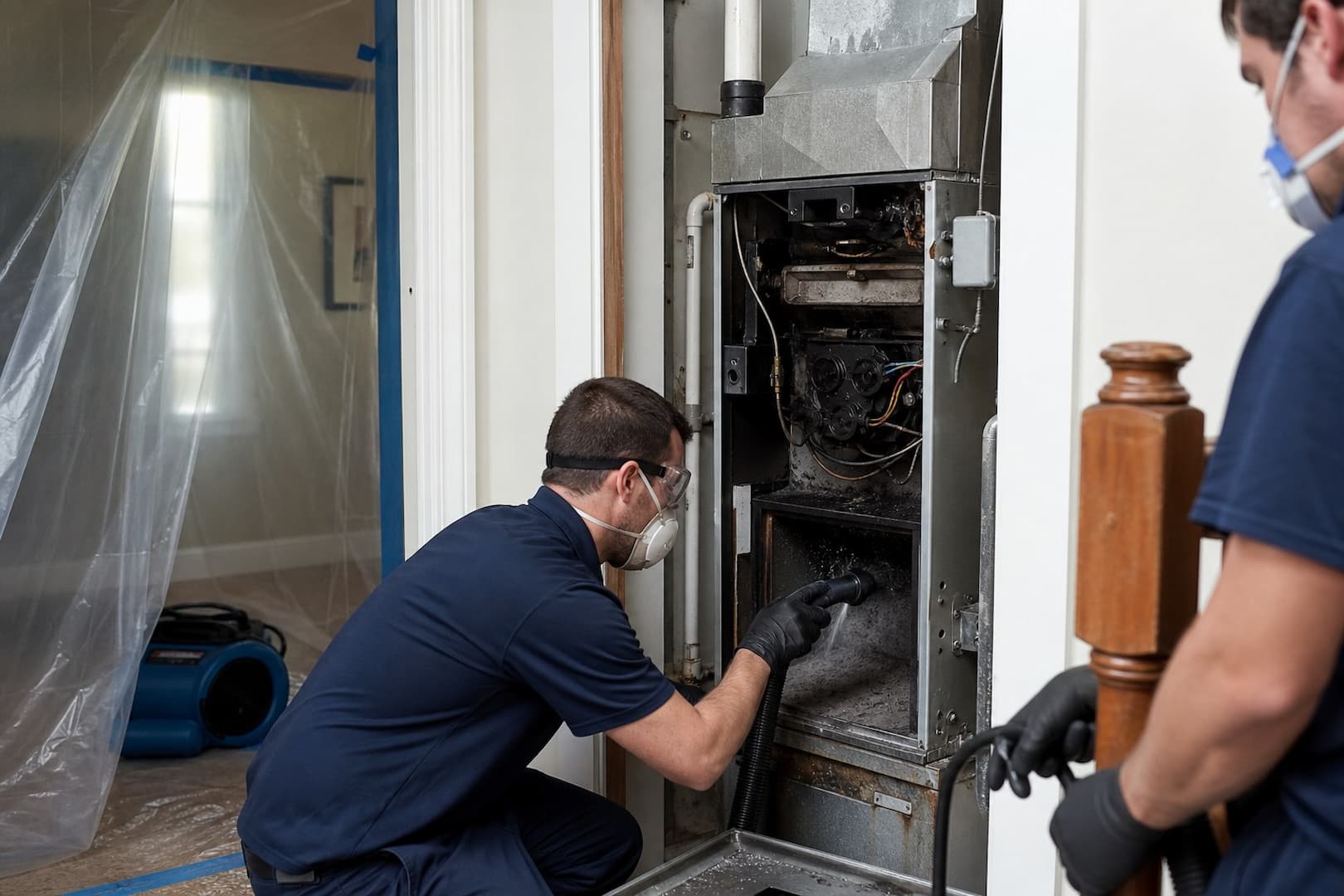
- HEPA-vacuum suitable loose residue without pressing it into the substrate.
- Test dry and wet cleaning methods on paint, wallcovering, wood, metal and fabric.
- Clean contents by material and separate specialty items.
- Evaluate duct and mechanical components through a qualified HVAC scope.
- Address residual odor only after source cleaning.
- Document visual cleanliness and repair status before return.
Fire and smoke damage restoration methods also apply to puffback because both involve combustion residue, but the source pattern and oily character can require different chemistry from a typical dry-smoke loss.
Walls, ceilings and contents
Latex paint, flat paint, wallpaper and acoustic tile respond differently. Some finishes clean; others hold residue or change sheen and need sealing or replacement after cleaning. Electronics should be de-energized and evaluated by a specialist; oily particulate can enter vents and contact points.
Textiles may require specialty laundering or dry cleaning identified for soot. Do not wash everything together, as cross-contamination and heat can set residue. Photograph and inventory items before pack-out or disposal.
Insurance documentation
Record the date and time, alarm status, thermostat and service history, rooms affected, photographs, heating-contractor cause report and replaced parts. Keep cleaning tests and scope changes documented. Ask whether equipment repair, building cleanup, contents and additional living expense are evaluated separately.
Preventing another puffback
- Service oil-burning equipment on the schedule recommended by the manufacturer and qualified technician.
- Do not ignore delayed ignition, rumbling, smoke, odors, frequent lockouts or soot near the burner.
- Never press the reset button repeatedly after a burner lockout.
- Maintain chimney, venting, combustion air and fuel delivery as specified.
- Install and test smoke and carbon-monoxide alarms according to local requirements and manufacturer guidance.
- Keep the mechanical room accessible and free of storage that blocks service or combustion air.
Puffback questions
Can I stay in the house after a small puffback?
That depends on combustion safety, carbon-monoxide evaluation, heating status, residue extent and occupant needs. Obtain fire/HVAC clearance rather than judging by visible soot.
Will repainting solve the soot marks?
Only after residue is removed and the substrate is prepared with a compatible system. Paint over oily soot can discolor, lose adhesion and retain odor.
Does every duct need replacement?
No automatic rule applies. Duct material, lining, residue location, access and HVAC findings determine cleaning or replacement.
A puffback starts as a combustion problem
Soot cleanup must not begin with restarting the appliance. Shut the heating system down if it is safe to do so and call a qualified heating professional. Oil burner ignition delay, fuel delivery, draft, chimney, controls, and maintenance can all be involved. Carbon monoxide alarms and emergency symptoms require immediate safety action. The restoration crew cleans resulting residue; it does not certify combustion equipment.
| Pattern | What it may suggest | Who investigates |
|---|---|---|
| Soot strongest at registers | HVAC distribution pathway | Heating/HVAC contractor plus restorer |
| Residue around appliance/door | Local release or venting issue | Heating professional |
| Puff marks at wall/ceiling edges | Air leakage and thermal deposition | Restorer maps residue; source trade fixes system |
| Oily film across contents | Combustion residue distributed widely | Contents and surface testing/cleaning plan |
| Repeated odor after cleaning | Missed reservoir or HVAC pathway | Reinspection before deodorization |
Why soot creates dark lines at framing and air leaks
Fine particles deposit where air moves and where surfaces have different temperatures. Ghosting along studs, ceiling edges, outlets, and picture frames can reveal air pathways, but it does not map all contamination. Open closets, cabinets, drawers, and mechanical chases. Compare rooms by distance and HVAC connection. Photograph light-colored reference surfaces before touching them.
Do not confuse ordinary candle or cooking soot with a puffback without checking the heating event and distribution. More than one source can exist. A heating technician’s findings and the occupant timeline help connect the residue to the appliance.
Test cleaning before committing the whole house
Oily soot smears when dry-wiped or washed with the wrong product. Begin with a representative test area using methods suited to the surface. Flat paint, wallpaper, unfinished wood, fabric, electronics, stone, and plastic can respond differently. A dry chemical sponge may lift loose residue on some surfaces; detergent systems may be needed elsewhere. Product and method should follow the material and residue.
- Protect clean routes and HVAC openings before work
- HEPA-vacuum loose particulate where appropriate without abrading it
- Test from least aggressive method upward
- Separate cleanable contents from specialist and discard decisions
- Clean before sealing or repainting
- Verify source repair before restoring HVAC operation
- Deodorize only after residue reservoirs are addressed
Smoke and soot restoration should document test results and excluded specialty items. The guide to whole-house smoke odor removal explains why fragrance and ozone cannot replace cleaning.
Textiles and electronics need separate specialists
Oily soot can penetrate fabric and settle through electronic vents. Do not wash all textiles in a household machine or power-test exposed devices. A contents specialist can test laundering or ultrasonic methods by material; an electronics specialist can advise cleaning, corrosion, and warranty. Photograph and label items by room so cleaned belongings do not return to an untreated reservoir.
Paper files, artwork, and unfinished antiques also need early triage. Stacking sooty papers can transfer residue; wiping art can remove media or finish. Isolate high-value pieces, record condition, and ask a conservator about packing and treatment before general cleaners handle them.
Insurance evidence should include the heating diagnosis
Keep the service report, appliance maintenance history, photographs, room map, samples or cleaning tests when appropriate, contents inventory, and restoration estimate. Ask whether the carrier wants to inspect before broad cleaning. Do not leave corrosive or oily residue in place indefinitely for evidence; agree on documentation and mitigation.
Prevent another event through service, not a coating
The heating contractor should repair the cause and confirm safe operation, draft, and venting according to the equipment and local requirements. Maintain the burner and chimney on the recommended schedule. Replace affected filters and inspect the distribution system. Painting soot marks without cleaning can cause bleed-through, but even perfect stain blocking does nothing to prevent another ignition problem.
Distinguish puffback from an active combustion emergency
Soot marks do not prove the appliance is safe or that the event is over. Fuel odor, smoke, unusual burner noise, repeated lockout, visible flame outside the chamber, a damaged flue, carbon-monoxide alarm, headache, dizziness, or nausea require evacuation and emergency or utility guidance appropriate to the condition. Do not reset the burner to test it.
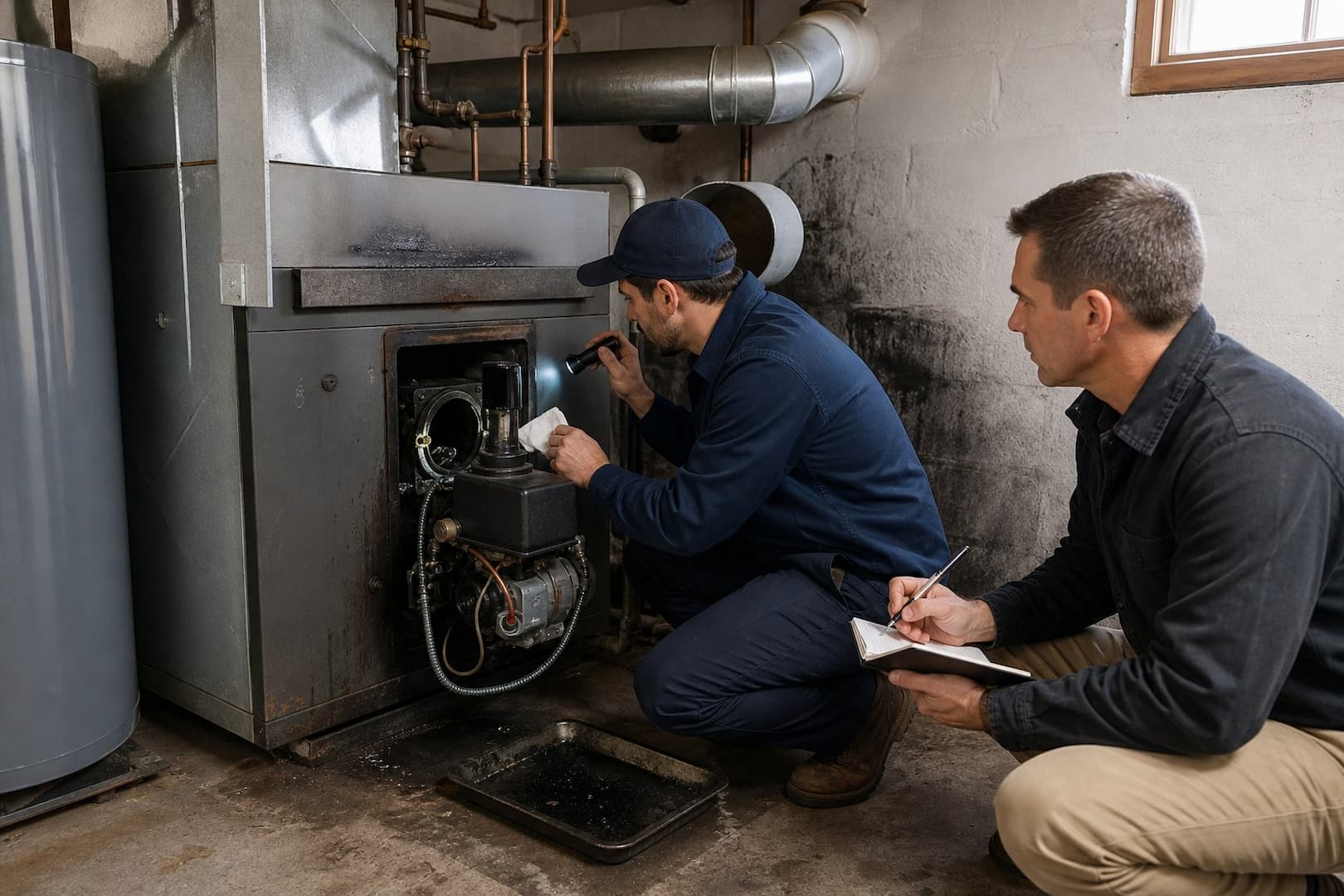
After the immediate hazard is controlled, a qualified heating technician should document the burner, ignition, nozzle, electrodes, fuel delivery, chamber, heat exchanger, draft, flue, controls, and reason for lockout or delayed ignition as applicable. Restoration should not start by cleaning away evidence the mechanical investigation needs.
Map soot by air pathway and surface type
A puffback can push residue through supply ducts and registers, but pressure and ordinary air movement can also carry fine particles along ceilings, wall intersections, door undercuts, closets, and contents. Start with the mechanical room and distribution system, then inspect remote rooms with oblique light and clean test materials. Avoid random wiping that creates permanent streaks.
| Pattern | Possible pathway | Next check |
|---|---|---|
| Dark halos at supply registers | Distribution from forced-air system | Duct, plenum, filter, blower, insulation, equipment specialist |
| Lines at studs or ceiling joists | Thermal bridging and particle deposition | Surface temperature, insulation, broader soot distribution |
| Heavy residue near burner/flue | Local release or venting problem | Mechanical source and adjacent porous material |
| Fine film in closed cabinets | Airborne infiltration through gaps | Contents and cabinet interior cleaning test |
| Oily spotting on fabrics | Oil-combustion residue deposition | Textile specialist and dye/cleanability test |
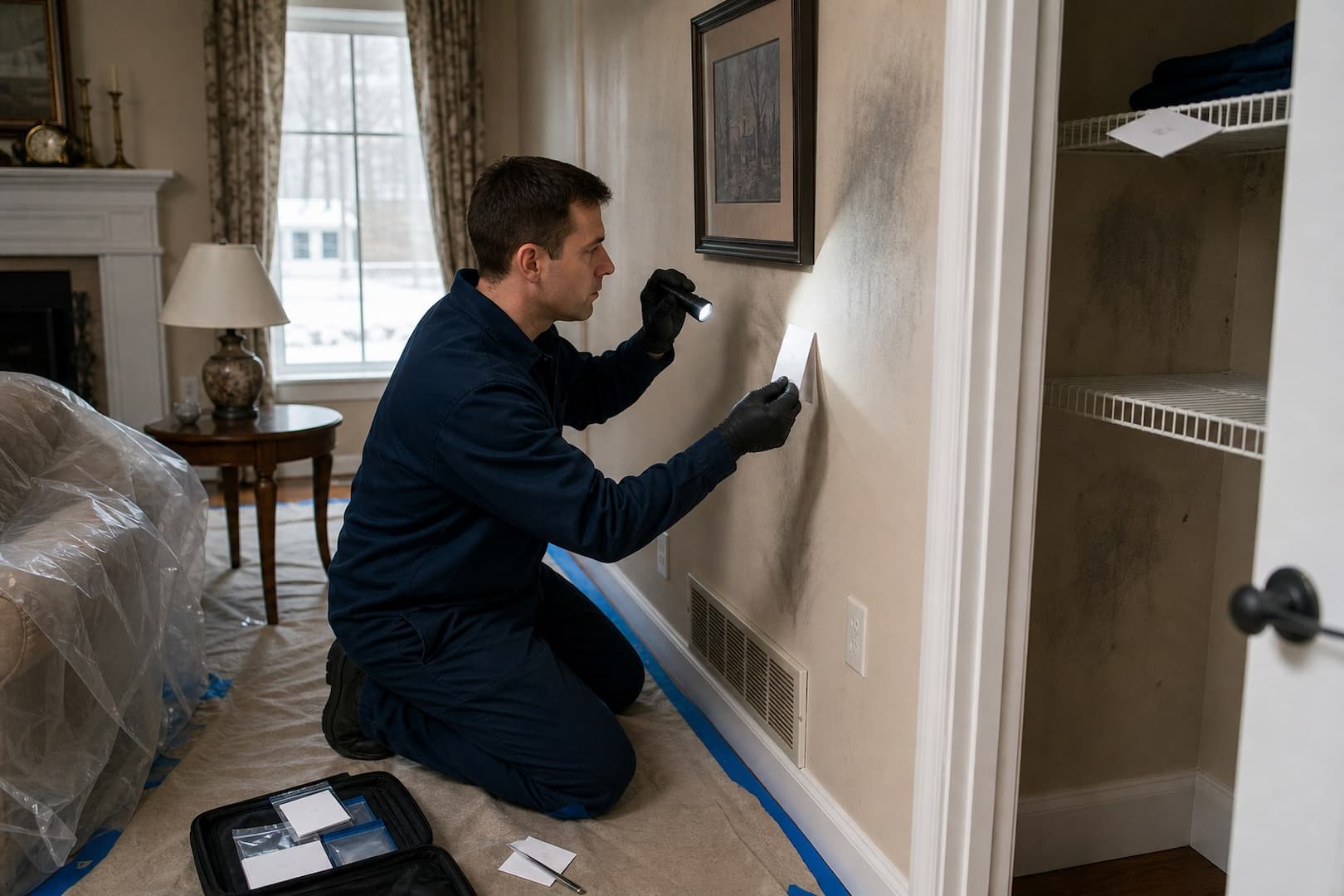
Identify the residue before choosing chemistry
Oil-burner soot may be oily and can smear or penetrate coatings. Dry smoke sponges, HEPA capture, detergents, alkaline products, solvents, or specialty systems each have material and safety limits. Test a small representative area, document the method, and move from less aggressive to more aggressive treatment. Never mix products or use an unlabeled recipe.
Unsealed drywall, flat paint, acoustic tile, unfinished wood, insulation, fabrics, paper, and electronics are more difficult than glazed tile or sound metal. Cleaning may remove particles but leave odor or staining; sealing is considered only after source removal and successful cleaning, and it should be compatible with the substrate and future finish.
Decide what stays by access and material condition
| Item | Possible recovery path | Replacement or specialist trigger |
|---|---|---|
| Sound painted wall/ceiling | Controlled dry removal and wet cleaning tests | Permanent staining, coating failure, inaccessible back side |
| Cabinets/furniture | Exterior and interior cleaning by finish | Unfinished composite core or persistent inaccessible residue |
| Carpet/upholstery | Specialty extraction or textile cleaning | Delamination, oily penetration, uneconomic recovery |
| Insulation | Limited evaluation if unaffected | Soot-laden porous material or inaccessible odor reservoir |
| HVAC interior | Specialist inspection and component cleaning decision | Damaged insulation, contaminated inaccessible components |
| Electronics | Equipment conservator/manufacturer evaluation | Powering wet/sooted equipment or internal corrosion risk |
Keep clean rooms clean during restoration
Create boundaries from the soot map, cover movement routes, isolate the mechanical area, and use HEPA-filtered capture appropriate to the task. Workers should change or clean protective coverings before entering clean zones. Bag removed porous material before transport. Do not use the central HVAC system until the mechanical and contamination plan permits it.
Cleaning sequence matters. Ceiling and high surfaces generally precede lower surfaces and floors, but the exact order follows the residue, room use, and equipment. Reinspect with directional light and white-cloth tests suited to the finish rather than relying on normal room lighting.
Separate odor, stain, and particle completion
- Particle criterion: no visible transferable soot on representative cleaned surfaces
- Material criterion: coatings and finishes remain stable after cleaning
- Odor criterion: source material and inaccessible reservoirs addressed before deodorization
- Mechanical criterion: qualified heating professional clears the appliance and venting
- HVAC criterion: affected distribution components have a documented disposition
- Contents criterion: cleaned, specialized, discarded, or inventoried for further work
A fragrance or ozone treatment cannot replace these steps. The EPA warns that ozone levels used for odor control can exceed those considered safe for people, and ozone can react with indoor chemicals. Any specialized unoccupied treatment requires a defined purpose, material review, exposure controls, and reentry process.
Prevent another puffback
Follow the heating professional’s repair and maintenance recommendations, including burner setup, cleaning, filters, nozzle or ignition service, draft and venting. Keep carbon-monoxide alarms installed and maintained according to local requirements and manufacturer instructions. Repeatedly pressing reset after a lockout can introduce unburned fuel and worsen the next ignition.
Keep mechanical findings, cleaning maps, test methods, contents inventories, photographs, and final clearances in one project file. That record shows why the source repair and building cleanup were both necessary without confusing their responsibilities.
Preserve representative evidence before broad cleaning
Before wiping every surface, photograph the appliance area, vent and register patterns, cold exterior walls, closet interiors, textiles, and a few protected surfaces. Note heating cycles, odor changes, alarms, service history, recent fuel delivery, and who first restarted or shut down the system. The mechanical professional may need filters, failed parts, burner observations, or residue near the unit. Good evidence helps separate the initiating equipment event from the building-wide cleaning scope.
Sources and further reading
- U.S. Fire Administration: After the Fire — Returning to Normal
- American Red Cross: Cleaning Up After a Fire
- American Red Cross: Disaster Cleanup and Repair for Your Home
- Massachusetts Division of Insurance: Frequently Asked Questions Following a Disaster
When soot appears beyond the mechanical room
Boston Restoration Group can document the spread, protect clean areas, test residue-specific cleaning, clean structure and contents and coordinate with the heating contractor.