
Commercial Restoration Company in Boston
A commercial loss is a building problem and an operations problem at the same time. BRG assigns a project lead, stabilizes the affected area, separates occupied and work zones, tracks materials and equipment, and gives owners, managers, tenants, carriers, and repair trades one usable record.
- 24/7 commercial damage response
- Certified restoration specialists
- Occupied and multi-tenant properties
- Mitigation through repair coordination
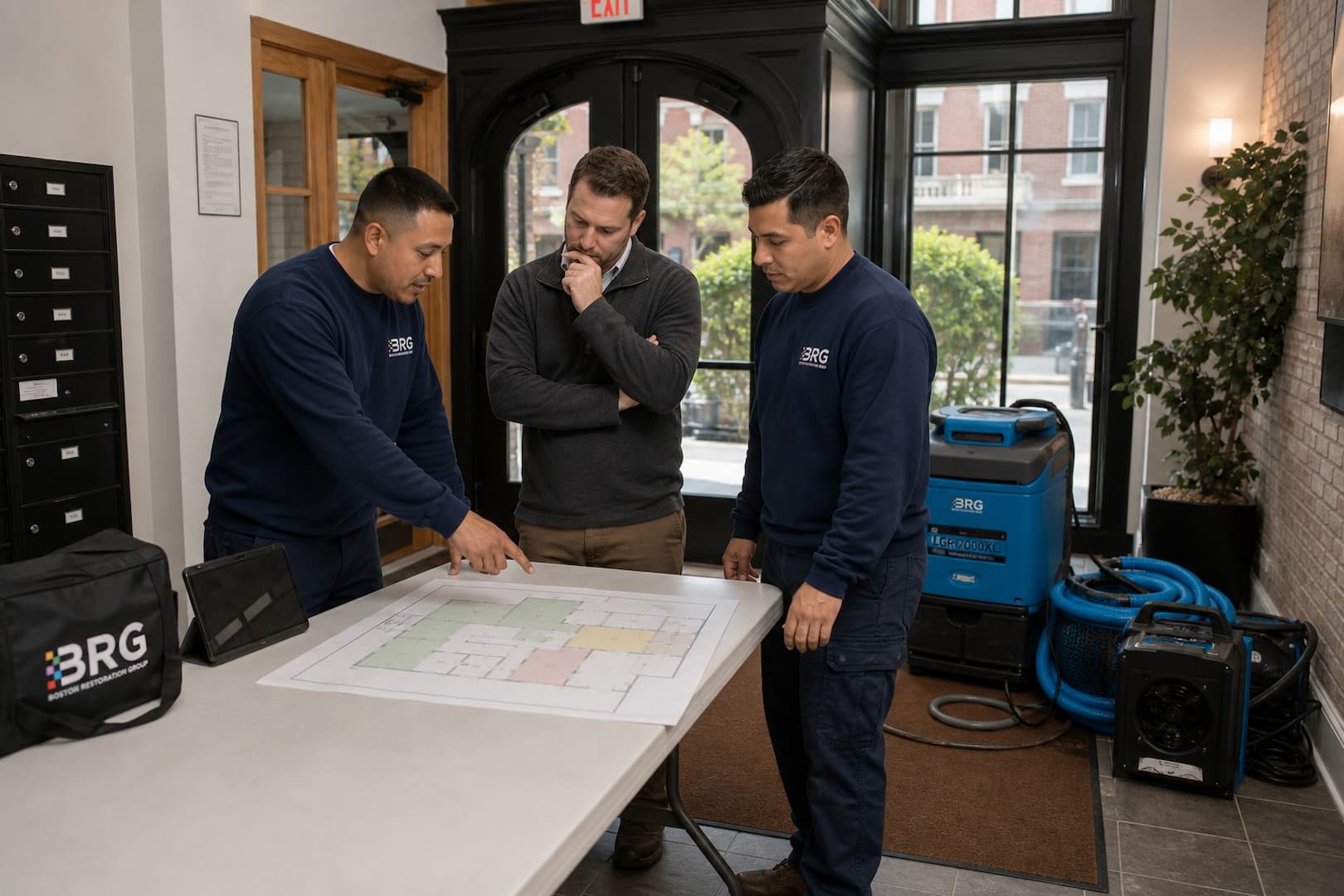
One project lead
Access, scope, updates, approvals, vendors, equipment, and handoffs move through an accountable contact.
Phased building use
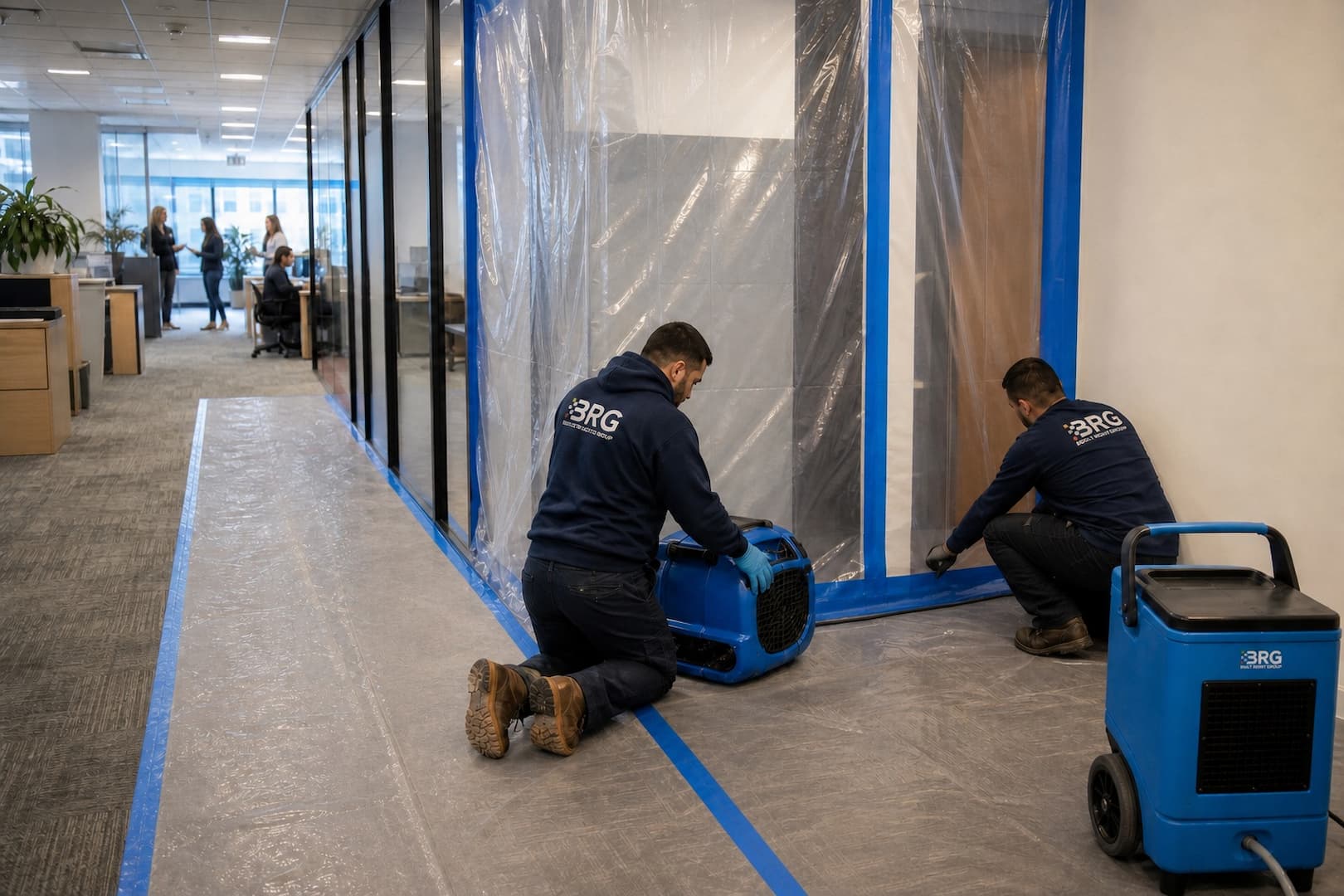
Affected, support, clean, and occupied zones are planned around exits, customers, tenants, and critical operations.
Decision-ready records
Conditions, measurements, removals, equipment, contents, delays, and remaining repairs stay traceable.
Source-to-repair coordination
Emergency trades, mitigation, specialty cleaning, contents, consultants, and reconstruction are sequenced.
The loss scope begins with people, access, and critical functions
Square footage matters, but it does not tell the crew which part of the business must remain open or who has authority to stop it.
Authority and contacts
Identify the owner representative, facility lead, tenant contacts, security, carrier contact, and person authorized to approve scope changes.
Life safety and release
Confirm fire, police, utility, environmental, elevator, structural, or building-official restrictions before property work proceeds.
Critical operations
List essential rooms, equipment, inventory, customer access, data, refrigeration, production, healthcare, education, or residential functions.
Building constraints
Document keys, loading, parking, freight elevators, union or site rules, noise windows, neighbors, dust sensitivity, alarms, and waste routes.
The best sequence may not be room-by-room
A retailer may prioritize public access and merchandise. A multifamily building needs safe apartments, egress, and tenant communication. A medical or laboratory space may require client protocols before ordinary restoration methods. A restaurant combines water, food-service, refrigeration, odor, and health-authority considerations. An office may need critical IT rooms protected while other areas dry.
BRG maps the loss by both building assembly and business use. The team can divide work into emergency stabilization, occupied-zone protection, extraction, controlled removal, cleaning, drying, contents, specialty referral, and repairs. Phasing is documented so a temporary reopening does not get confused with project completion.
BRG restores property; the operating authority decides reopening
Owners, building officials, health authorities, fire officials, consultants, employers, or other responsible parties may determine whether a business or area can operate. BRG documents restoration conditions and the work-zone status.
A daily operating cycle keeps a complex loss from becoming a chain of assumptions
The frequency and detail scale to the project, but the same questions should have owners every day.
Morning condition and access check
New water, weather, utility, security, tenant, equipment, and building-use changes are recorded before work begins.
Priorities and permits to work
The project lead confirms the day plan, affected rooms, shutdowns, specialty trades, occupant routes, approvals, and safety constraints.
Production and measurement
Extraction, removal, cleaning, drying, contents, and repair work are tied to rooms, quantities, readings, and photographs.
Scope-change control
Hidden conditions, source changes, delays, and added work are documented before they silently alter schedule or cost.
Stakeholder update and next shift
Completed work, open hazards, equipment, access, decisions due, dependencies, and next priorities are summarized for the approved contacts.
The restoration methods overlap; the operational risks do not
BRG adapts controls and communication to the building instead of forcing every loss through a residential template.
| Property | High-value continuity questions | Restoration planning focus |
|---|---|---|
| Multifamily and condominium | Tenant access, habitable areas, shared systems, association and unit boundaries, vulnerable residents | Vertical water paths, common-area protection, unit records, communication windows, repair responsibility |
| Retail and restaurant | Customers, food or merchandise, refrigeration, health requirements, deliveries, public walks | Public separation, contents triage, odor and sanitation, off-hours work, opening authority |
| Office and professional space | IT, records, staff access, neighboring suites, lease obligations, business hours | Phased zones, electronics referral, document protection, noise and dust control |
| Education, healthcare, and care settings | Sensitive occupants, infection-control or client protocols, schedules, privacy, regulated areas | Facility protocol alignment, approved barriers, communication, specialty consultant boundaries |
| Warehouse and light industrial | Inventory, racks, forklifts, power, production, loading, floor area, process hazards | Safe routes, equipment and product protection, large-area extraction and drying, industrial referrals |
| Hospitality and mixed-use | Guests, residents, retail tenants, common systems, elevators, noise, reputation | Floor-by-floor phasing, front-of-house separation, room records, coordinated repair release |
Each stakeholder should receive what the role requires
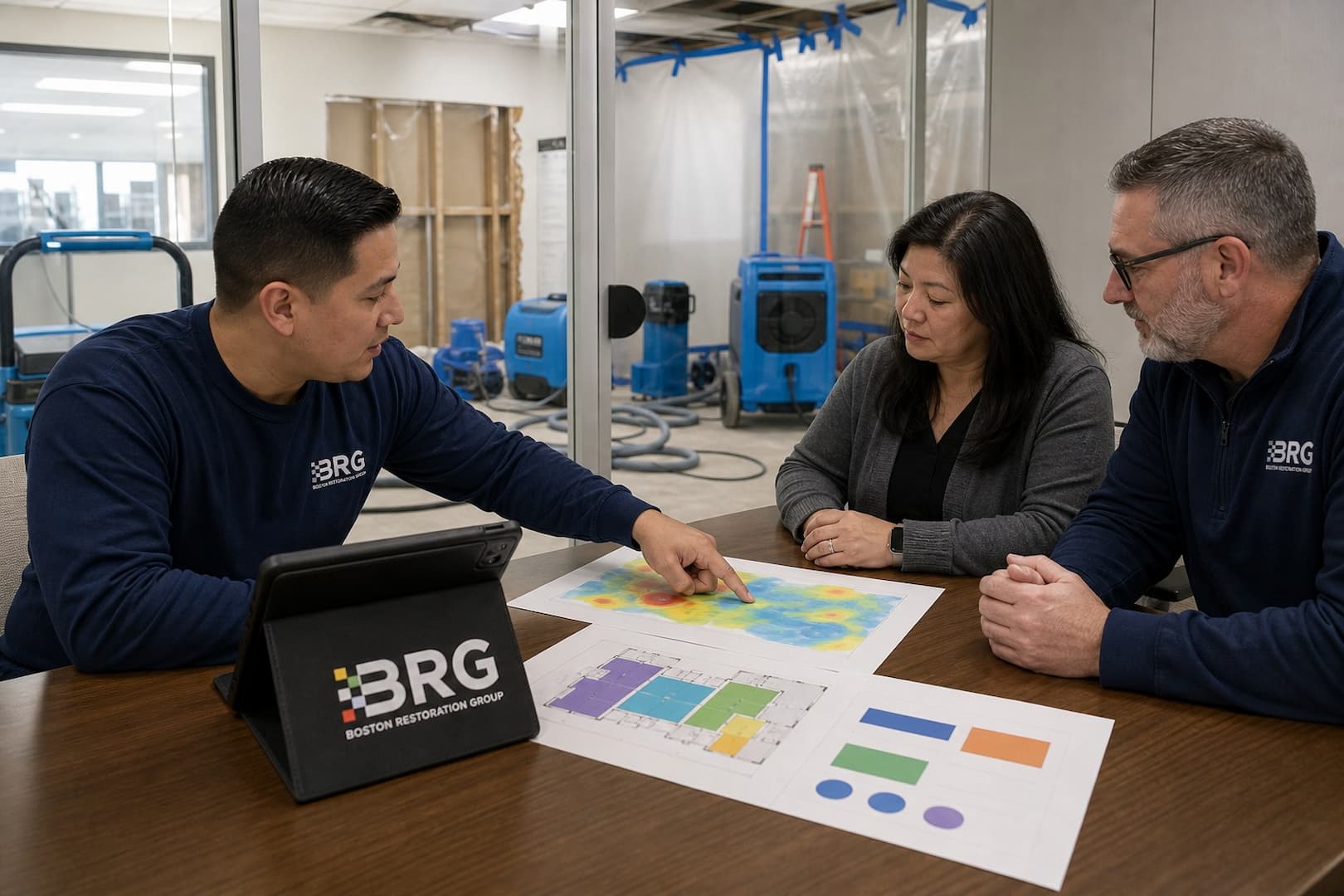
The owner may need cost, schedule, risks, and approvals. Facility staff need affected equipment and access. Tenants need usable-area and work-hour updates. The carrier needs cause and damage documentation. Repair trades need substrates, dimensions, dry status, and remaining work. Sensitive tenant, employee, health, or security information should not appear in every distribution.
BRG establishes the approved contacts and reporting rhythm at mobilization. Daily notes, photographs, moisture data, equipment logs, contents records, change documentation, and repair handoffs can then support decisions without creating conflicting versions of the loss.
Pre-loss access information can save hours when the building is wet
Emergency contacts, shutoff locations, utility and alarm procedures, keys, loading rules, critical rooms, vendor contacts, floor plans, after-hours approvals, tenant notices, and documentation preferences can be organized before an event.
Keys, alarms, parking, freight routes, security, and after-hours authority.
Shutoffs, panels, risers, elevators, IT, refrigeration, process equipment, and specialist contacts.
Owner, facility, tenant, carrier, broker, consultant, and repair decision paths.
Commercial restoration questions from owners and managers
An early call can establish authority, safe access, critical operations, and the source trade before the full scope is known.
Can BRG work while part of the building remains open?
Sometimes. The decision depends on life safety, utilities, contaminants, structure, egress, air pathways, noise, dust, equipment, and the ability to separate occupied and work zones. The responsible operating authority decides whether an area opens.
Who should be the main project contact?
Choose one owner-authorized decision-maker and one day-to-day facility contact. Tenant, carrier, consultant, security, and repair contacts can receive role-specific updates without creating competing approvals.
Can BRG coordinate other trades?
BRG can sequence restoration with plumbers, electricians, roofers, HVAC specialists, engineers, environmental consultants, security, tree contractors, and repair trades. Each party remains responsible for its licensed or specialist scope.
How are multi-tenant damages documented?
The project can be separated by building area, unit, tenant, material, contents, equipment, and work type while maintaining one overall source and project timeline.
Does BRG guarantee insurance coverage or business-interruption payment?
No. BRG documents observed property conditions and work. Coverage, valuation, deductibles, limits, exclusions, and business-interruption decisions remain with the policyholder and carrier.
Are BRG employees certified?
Yes. All BRG employees are certified restoration specialists. Project-specific qualifications and the role of the assigned lead can be provided.
Request commercial property restoration in Greater Boston
Call for an active loss. Provide the property type, source status, affected floors or units, utilities, business functions, occupants, public access, authority on scene, and owner-approved contact.
617-202-3772- Identify critical rooms, equipment, inventory, residents, and reopening priorities.
- Mention elevators, loading, parking, security, alarms, and restricted work hours.
- Name the person who can approve emergency work and scope changes.
Begin the commercial loss brief
A project lead will turn the initial facts into an access and stabilization plan.