
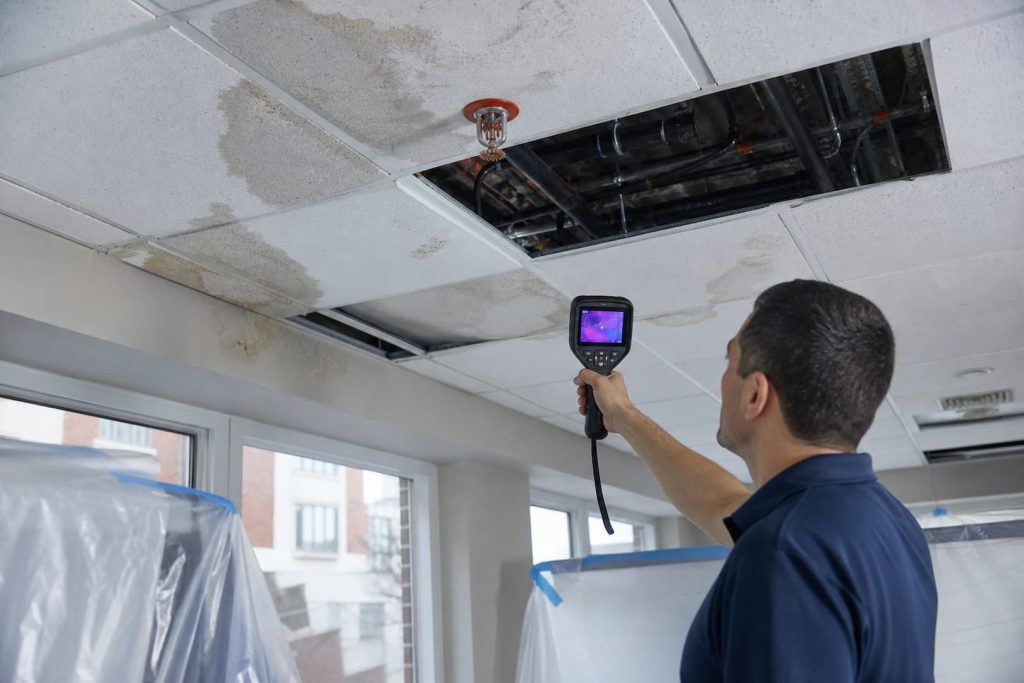
Do not shut a fire-sprinkler valve, silence required alarms or restore an impaired system on your own. The fire department, building representative, sprinkler contractor and alarm provider may need to coordinate after fire control. A closed valve can leave the property without required protection; a flowing head may be responding to an active hazard.
Once authorities permit restoration access, treat the event as a combined loss. Water from sprinkler piping can carry corrosion products and stagnant residue, then mix with soot, char, ceiling debris, chemicals and floor soil. The visible water category and salvage options depend on that complete path.
First response roles
| Decision | Responsible party commonly involved | Restoration dependency |
|---|---|---|
| Fire extinguished and entry allowed | Fire department / authority having jurisdiction | No entry before release |
| Sprinkler flow stopped and system impaired | Fire department, building engineer, sprinkler contractor | Coordinate water control without defeating fire safety |
| Alarm status and fire watch | Alarm contractor, building/fire authority | Access and occupied-building requirements |
| Electricity isolated or cleared | Electrician / utility | Extraction and drying equipment power |
| Source head/pipe repaired | Licensed sprinkler contractor | No permanent restoration around unresolved system |
| Water and residue stabilized | Restoration contractor | Extraction, cleaning, material decisions and drying |
| Reopening authorized | Building owner, fire/safety authority and operations | Area-specific completion criteria |
Protect people and evidence
- Restrict access. Wet ceilings, electricity, broken glass, sharp sprinkler trim and slippery floors create hazards.
- Follow fire-system instructions. Do not turn valves or move heads.
- Photograph initial conditions. Capture the activated area, water height, soot, debris, equipment and rooms below.
- Move critical contents only after clearance. Use clean pathways and item tracking.
- Extract free water. Prioritize electrical, archives, equipment and vertical migration according to the incident plan.
- Separate contamination zones. Fire debris and clean areas need controlled traffic.
- Map all levels. Water follows columns, conduits, shafts and penetrations beyond the fire room.
Is sprinkler water clean?
Do not assume it is equivalent to fresh tap water. Water may have remained in steel piping, accumulated scale or corrosion, passed through antifreeze or another system component, and then crossed smoke, debris and building surfaces. The restoration category is based on observed source and path, not the fact that the system is designed for fire suppression.
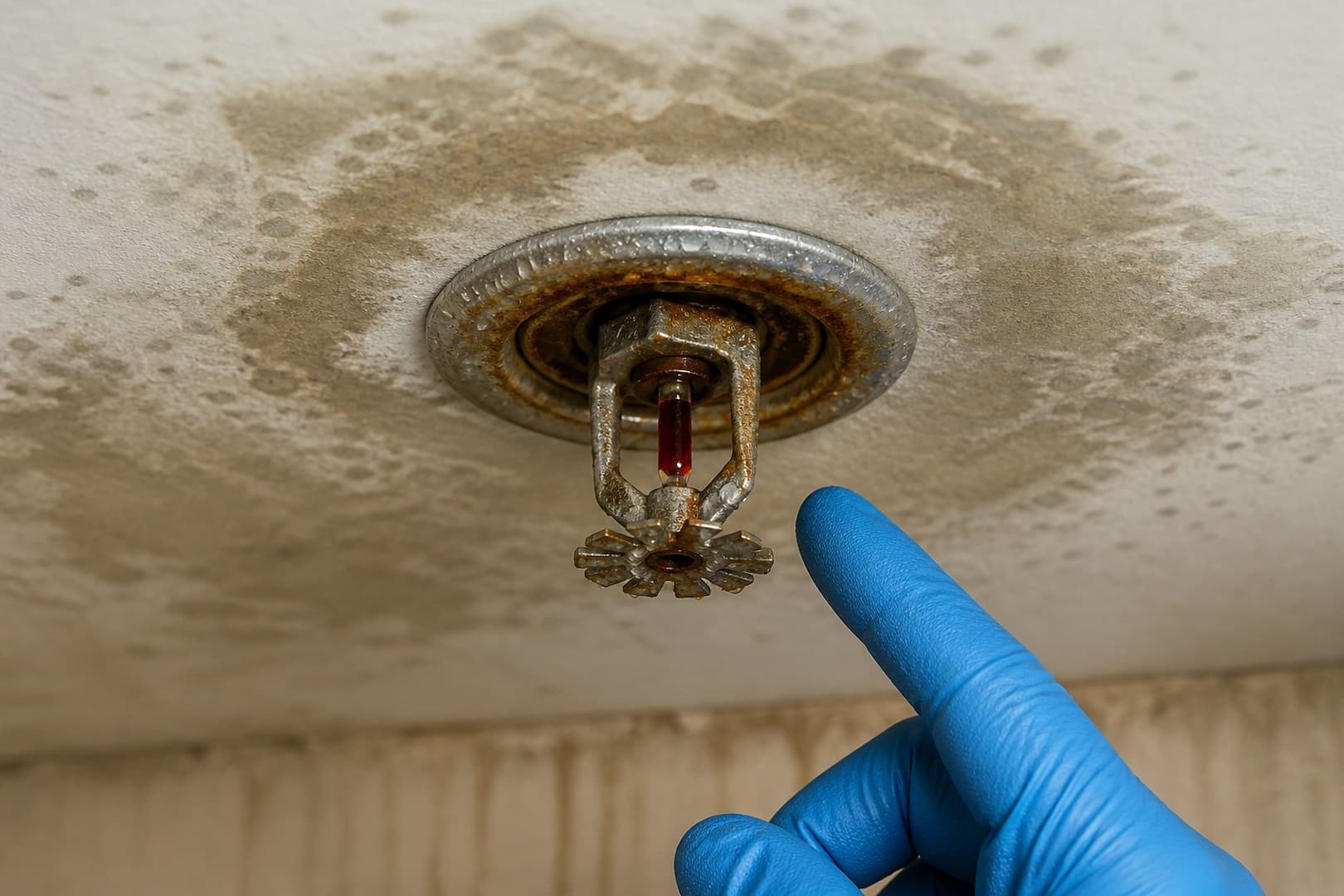
An accidental release in a clean, recently serviced system may differ from discharge through a smoke-filled fire area. Provide sprinkler-service records and incident details to the restoration team. When a listed antifreeze or special agent is involved, follow the safety data and sprinkler contractor’s guidance.
Ceilings and walls
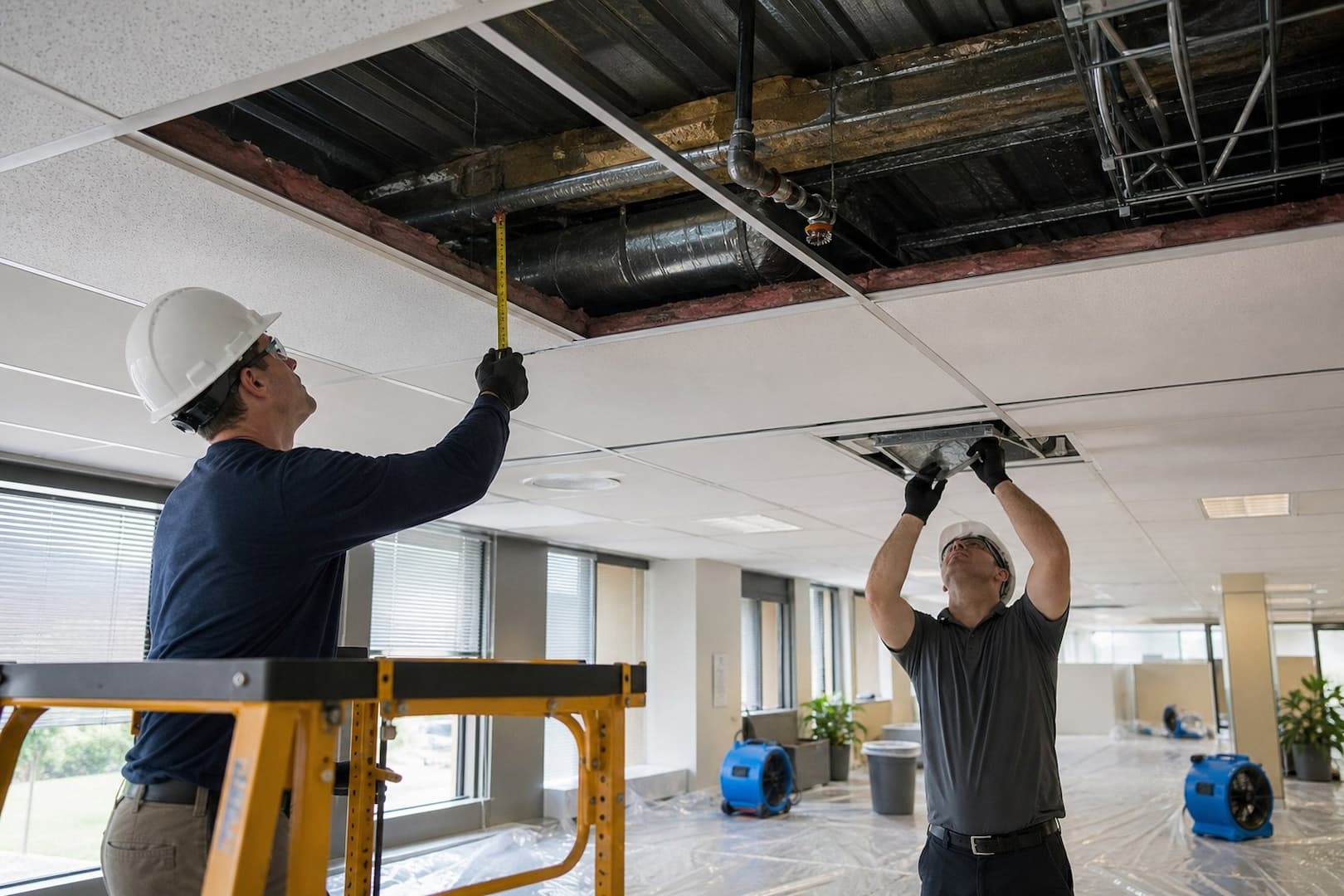
Sprinkler discharge can saturate acoustic tile, insulation and gypsum rapidly. Ceiling tile may fall, and wet drywall can sag or detach. Keep people out from below. Water can collect on top of vapor-resistant finishes and travel inside metal-stud tracks or wood plates.
Selective demolition boundaries follow contamination, physical damage, access and moisture—not a standard distance from the sprinkler head. Before disturbing older buildings, screen for asbestos-containing materials, lead coatings and other regulated hazards.
Floors, contents and equipment
Carpet, pad and subfloor can hold a large reservoir; floating floors can spread water across tenant boundaries. Elevators, electrical rooms, servers, manufacturing controls and medical or laboratory equipment require the appropriate specialist before energizing or moving. Do not test a wet device to see whether it works.
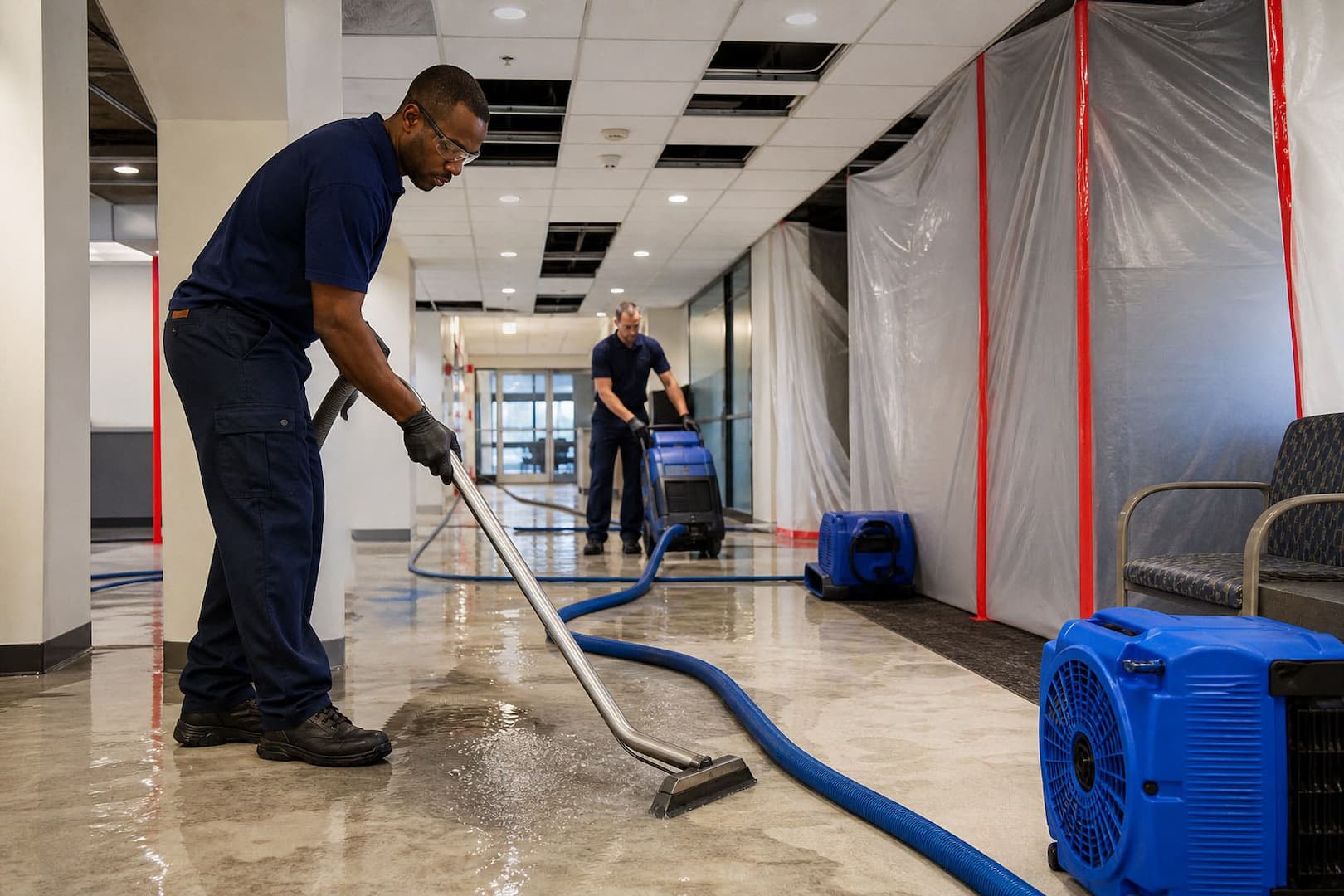
Prioritize irreplaceable records and temperature-sensitive or business-critical contents. Waterlogged paper may be stabilized by freezing or specialty drying. Track chain of custody, photographs and disposition for every pack-out category.
Drying with soot present
Air movers can spread loose soot and ceiling debris. Restoration should first establish electrical clearance, contamination controls and source removal. After extraction and controlled cleaning, dehumidification and air movement can target retained materials without distributing residue.
Commercial restoration coordination is especially important in multi-tenant and operating buildings, where egress, fire watch, noise, equipment circuits, tenant pathways and phased reopening affect the drying design.
Odor and corrosion
High humidity after a fire can increase odor release and accelerate corrosion on metal, electronics and equipment. Early climate control and residue stabilization may reduce secondary damage. Deodorization comes after burned debris, soot and wet material are removed or cleaned.
Sprinkler-water staining and black residue may be corrosion, fire soot or both. Cleaning tests should identify how the surface responds before broad wiping. Corrosive agent on metal or electronics needs specialty triage.
Claim and incident documentation
- Fire report and sprinkler/alarm service records.
- Authority release, impairment and restoration times.
- Location and identification of operated or damaged heads and piping.
- Photographs and floor plans showing water and soot migration.
- Utility status and equipment clearances.
- Contents inventory, stabilization, pack-out and disposal.
- Extraction, cleaning, equipment and moisture logs.
- Tenant interruption and area reopening decisions.
- Permanent repair, code and fire-system sign-offs.
Return to service
The area is not ready merely because surface water is gone. Fire protection must be restored or managed under approved impairment procedures; electricity and equipment need clearance; debris and contamination must be removed; retained materials need a defensible moisture endpoint; egress and occupancy requirements must be met.
Sprinkler-loss questions
Can building staff close the sprinkler valve?
Only authorized people following the emergency and fire-protection procedure should operate it. Fire department and system impairment rules take priority over property cleanup.
Are all wet ceiling tiles discarded?
Ordinary porous acoustic tiles often lose integrity and are difficult to restore, but the final scope follows material, contamination and system requirements. Do not stand beneath them while deciding.
Can drying begin before the sprinkler is repaired?
Emergency extraction may proceed after authority and utility clearance, while permanent repair is coordinated. The work cannot obstruct required fire watch, access or system restoration.
Do not close or restore the sprinkler system without authorization
A flowing sprinkler is part of a fire-protection event. The fire department, building authority, and licensed fire-protection contractor control shutdown, impairment, inspection, and return to service. Staff should not close a valve simply to reduce water unless their emergency plan and authority permit it. A closed system leaves the building exposed and may require a fire watch, notification, or temporary protection.
| Workstream | Primary concern | Lead coordination |
|---|---|---|
| Life safety/fire investigation | Re-entry and evidence | Fire department/authority |
| Sprinkler impairment | System shutdown and restoration | Licensed fire-protection contractor |
| Electrical systems | Wet panels, devices, wiring | Qualified electrician |
| Water mitigation | Extraction, mapping, drying | Restoration team |
| Soot/combustion residue | Cleaning before uncontrolled air movement | Fire-restoration team |
| Operations/tenants | Access and continuity | Property management/risk |
Sprinkler water changes after it leaves the pipe
Water stored in sprinkler piping may contain rust, scale, treatment chemicals, and stagnant residue. Once released, it can mix with smoke, soot, ceiling dust, insulation, burned materials, or hazardous products. Classification should use source, contact, time, and site conditions. Do not promise that all sprinkler water is category 1, and do not call dark rust-colored discharge sewage.
Preserve samples or failed components only when the investigator or insurer requests them and handling is safe. Photograph water color, ceiling debris, affected contents, and flow paths. Separate fire-origin evidence from routine cleanup debris until the authority releases it.
Drying must respect soot and corrosion
High airflow across dry soot can spread oily or acidic residue to clean rooms and electronics. Establish containment and clean gross residue before aggressive air movement where the loss requires it. Metal equipment, electrical connections, fasteners, and HVAC components may corrode even after surfaces look dry. Specialty evaluation can be time-sensitive.
Fire and smoke restoration and water mitigation need one sequence. Cleaning a wall after it has been dried with soot embedded in dust is harder; washing soot into porous material can also make damage worse. Coordinate tests and methods on representative surfaces.
Elevators and vertical shafts need early review
In commercial buildings, sprinkler water can enter elevator lobbies, pits, stair shafts, and utility risers. Keep elevators out of service until the authorized elevator and electrical teams inspect them. Water following a shaft may affect floors with no obvious ceiling stain. Add those vertical pathways to the moisture map and tenant notification plan before reopening isolated areas.
Ceiling and floor assemblies hold more water than the room suggests
Acoustic tile and insulation can become heavy and fall. Water moves through light fixtures, deck flutes, wall tops, and cable penetrations. Raised floors conceal cabling and low points. Hardwood, carpet, resilient flooring, and concrete each need layer-specific inspection. Isolate the area below and do not remove a saturated tile while standing under it.
The ceiling water-damage guide covers sagging and access decisions. For technical areas, use the server-room response framework before moving or energizing equipment.
Return to service requires two closeout packages
- Fire-protection repair, inspection, testing, and impairment closure
- Water-loss moisture map and drying documentation
- Electrical inspection and equipment decisions
- Fire/soot cleaning records and unresolved corrosion concerns
- Contents inventory and chain of custody
- Authority, insurer, tenant, and operations notifications
- Reconstruction photographs and system penetrations restored
The sprinkler-system package and building-restoration package should reference the same incident but remain distinct. A dry ceiling does not prove the sprinkler is compliant, and a tested sprinkler does not prove the structure below is dry.
Treat the sprinkler system as an impaired life-safety system
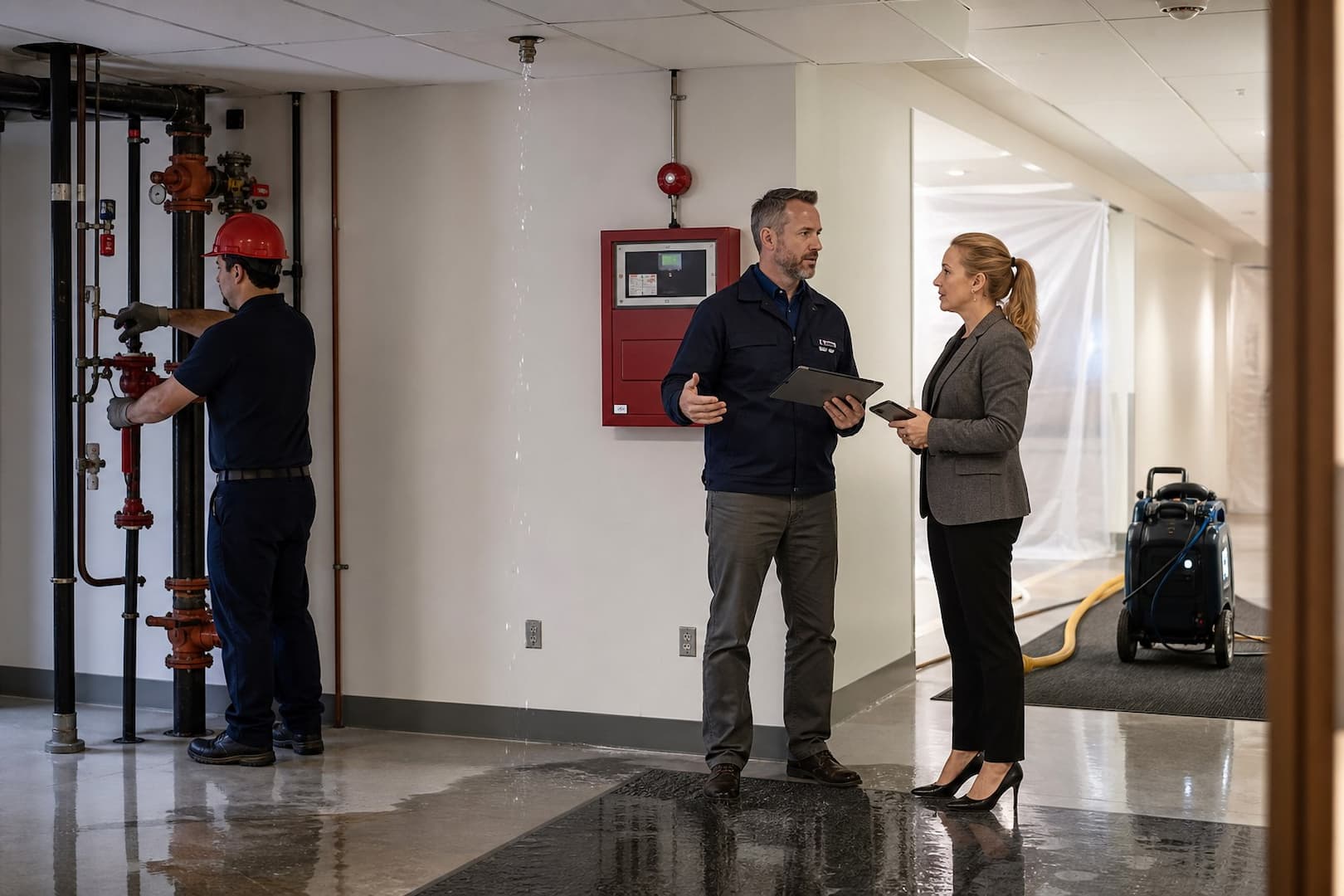
After discharge, damage, or an unauthorized closure, the sprinkler system may be impaired until the responsible fire-protection professional and authority complete the required steps. Building management should activate its impairment procedure, notify the parties required by its plan or code, establish any temporary fire watch or protection directed by the responsible authority, and control who may operate valves. Restoration staff should work around that process, not take it over.
| System condition | Lead responsibility | Restoration coordination |
|---|---|---|
| Active fire or uncertain hazard | Fire department/emergency command | No entry until released |
| Water still flowing after incident control | Authorized fire-protection/building personnel | Protect safe areas without touching system controls |
| Damaged head or piping | Licensed sprinkler contractor | Coordinate access, capture, and building drying |
| Closed or impaired zone | Building/fire authority procedure | Maintain barriers and egress around required measures |
| System restored but ceiling remains wet | Restoration/electrical/structural trades | Dry building without obstructing heads, valves, or alarms |
Classify water after its entire contact path
Water in sprinkler piping may have stood for a long period and can carry corrosion products, sediment, treatment chemicals, or microbiological residue. Once discharged, it may mix with smoke, soot, extinguisher agent, ceiling dust, insulation, floor soil, stored chemicals, or fire debris. Do not decide cleaning controls from the pipe source alone.
Map clean and affected zones before foot traffic spreads residue. Protect drains when runoff could carry soot or chemicals. Ask the restoration lead to document the source, appearance, odor, contact materials, fire residues, elapsed time, and any specialist sampling rather than assigning a category from color.
Inspect above the wet ceiling before setting ordinary airflow
Sprinkler water can saturate ceiling tile, gypsum, insulation, wood, metal framing, cable trays, light fixtures, alarms, duct insulation, and concealed fire-stopping. Wet ceiling material may fall. Water can travel along pipe, conduit, deck flutes, beams, and penetrations into rooms that never received direct spray.
Do not aim air movers into a soot- or debris-contaminated ceiling or occupied clean zone. Establish electrical safety, remove unstable material, control contamination, and create access to reservoirs first. Airflow design should also avoid interfering with smoke detection, sprinkler operation, temporary fire protection, and required egress.
Use a combined fire-and-water material matrix
| Material | Water issue | Fire-residue issue | Likely decision factors |
|---|---|---|---|
| Ceiling tile/fibrous insulation | Rapid saturation and sagging | Captures soot and debris | Porosity, stability, access, contamination |
| Gypsum board | Wicking and paper damage | Smoke deposits on face/back | Source, layer condition, cleaning access |
| Wood framing | Absorption and slow drying | Char or oily soot | Section loss, cleanliness, readings |
| Metal grid/duct exterior | Corrosion and trapped joints | Deposited soot | Access, coating, electrical proximity |
| Electronics/controls | Internal water and corrosion risk | Conductive or corrosive residue | Manufacturer/electrical specialist |
| Hard flooring | Water at seams and underlayment | Tracked residue | Finish, layers, cleaning, category |
A surface can be dry but still require soot cleaning; it can also look clean while water remains beneath it. Keep the water drying record and fire-residue cleaning record connected but not interchangeable.
Protect evidence and custody
- Photograph the activated area, head or pipe location, alarm and suppression conditions after release by authorities
- Record who operated valves and when
- Retain damaged components only under fire-protection and insurer direction
- Separate fire debris, wet building material, electronics, and customer property
- Log movement of records, inventory, keys, and high-value contents
- Preserve security video and incident reports according to policy
- Keep suppression, source repair, mitigation, cleaning, and reconstruction invoices distinct
Do not speculate publicly about why a sprinkler operated. Accidental impact, freeze damage, mechanical failure, heat activation, and fire response require different investigators. The restoration file should report observed conditions and work performed.
Dry around fire protection without creating a second impairment
Equipment placement must preserve access to valves, fire-department connections, alarm panels, extinguishers, exits, and sprinkler clearances. Temporary plastic cannot block heads or detection devices. Electrical circuits and extension distribution need review appropriate to the building. Condensate from dehumidifiers must discharge without creating another slip, overflow, or sanitary problem.
Daily monitoring should include building materials and the interfaces with life-safety work: areas opened, temporary protection, ceiling access, dust control, system status reported by the responsible party, and any change in occupancy. Restoration completion does not itself authorize normal occupancy or declare the sprinkler system restored.
Use separate release criteria
- Fire scene release: responsible authority permits access and evidence handling.
- Sprinkler release: fire-protection parties complete repair, testing, notification, and restoration steps.
- Electrical release: qualified personnel evaluate affected components.
- Structural/ceiling release: unstable assemblies are removed or accepted.
- Restoration release: affected materials meet cleaning and moisture criteria.
- Operational release: the owner and any regulator accept sanitation, egress, utilities, and business conditions.
These milestones may occur on different days. A combined-loss plan is stronger than a single contractor’s blanket statement that the building is “done.”
Account for corrosion-sensitive systems after visible drying
Sprinkler water can enter access-control hardware, fire-alarm devices, elevator interfaces, lighting, cable trays, ceiling supports, and metal enclosures. Surface dryness does not release those systems. Equipment owners and qualified vendors should inspect, test, clean, or replace affected components and document their decisions. Keep restoration humidity and air movement within limits suitable for occupied operations, stored products, and electronics; an aggressive drying setup that creates condensation elsewhere merely moves the problem.
Sources and further reading
- U.S. Fire Administration: After the Fire — Returning to Normal
- American Red Cross: Cleaning Up After a Fire
- American Red Cross: Disaster Cleanup and Repair for Your Home
- Massachusetts Division of Insurance: Frequently Asked Questions Following a Disaster
- CDC: Guidelines for Cleaning Safely After a Disaster
- Boston.gov: Recovering from a Flood
- Massachusetts DPH and MassDEP: Flooding and Sewage Back-ups Home Care Guide
- Massachusetts DPH: Quick Reference — Water Damage Response in Buildings
- IICRC: ANSI/IICRC S500 Standard for Professional Water Damage Restoration
Coordinate the combined fire-and-water loss
Boston Restoration Group can extract water, map affected assemblies, control soot and debris, stabilize contents, dry the structure and document restoration milestones after fire-system and utility clearance.