
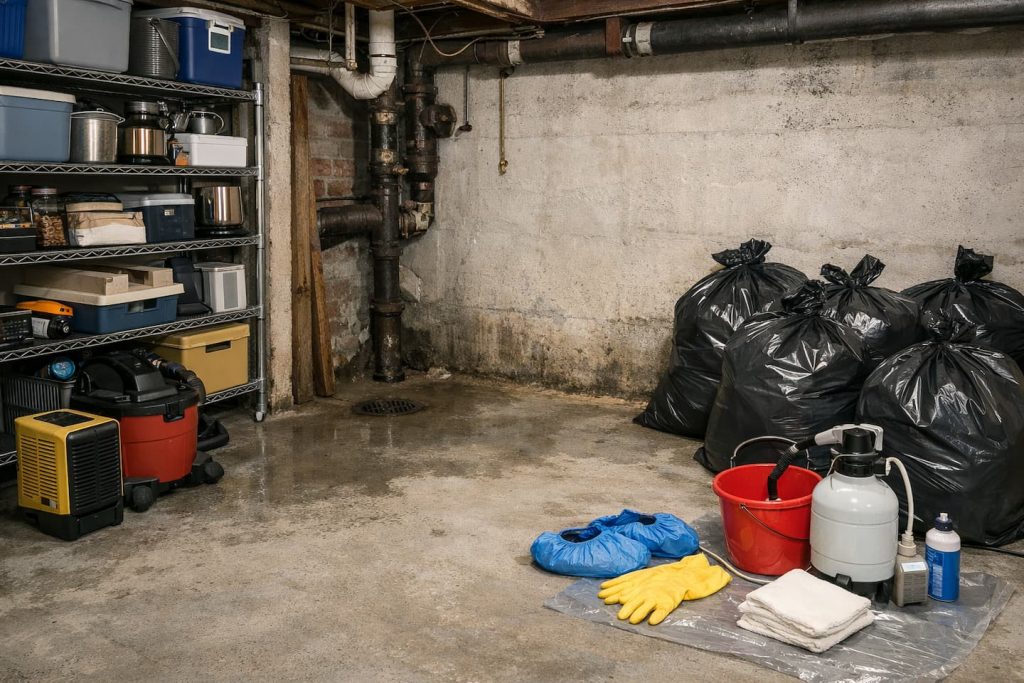
A sewage backup is one of the most stressful and unpleasant things that can happen in a home. Even a relatively small event can leave homeowners staring at a basement, bathroom, utility area, or lower-level room wondering what is still safe to keep. The instinct is understandable: try to save as much as possible, clean what looks cleanable, and avoid throwing out valuable belongings too quickly.
But sewage contamination does not work like ordinary water damage. A sewage backup is not simply a moisture problem. It is a contamination problem first, and a drying problem second. That distinction changes everything.
Items that might be salvageable after a clean water leak are often not reasonable to keep after sewage exposure. Materials that look only slightly dirty may actually be unsafe because contamination has penetrated porous surfaces. Some things can be cleaned and disinfected successfully. Others can sometimes be saved only if the exposure was limited and addressed very quickly. And some things almost always belong in the discard pile, no matter how expensive or sentimental they are.
That is why the right question is not just, “Can I clean this?” The better question is, “Can this item be returned to a safe, sanitary, stable condition after sewage exposure?” In many cases, appearance alone does not answer that.
If the affected area involves active contamination, standing wastewater, or spread into surrounding materials, sewage cleanup and disinfection is the most relevant internal service path because the primary issue is not only water removal, but safe handling of contaminated surfaces and materials.
This guide walks through what homeowners can often save after a sewage backup, what usually has to be thrown away, how to think about different categories of materials, what common mistakes to avoid, and why some items become unsafe even when they do not look badly damaged.
Why Sewage Backups Are Different From Ordinary Water Damage
When people think about water damage, they often picture a burst pipe, an appliance leak, or rainwater in a basement. Those events can be serious, but they do not automatically involve biological contamination. A sewage backup is different because the water itself may contain bacteria, viruses, parasites, organic waste, and other contaminants that can spread into anything they touch.
That means the damage is not just about saturation. It is about contamination, absorbency, contact time, and cleanability.
A cardboard box soaked by clean water is frustrating. A cardboard box soaked by sewage is almost never worth saving. A tile floor wet from a supply line leak may only need drying. The same floor after a sewage backup needs cleaning and disinfection as well. Upholstered furniture, insulation, carpet pad, paper goods, unfinished wood, and soft materials often become much harder to justify keeping because contamination penetrates below the surface.
If the wastewater is especially heavy, foul, or clearly involves toilet backup or dark contaminated discharge, the situation may fall into the more severe black water cleanup category, where disposal decisions become even stricter.
The biggest mistake homeowners make is assuming they can treat sewage like dirty water. They cannot. The cleanup standard is higher because the health risk is higher.
First Principle: Porous vs. Non-Porous Matters More Than Cost
One of the simplest ways to make smarter keep-or-throw decisions after a sewage backup is to separate items into two broad categories:
Non-porous or low-porosity items, which are more likely to be cleaned and disinfected successfully.
Porous or absorbent items, which are much more likely to trap contamination below the surface and become discard candidates.
This is not a perfect rule, but it is the best starting point.
More likely to be salvageable:
- metal items
- glass
- hard plastic
- sealed finished wood in some cases
- ceramic and porcelain
- washable tools
- some non-porous storage bins
- certain hard-surface furniture with limited exposure
More likely to require disposal:
- carpet pad
- cardboard
- paper goods
- unfinished wood
- upholstered furniture
- mattresses
- insulation
- stuffed items
- soft toys
- clothing exposed heavily or for too long
- particleboard furniture
- laminate furniture with swollen seams
- drywall that wicked contaminated water
That does not mean every hard item is automatically safe, or every soft item is automatically unsalvageable. But once sewage gets into absorbent materials, it becomes very difficult to remove contamination completely.
Before Sorting: Make the Area Safe First
Before deciding what can be saved, the area itself has to be handled safely. Homeowners often want to start moving belongings right away, but a sewage backup area may contain:
- contaminated standing water
- slippery residues
- sharp objects hidden under debris
- electrical risks
- contaminated aerosols and splashes
- floor drains or toilet overflow sources still active
Do not start sorting until the backup source has stopped and the area is safe to enter appropriately. That includes thinking about gloves, footwear, exposure to skin, and whether nearby materials are continuing to wick contamination upward.
If the sewage backup is in a basement and water has spread widely across the floor, emergency standing water removal in Boston may be part of the urgent response, but with sewage the extraction and disposal decisions have to be handled with contamination in mind, not just speed.
What Can Usually Be Saved After a Sewage Backup?
The good news is that not everything exposed to sewage must automatically be thrown away. Some materials and belongings can often be cleaned successfully if exposure was limited and the response was fast.
1. Metal items
Metal shelving, tools, hardware, some furniture frames, and other solid metal items are often salvageable because they are non-porous and can usually be cleaned and disinfected thoroughly.
Examples:
- hand tools
- metal shelving
- steel table legs
- metal storage containers
- aluminum ladders
- hardware bins if contents are washable
Rust may become a secondary issue if wetness remains too long, but from a contamination standpoint, metal is usually one of the easier materials to restore.
2. Glass and ceramic
Glass jars, bottles, decorative items, ceramic containers, and porcelain pieces are often good salvage candidates if they are intact and can be washed and disinfected fully.
Examples:
- glass storage jars
- ceramic planters
- glazed decorative pieces
- porcelain household items
The key is whether the item has crevices, cracks, absorbent backing, or unsealed components that trap contamination. Smooth intact surfaces are much easier to restore safely.
3. Hard plastics
Plastic bins, some storage containers, plastic furniture, and similar items are often salvageable if they are structurally intact and not badly scratched, porous, or filled with contaminated contents.
Plastic bins are especially common in basement storage, and this is one of the clearest examples of why sealed storage matters. A hard plastic tote with a secure lid may save the contents inside even when the outer surface is contaminated. A cardboard box in the same spot is usually a loss.
4. Some sealed finished furniture
A hard-surface piece with sealed, non-absorbent finishes and only limited contact may sometimes be salvageable.
Examples:
- metal-leg furniture with non-porous tops
- sealed wood tables with very brief shallow contact
- hard plastic utility furniture
- certain painted surfaces if contamination did not penetrate joints or raw edges
However, this category requires caution. Furniture that looks “wipeable” may still have unfinished bottoms, seams, fabric undersides, pressed wood cores, or absorbent joints that make it a bad candidate after sewage exposure.
5. Washable footwear and some washable clothing
Some non-delicate clothing and footwear may be salvageable if exposure was limited, the material is washable, and it can be cleaned appropriately. Heavy contamination, prolonged soaking, or delicate materials change that equation.
Examples that may sometimes be saved:
- rubber boots
- washable work clothes
- some cotton or synthetic garments
- machine-washable textiles with limited exposure
But if the contamination is heavy or the item is difficult to sanitize confidently, replacement is often the safer choice.
6. Some appliances or hard goods with limited contact
Not everything in a sewage-affected room is automatically ruined. Some hard-surface belongings stored above the water line or with only exterior splash contamination may be cleanable.
Examples:
- plastic tool cases
- sealed holiday decorations in bins
- some non-porous exercise equipment
- hard-surface luggage
- certain garage items with intact surfaces
Again, the question is not only whether it looks okay. It is whether the materials, seams, cavities, and surfaces can truly be cleaned and disinfected without trapping contamination.
What Usually Must Be Thrown Away?
This is the harder part for homeowners, especially when the affected area contains sentimental or costly items. But sewage backups create conditions where some categories of materials are almost never worth trying to save.
1. Carpet pad
Carpet pad is one of the clearest discard categories after sewage exposure. It is highly absorbent, holds contamination below the carpet surface, and is not a realistic sanitation candidate once sewage has soaked into it.
Even if the carpet surface itself does not look horrible, pad contamination changes the decision fast. Once the pad is involved, keeping the assembly becomes much harder to justify.
If carpet, pad, and lower wall materials have already taken contamination, debris removal, tear-out, and haul-away often becomes a practical next step because disposal, not preservation, becomes the safer path.
2. Upholstered furniture
Couches, armchairs, padded stools, upholstered benches, and similar items are usually poor candidates after sewage contact. Contamination penetrates the fabric, cushion cores, seams, webbing, and internal absorbent layers.
Even when the visible stain seems limited to the legs or lower skirt, contamination can wick upward into the internal structure. The labor and uncertainty involved in attempting sanitation usually outweigh the value of trying to keep it.
3. Mattresses and box springs
These almost always belong in the discard pile after sewage exposure. They are highly absorbent, difficult to disinfect internally, and not realistic to restore safely.
4. Cardboard boxes
Cardboard is one of the first things to go after a sewage backup. It absorbs immediately, softens, traps contamination, and offers no reliable sanitation path.
This includes:
- moving boxes
- storage cartons
- shoe boxes
- paperboard packaging
- most paper-file storage containers
Even if the outer box looks “not too bad,” contamination may have already penetrated both the cardboard and its contents.
5. Paper goods and books
Loose papers, magazines, cardboard-backed items, photo albums with absorbent pages, and many books become extremely difficult to justify after sewage exposure.
Important exceptions may exist for irreplaceable documents or photographs, but these are specialty recovery decisions, not ordinary home cleanup decisions. For most practical household items, paper exposure to sewage usually means disposal.
6. Insulation
Wet insulation contaminated by sewage is typically a removal item, not a cleanup item. It traps waste and moisture inside wall or ceiling cavities and rarely makes sense to keep.
This is especially true for:
- fiberglass batt insulation that has become soaked
- blown-in insulation contaminated by overflow
- lower wall cavity insulation after basement backup
- insulation around affected utility spaces
Once cavity contamination is present, hidden materials matter just as much as visible ones.
7. Drywall that wicked contaminated water
Drywall is one of the most commonly misunderstood materials after sewage exposure. A homeowner may see only an inch or two of backup on the floor and assume the wall is fine. But drywall wicks upward quickly, especially from the bottom edge.
If contaminated water contacted drywall long enough for absorption, the lower portion often becomes a removal issue rather than a simple cleaning issue. Paintable surfaces can hide deeper contamination inside the paper facing and lower wall cavity.
8. Pressed wood, particleboard, and many laminate furniture pieces
This category includes:
- cheap shelving
- particleboard cabinets
- MDF furniture
- laminate-finish furniture with exposed seams
- flat-pack storage units
- drawer units with compressed wood cores
These materials absorb through edges, bottoms, screw penetrations, and seams. Once sewage enters those internal layers, reliable sanitation is rarely realistic.
9. Soft toys, stuffed items, and fabric décor
Absorbent decorative pillows, stuffed animals, fabric storage bins, and similar soft items are usually discard candidates after sewage contact. Even if they look emotionally “worth saving,” sanitation confidence is low.
10. Ceiling tiles and porous acoustic materials
If the backup affected a finished basement or utility area with porous ceiling materials, those absorbent components often need disposal too—especially if there was splash, aerosol spread, or direct wetting.
What About Hardwood, Tile, Concrete, and Other Building Surfaces?
Building materials deserve their own category because homeowners often assume the decision is only about personal belongings.
Tile and some hard flooring
Tile, concrete, sealed stone, and some resilient hard surfaces can often be cleaned and disinfected if the contamination stayed on the surface and did not penetrate absorbent grout lines, cracks, or subfloor assemblies significantly.
But the flooring itself is only one part of the story. The question is also whether sewage got:
- under baseboards
- into wall bottoms
- into flooring seams
- beneath floating floors
- into subfloor materials
- into adjoining carpet or pad
Hardwood flooring
Hardwood is much trickier. A brief, limited sewage exposure on a sealed floor is one thing. But if contamination gets between boards, into unfinished edges, beneath the flooring, or into the subfloor, confidence in full restoration drops sharply.
This is where even materials that might technically dry become questionable because contamination is the main problem, not moisture alone.
Concrete basement floors
Concrete is often salvageable because it is not damaged by water in the same way soft finishes are. But concrete is porous enough that it still needs proper cleaning and disinfection after sewage exposure. Surface appearance is not enough.
If the backup happened in a basement, the type of system involved also matters. A rainfall-triggered septic-related event can sometimes call for septic backup cleanup or, when the damage is concentrated in a lower-level area, septic backup cleanup in basement rather than a more generic water cleanup approach.
A Better Way to Sort: Five Practical Categories
When homeowners feel overwhelmed, it often helps to sort belongings into five decision groups instead of trying to decide everything individually at once.
Category 1: Clearly salvageable hard items
These are smooth, non-porous, intact items that can be cleaned confidently.
Examples:
- metal tools
- glassware
- hard plastic totes
- washable plastic equipment
- intact ceramic items
Category 2: Probably salvageable with caution
These are items that may be kept if exposure was limited and sanitation is realistic.
Examples:
- some finished furniture with minimal contact
- some washable clothing
- sealed storage containers
- certain hard-surface household items
Category 3: Uncertain and needs careful judgment
These are borderline cases where material type, contact time, seams, raw edges, or sentimental value complicate the choice.
Examples:
- finished wood furniture with exposed bottoms
- some children’s items
- shoes with mixed materials
- framed objects with absorbent backing
- items with fabric plus hard surfaces
Category 4: Usually not worth saving
These are heavily porous, contaminated, or hard-to-sanitize items.
Examples:
- cardboard
- upholstered furniture
- carpet pad
- stuffed items
- particleboard shelving
- loose papers
Category 5: Must be removed from the structure
These are contaminated building materials rather than movable belongings.
Examples:
- saturated lower drywall
- contaminated insulation
- soaked base trim
- absorbent floor finishes that trapped sewage
- unsalvageable basement contents built into the space
Thinking in categories helps because it reduces emotional overdecision-making during a stressful event.
Common Mistakes Homeowners Make After a Sewage Backup
Even smart, careful homeowners make avoidable mistakes after sewage contamination because they treat it like a messy cleanup rather than a contamination event.
Mistake 1: Keeping items because they “look fine”
Appearance is one of the least reliable ways to judge sewage-exposed materials. A fabric item can look mostly normal and still be unsafe to keep. Drywall can look only lightly stained while the lower cavity has wicked contamination.
Mistake 2: Focusing only on what touched standing sewage directly
Splashing, wicking, and aerosolized contamination matter too. The contamination zone is not always limited to the visible water line.
Mistake 3: Trying to save all sentimental items equally
Sentimental value matters, but it should not override material reality. A metal keepsake box may be cleanable. A contaminated stuffed toy or fabric memory item may not be.
Mistake 4: Forgetting the underside, seams, and interiors
Furniture legs, bottoms of cabinets, drawer tracks, fabric backing, box contents, and hidden cavities often matter more than the visible top surface.
Mistake 5: Delaying disposal too long
Leaving contaminated porous items in the house while deciding what to do allows odor, moisture, and contamination concerns to continue affecting the space.
Mistake 6: Assuming odor means the only problem is smell
Odor after a sewage backup is not just an annoyance. It often signals contamination or wet materials still present. In some cases, residential odor damage restoration becomes relevant after the visible mess is gone but lingering contamination-related odor remains trapped in affected materials or surfaces.
What About Clothing, Shoes, and Children’s Items?
These categories are often emotionally difficult because they feel personal and replaceable at the same time.
Clothing
Machine-washable clothing with limited exposure may sometimes be saved. Heavily soaked clothing, delicate fabrics, and items that sat in sewage too long are harder to justify.
Shoes
Rubber boots or washable work shoes are much easier to keep than leather shoes, suede items, or fabric footwear with absorbent interiors.
Children’s items
Hard plastic toys may sometimes be cleaned. Plush toys, stuffed animals, foam play mats, and many fabric-based items are far less reliable candidates.
This is one of the areas where homeowners often try too hard to save too much. When children’s items are heavily porous and sewage-contaminated, replacement is usually the more responsible choice.
What If the Backup Was “Only a Little Bit”?
This is one of the most common phrases after a sewage event: “It was only a small backup.”
Sometimes that is true from a volume perspective. But the amount of contamination matters as much as the water depth. A shallow sewage backup can still ruin:
- carpet pad
- cardboard storage
- lower drywall
- fabric items on the floor
- basement toys
- laundry piles
- unfinished wood legs
- shelving bottoms
- wall cavities at the floor line
A small amount of sewage in the wrong place can create a bigger discard list than a larger amount of clean water in a simpler room.
Depth alone is not the right measure. Think instead about contact, absorbency, and exposure time.
Structural Materials: What Stays and What Goes?
Homeowners often focus on belongings first, but structural decisions are just as important.
Often cleanable in place:
- concrete floors
- some tile floors
- some hard non-porous wall surfaces with limited exposure
- metal framing or exposed pipes if accessible
Often partial-removal candidates:
- lower drywall
- baseboards and trim
- insulation
- laminate plank flooring with contaminated seams or trapped moisture
- subfloor sections if contamination penetrated
This is where sewage cleanup becomes more than mopping and disinfecting. It becomes a controlled removal and rebuilding issue in parts of the structure.
If contaminated materials have to be removed and the area then needs sanitation before rebuilding, disinfection and sanitizing services can be a useful related internal destination after contaminated debris and affected materials are out.
What If the Source Was Septic, Not Municipal Sewage?
From a homeowner’s point of view, the practical question is usually the same: what is contaminated and what can be saved? But source still matters because septic backups, basement septic failures, and rainfall-triggered septic events may affect disposal scale, odor severity, and the areas impacted.
A septic-related event may still produce the same general keep-or-throw decisions:
- porous items are poor salvage candidates
- hard surfaces may be recoverable
- lower walls and insulation often become removal issues
- carpeting and absorbent contents are especially vulnerable
If the event is clearly tied to a septic issue rather than a general drain overflow, septic backup cleanup and septic backup cleanup in basement are the most appropriate related internal service pages to support within the article structure.
How to Decide on Sentimental Items
This is the part that no checklist solves perfectly.
When an item is sentimental, ask:
- Is the material non-porous or porous?
- Was the contact direct, prolonged, or minimal?
- Can the entire item be accessed and cleaned thoroughly?
- Is the item replaceable, or is it truly unique?
- Does keeping it create ongoing health uncertainty?
A framed family photo with a non-porous frame may be salvageable if contamination was minimal and the photo itself stayed protected. A fabric heirloom toy is a different story. A metal keepsake trunk may be worth cleaning. A cardboard memory box usually is not.
Sentimental value can justify more care in evaluation. It should not justify unsafe optimism about heavily contaminated porous materials.
Why Drying Alone Is Not Enough
After a sewage backup, homeowners sometimes focus on getting everything dry and assume that dryness equals safety. It does not.
A sewage-contaminated carpet can become dry and still be a bad candidate to keep. A piece of furniture can dry and still contain contamination in seams and cores. A wall can dry and still have contaminated insulation behind it. This is why sewage events cannot be judged by moisture alone.
Drying matters, but sanitation and material suitability matter more.
If the affected area also took on heavy liquid waste and standing contamination, black water cleanup is the more precise internal page to reference because the recovery standard is higher than in an ordinary wet cleanup.
FAQ: What Can Be Saved After a Sewage Backup?
Can I keep furniture if only the legs touched sewage?
Maybe, but it depends on the material. Solid metal or some non-porous furniture legs may be cleanable. Upholstered furniture and absorbent wood-based pieces are much harder to justify, even with shallow contact.
Does carpet always have to go after sewage?
The carpet system is usually a poor salvage candidate once sewage contamination reaches the pad and lower backing. Carpet pad in particular is almost always a discard item.
Can drywall be disinfected instead of removed?
If drywall has wicked contaminated water, the lower affected portion is often more realistically removed than trusted as a cleanup-only surface.
Are plastic bins safe to keep?
Often yes, if they are intact hard plastic and can be cleaned thoroughly. The bigger question is whether the contents inside remained protected.
What about clothes in the laundry room?
Some washable clothing may be recoverable if exposure was limited and the fabric tolerates thorough laundering. Delicate, heavily soaked, or absorbent items are much less reliable.
Is a small sewage backup less serious?
Smaller volume does not automatically mean low risk. Even shallow sewage contact can ruin porous contents and contaminate lower wall materials quickly.
Final Thoughts
After a sewage backup, the hardest part is often accepting that the right answer is not “save as much as possible.” The right answer is “save what can truly be returned to a safe, sanitary condition—and let go of what cannot.”
That usually means hard, smooth, non-porous items have the best chance. Metal, glass, ceramic, hard plastic, and some limited-contact hard-surface belongings can often be cleaned successfully. It also means that porous, absorbent, layered, and hard-to-sanitize materials usually move quickly toward disposal. Upholstered furniture, carpet pad, cardboard, insulation, lower contaminated drywall, and soft storage items are common examples.
What makes sewage backups so difficult is that the damage is often emotionally disproportionate to the visible mess. A small amount of contaminated water can create a surprisingly large discard pile, especially in basements, utility rooms, kids’ spaces, and storage areas full of soft goods and boxed belongings.
The best rule is simple: do not judge by looks, and do not judge by cost alone. Judge by contamination, absorbency, and whether the item can realistically be restored to a safe condition. That standard will lead to better decisions—and usually to a healthier home after the cleanup is over.