

In a small clean-water loss addressed quickly, carpet may feel dry within a day or two and drywall may improve over several days. Hardwood and subfloor can take many days or weeks to stabilize. Saturated insulation may be a removal decision rather than a drying timeline. Those are planning ranges, not promises.
The calendar cannot see water behind paint, under flooring, inside insulation, or beneath carpet pad. Completion should be based on source control, material condition, contamination, moisture measurements compared with dry references, and stable indoor conditions.
Typical planning ranges
| Material | Planning range in favorable clean-water conditions | Common reason the range fails |
|---|---|---|
| Drywall | Often about 3–5 days for limited wetting with open drying access | Wet insulation, vinyl wallcovering, multiple layers, swelling, or hidden source |
| Fiberglass batt insulation | Several days only when lightly damp and openly exposed | Saturation, compression, closed cavity, contamination |
| Cellulose or loose-fill insulation | Often removed when significantly wet | Clumping, retention, contamination, limited access |
| Carpet face | Often 24–48 hours after effective extraction | Wet pad, subfloor, high humidity, contamination |
| Carpet pad | Longer than the face; often lifted, dried separately, or removed | Deep saturation and limited airflow |
| Hardwood flooring | Several days to weeks | Water below boards, dense species, finish, subfloor, cupping |
| Wood subfloor | Many days to weeks depending on layers | Floor covering traps evaporation; deep wetting |
| Concrete slab | Surface may dry quickly while internal moisture persists | Coatings, low temperature, ground moisture, dense assembly |
These ranges assume the water source is stopped, extraction is effective, the room is controlled, and the material is a suitable salvage candidate. Sewage, outdoor floodwater, physical deterioration, mold colonization, or long exposure can require removal even if equipment could eventually reduce moisture.
What controls drying speed
- Water volume and contact time. A shallow spill removed in minutes differs from a leak that ran overnight.
- Material layers. Carpet, pad, adhesive, wood, and subfloor exchange moisture at different rates.
- Vapor resistance. Paint, vinyl, cabinets, flooring finishes, and membranes slow evaporation.
- Temperature and relative humidity. Air must have capacity to accept moisture, and dehumidification must remove it.
- Air movement. Air must reach wet surfaces without spreading contamination.
- Access. Closed cavities may need openings or material removal.
- Material condition. Swollen, delaminated, stained, or contaminated products may no longer be reasonable to save.
Drywall and plaster
Drywall can wick water above the floor line and conceal wet back paper. Sound panels after brief clean-water exposure may dry in place if the cavity and insulation stayed dry. Soft, sagging, crumbling, delaminated, mold-colonized, or sewage-contaminated drywall is a stronger removal candidate. Plaster behaves differently: the finish may be durable while wood lath, insulation, and cavities retain water, so its heavier mass often extends the investigation.
Insulation
Lightly damp fiberglass batt may dry when the cavity is opened and the batt has not compressed or become contaminated. Saturated batts, cellulose, and many fiber products hold water against wood and reduce thermal performance. If insulation blocks framing access or cannot be dried uniformly, waiting longer is not an improvement. It may need removal so the structure can dry.
Hardwood and subfloor
Hardwood changes slowly. Boards can cup as their underside stays wetter than the face, then crown if sanded before moisture equalizes. Do not rush refinishing. Moisture should be monitored in affected boards, dry comparison flooring, subfloor, and the space below. Severe buckling, contamination, delamination, or a wet composite subfloor may limit salvage even when individual boards look repairable.

Carpet, pad, and tack strip
The carpet face is the first layer to feel better, which makes it a poor completion test. Pad and subfloor often remain wet. Clean-water carpet may be salvageable after prompt extraction and controlled drying; pad may need separate treatment or replacement. Sewage, outdoor floodwater, backing failure, odor, or long saturation makes the decision more conservative.
How professionals know when to stop equipment
- Establish dry references. Measure comparable unaffected materials in the same building.
- Map the wet boundary. Include adjoining rooms, wall bases, flooring, and cavities.
- Set the drying plan. Choose extraction, access, air movement, dehumidification, and removal for the assembly.
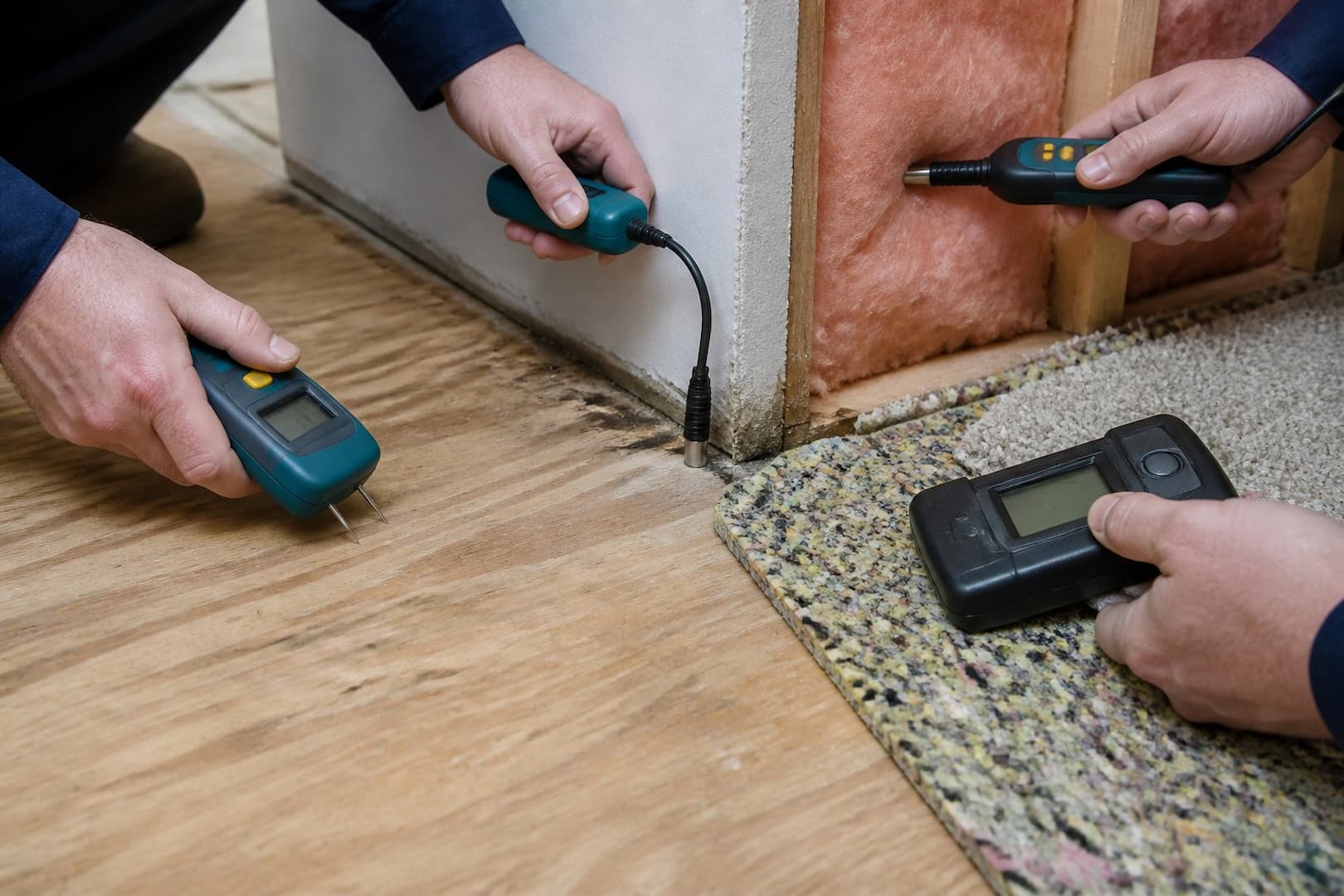
- Monitor the trend. Readings should decline in a pattern that makes sense; a stalled area may be concealed or vapor-closed.
- Confirm the endpoint. Affected materials should return to an acceptable condition relative to references and material requirements.
- Document before reconstruction. Keep readings, locations, equipment dates, and material decisions.
Professional water damage restoration does not make every project faster by running more fans. It improves the odds that extraction, humidity control, access, and material decisions match the actual assembly.
Signs the structure is not dry
- A musty or damp odor persists after surface water is gone.
- Paint bubbles, trim remains swollen, or stains expand.
- Hardwood cupping appears or worsens.
- Carpet feels cool or damp at the backing or edge.
- A wall base reads higher than dry comparison material.
- The room humidity rebounds when equipment pauses.
- A cabinet toe-kick, floor transition, or adjoining room stays wet.
- The drying trend stalls for more than one monitoring cycle.
Drying-time questions
Can I dry a wall with a household fan?
A fan may help a tiny clean-water surface event, but it does not prove that insulation or the back of drywall is dry. It can also spread contaminants or mold when used without assessment.
When can hardwood be sanded?
After the flooring and subfloor have stabilized near appropriate dry reference conditions. Sanding a cupped floor too early can create crowning later.
Does a dehumidifier remove water from materials?
It lowers moisture in the air, which supports evaporation. Extraction, air contact, temperature, access, and material properties still control how water leaves the assembly.
Does everything have to dry within 48 hours?
Public-health guidance urges rapid cleanup and drying, often within 24–48 hours where feasible, to reduce mold risk. Dense materials can take longer under a controlled plan; the point is to begin promptly and not leave hidden wet layers unmanaged.
A drying estimate should be a hypothesis, not a promise
The first schedule is based on source, water category, material, assembly, weather, access, and initial readings. It should be updated as data arrives. A room that loses moisture steadily may meet its target within the planning range. A wall that stalls can contain wet insulation, a vapor-resistant finish, double drywall, plaster, masonry, or a continuing leak. The correct response to a plateau is investigation–not declaring the calendar complete.
| Drying record | What it tells you | What it cannot prove alone |
|---|---|---|
| Room temperature and relative humidity | Whether the air can accept moisture | That the center of a material is dry |
| Surface scan | Where relative wet patterns extend | Exact moisture content in every substrate |
| Pin reading in wood or gypsum | Change at a chosen depth/location | Condition of inaccessible layers elsewhere |
| Dry reference reading | Normal comparison for this building/material | A universal target for every assembly |
| Daily trend | Whether conditions are improving or stalled | Cleanliness or suitability after contamination |

Material assemblies dry differently from samples on a bench
Painted drywall on an open stud can dry toward both faces. The same board behind vinyl wallpaper, a cabinet, tile, or polyethylene has fewer evaporation paths. Fiberglass may release water while paper facings and wood remain wet. Closed-cell foam sheds bulk water but can hide moisture at framing contacts. Hardwood may look better at the surface while the subfloor below still drives cupping.
Connections slow the process. Bottom plates, sill gaskets, tongue-and-groove joints, tack strips, cabinet toe-kicks, and floor-wall intersections hold water in narrow gaps. Concrete and masonry add a large reservoir. A restoration plan must consider where vapor can leave and whether air movement reaches that surface. More fans in the room do not automatically move air through a closed layer.
Contamination changes the question from “can it dry?” to “should it stay?”
Drying capability is not the same as cleanability. Sewage-contaminated drywall and insulation are commonly removed even if equipment could lower their moisture readings. Carpet from a short clean-water loss may be salvageable; carpet and pad exposed to category 3 water usually are not treated as an ordinary drying project. Fire-suppression water mixed with soot may also need cleaning and corrosion control before aggressive air movement.
Use the water-damage categories guide to classify the source and pathways before choosing salvage. Category can worsen with time and contact. Clear water is not proof of category 1, and a dark stain is not proof of category 3.
What a useful daily drying log includes
- A floor plan or consistent labels for every reading location
- The instrument and material setting used
- Affected readings and unaffected reference readings
- Ambient temperature, relative humidity, and when useful vapor-pressure data
- Equipment placement and each change made
- Notes on access, removal, source repair, weather, and occupancy
- A final record showing why the drying goal was accepted
Numbers without locations are hard to audit. “Drywall 12” means little unless the record identifies the wall, height, side, meter mode, and reference. Photographs help connect readings to the building. If cabinets or flooring prevent direct access, the report should state that limitation rather than implying the hidden layer was measured.
Do not close a wall because the room feels dry
Comfort returns before the assembly necessarily dries. Low room humidity and warm air can make surfaces feel normal while wood, gypsum cores, insulation, or masonry still release moisture. Before reconstruction, inspect the source repair, check the previously wet boundary, compare references, and review trend stability. Professional structural drying should leave a record another contractor can understand before installing new finishes.
Sources and further reading
- CDC: Guidelines for Cleaning Safely After a Disaster
- Boston.gov: Recovering from a Flood
- Massachusetts DPH and MassDEP: Flooding and Sewage Back-ups Home Care Guide
- Massachusetts DPH: Quick Reference — Water Damage Response in Buildings
When the property needs a closer look
Boston Restoration Group can inspect the affected area, document moisture and material conditions, and explain which restoration step fits the loss. Use the BRG contact page to request service in Greater Boston.