
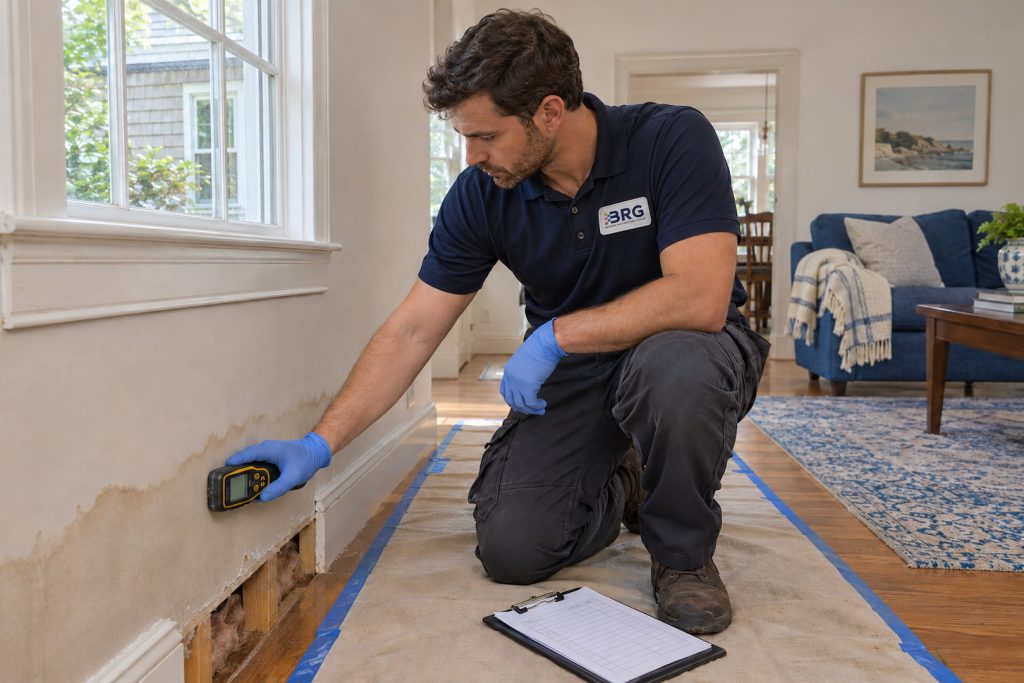
For a national budgeting reference, Angi’s September 2026 cost data put most water damage restoration projects between $1,385 and $6,381, with a reported average of $3,874 across 1,500 projects. These figures describe a mix of U.S. jobs; they are not a Boston price schedule, a BRG quote, or a cap on a larger loss. The work included in your estimate matters more than whether its total sits near that average.
Water damage restoration cost depends on what got wet, how contaminated the water is, and how much of the building needs access, cleaning, drying, or replacement. A room’s floor area alone cannot answer the price question. Water under a cabinet or inside a ceiling can require more work than a larger, accessible spill on a sound floor.
Before comparing prices, ask whether the estimate covers emergency mitigation, finished repairs, or both. Extraction and drying may leave a room ready for rebuilding, with flooring, drywall, trim, and painting still to come. A lower total can reflect that difference rather than a better price for the same work.
Start with the scope, then the total
For a useful budget, separate the source repair from the resulting damage. A plumber may replace a failed supply line while a restoration crew removes water and dries the floor assembly. A roofer may close an opening while interior work continues. Those tasks can sit on different invoices even though they came from the same event.
The term restoration is broad enough to cause confusion. Ask for an explicit endpoint: a dry, cleaned structure; a room with walls closed; or a fully finished space with its contents returned. BRG’s residential water damage service explains how assessment, mitigation, drying, and repair planning fit together.
| Part of the job | What the estimate should identify | Common separate item |
|---|---|---|
| Source control | Who stops the leak and confirms the repair | Plumber, roofer, appliance or HVAC repair |
| Emergency mitigation | Water removal, protection, access, initial equipment | After-hours work or unusual access, if applicable |
| Cleaning and drying | Affected materials, equipment, monitoring, completion criteria | Additional work if concealed damage appears |
| Reconstruction | Materials to replace and finish standard | Upgrades, matching work, permits or specialty trades |
| Contents | Moving, inventory, cleaning, storage and return | Specialty restoration or replacement of belongings |
Why a price per square foot can mislead
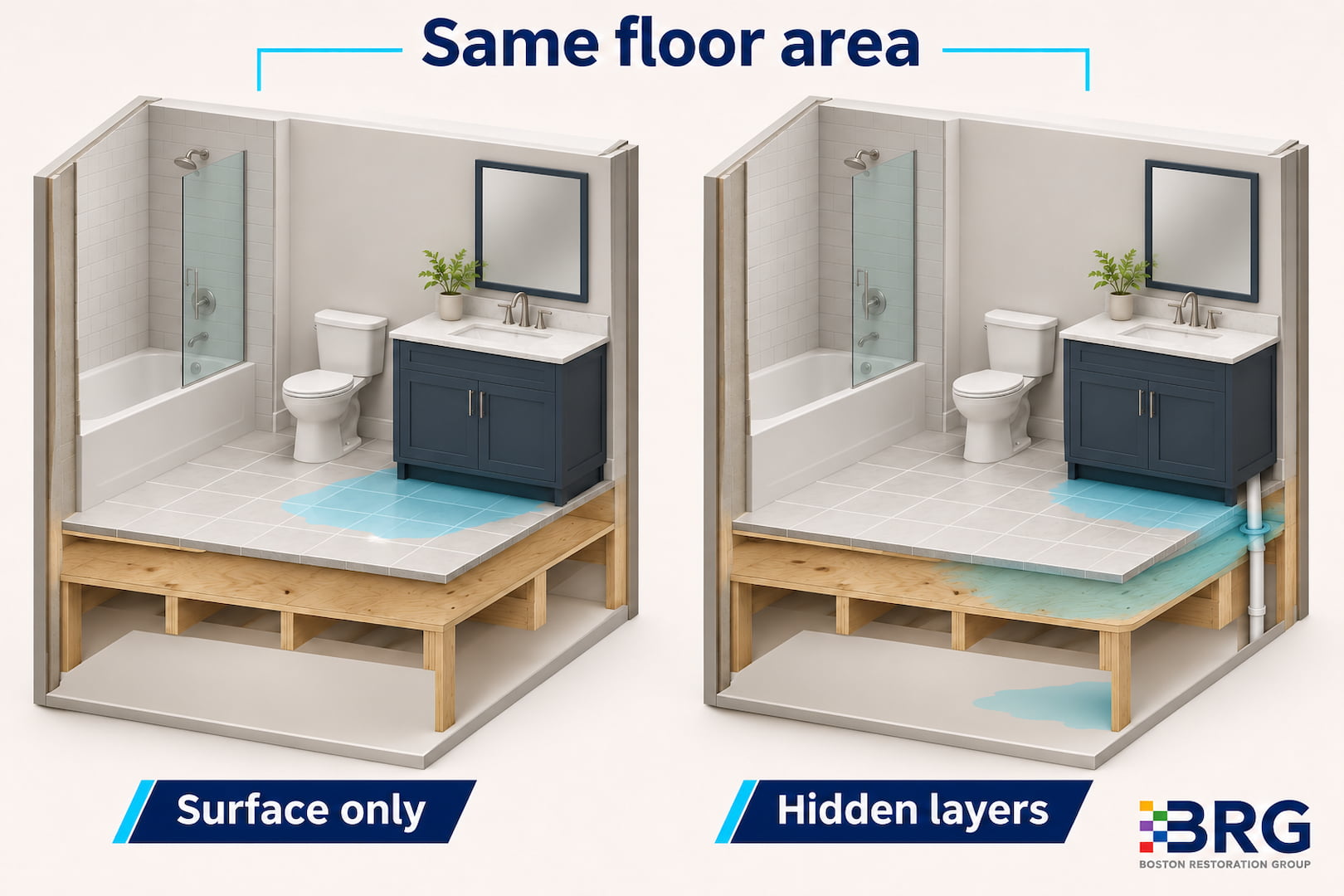
Square footage helps measure work once the work is defined. It does not define the work by itself. A wet floor, the wall surface above it, and the ceiling below are three different quantities. An estimate based only on the room’s footprint may miss two of them.
Picture two bathrooms with the same floor area. In one, water from a recent supply leak stayed on accessible tile. In the other, an overflowing toilet sent contaminated water below a vanity and through the floor into the kitchen ceiling. The second room may need containment, removal, cleaning, drying from more than one level, and repairs to several finishes. Multiplying both footprints by one rate hides most of that difference.
National online cost ranges also combine different markets and scopes. Some describe extraction; others include demolition and finished repairs. Use a published range only when its inclusions match the estimate in front of you. A site-specific assessment is needed for a Boston-area property, especially where access, older materials, or several units complicate the work.
The conditions that change the bill
Where the water traveled
The visible puddle is a starting point. Water can reach carpet pad, baseboards, wall plates, insulation, cabinet bases, and the underside of flooring. The initial assessment should identify the wet boundary and the areas that could not yet be checked. Selective access may change that boundary.
A short visit that counts wet rooms without checking assemblies may produce a low preliminary number, followed by a larger change later. Ask what was measured, what remains uncertain, and which discoveries would change the scope. Photographs and a simple room plan make that conversation easier.
Water source and contamination
A recent potable-water leak and a sewage backup require different decisions about access, contents, and cleaning. Clear-looking water does not prove a clean loss. Its path through the building and contact with soil, waste, or other contaminants matter.
Contaminated porous material can need removal even if it could physically be dried. That adds handling, protection, disposal, and replacement work. Massachusetts’ flooding and sewage-backup guidance distinguishes cleaning and disinfection and identifies materials that are poor candidates for salvage. A drying-only quote may omit these tasks.
Materials and access
Solid wood, particleboard, plaster, drywall, carpet, and floating flooring respond differently to water. The choice is not simply save everything or remove everything. A sound framing member may remain while a swollen cabinet base cannot. Access to a wet underside may require carefully taking up a finish that looks acceptable on top.
Older Boston-area homes can also have several generations of finishes. Before disturbing suspect flooring, ceiling texture, pipe insulation, or other material, the team may need specialist assessment. EPA recommends professional asbestos sampling when suspect material is damaged or planned work would disturb it. Those costs and responsibilities belong in the scope, not in an unexplained demolition allowance.
Equipment, monitoring, and time
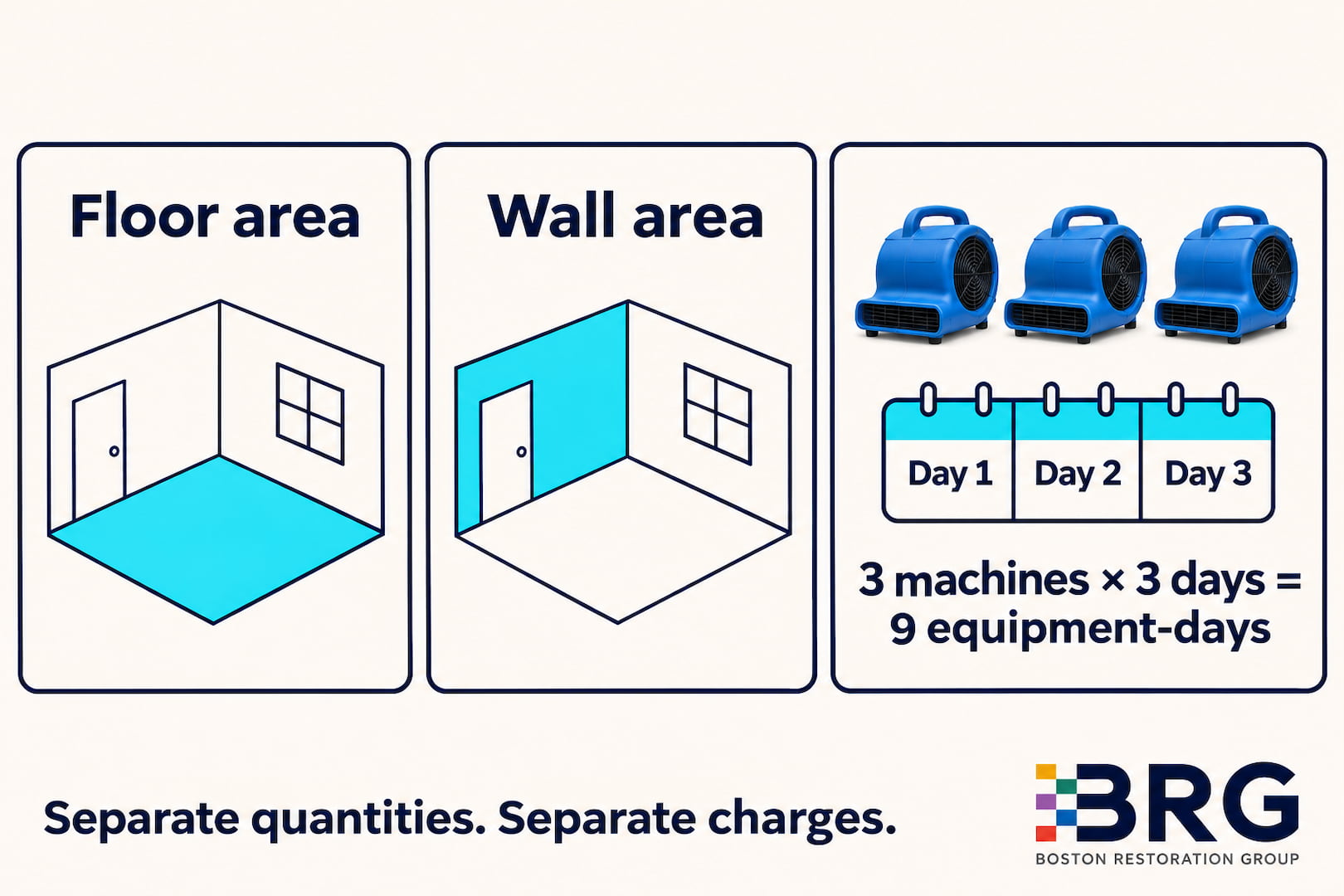
Equipment charges commonly depend on the type and number of machines and how long they operate. Look for separate quantities and dates for air movers, dehumidifiers, and any air-filtration equipment. Ask how delivery, setup, monitoring visits, repositioning, and pickup appear on the estimate. A machine-day and a labor visit are different units; the proposal should make them understandable.
More runtime is not automatically better drying. Progress depends on access to wet materials, extraction, airflow, humidity, temperature, and whether the source is actually stopped. Water extraction and moisture assessment help establish what needs drying before the equipment count is set.
Ask for the starting conditions and the readings that will support removing equipment. If progress stalls, the response should be reassessment: perhaps water is trapped behind a finish or another leak remains. Simply extending rental time without explaining the condition leaves both the bill and the result uncertain.
Three scopes that should not receive the same estimate
| Observed situation | Likely work to investigate | Main budget uncertainty |
|---|---|---|
| Recent, limited supply leak; accessible surfaces remain sound | Extraction, moisture checks, drying if needed, final verification | Whether water entered hidden layers |
| Water under flooring or inside walls and ceilings | Selective access, material decisions, controlled drying, finish repairs | Extent of concealed moisture and removal needed for access |
| Sewage, outdoor floodwater, or a broader contaminated loss | Controlled cleanup, porous-material removal, cleaning, drying, reconstruction | Contamination boundary, contents loss, disposal and specialist work |
These are scope comparisons, not price bands. Even within one row, a closet with open access differs from an occupied apartment where work must cross common areas. Stairs, parking, elevator reservations, working hours, and protection for unaffected rooms can all change labor and logistics. Include those details when requesting a quote.
Read the estimate by quantity and responsibility
You should be able to trace each charge to an area, an item, or a period of work. Check which rooms the estimate includes and whether the quantities match the measurements. Estimating-system codes can be hard to read. Ask the contractor to explain any line you cannot connect to work in your home.
For an equipment line billed daily, the calculation is machine count × billed days × the stated daily rate. Three air movers billed for three days produce nine equipment-days. A dehumidifier has its own quantity and rate. This arithmetic explains a billing unit; it does not prescribe how many machines your room needs or how long drying should take. Confirm what counts as a billable day and when charges stop.
Surface work needs the same clarity. An affected wall section 8 feet long and 3 feet high measures 24 square feet, separately from the floor beneath it. Baseboard may be measured in linear feet. Removal, disposal, replacement drywall, finishing, and painting can be distinct lines. Ask whether each rate includes labor and materials before comparing it with a quote that groups the work together.
- Extraction: surface or material treated, measured area, and whether hidden reservoirs are included.
- Removal: material, quantity, handling, bagging or containment, and disposal.
- Equipment: type, quantity, anticipated duration, monitoring, and the process for extending the rental period.
- Cleaning: surfaces, method, and any disinfection required after soil is removed.
- Repairs: replacement materials, finish work, exclusions, and who coordinates other trades.
- Payment: deposit, progress payments, final billing, taxes or other charges, and how changes receive approval.
Check for both gaps and duplication. Moving contents might be necessary before extraction, but the same move should not disappear into several unexplained allowances. If one contractor removes a vanity and another replaces it, establish who disconnects plumbing, stores salvageable parts, and reconnects the fixtures.
Compare two quotes on the same endpoint
Put the proposals next to each other and mark what each promises to leave behind. If one includes dry retained materials plus reconstruction and the other ends after extraction, the totals do not answer the same question. Request the missing scope before deciding that one contractor is more expensive.
Then compare assumptions. How many rooms were inspected? Are walls and floors being opened? Is contamination addressed? What equipment duration is assumed? Who verifies completion? A proposal can reasonably start with provisional quantities, but it should identify them and explain how they will be revised.
Check the document you are signing. An estimate, a fixed-price contract, and a time-and-materials authorization do different things. Does yours set a spending limit, authorize an initial scope, or establish a final price? If concealed damage changes the job, request photographs, an explanation, and the cost effect in writing before additional non-emergency work proceeds.
What insurance may change, and what it does not
The restoration cost and the insurance payment are separate numbers. Coverage depends on the policy, source, exclusions, limits, and the insurer’s review. A contractor’s agreement to document or submit an estimate does not establish that every line item will be covered.
The Massachusetts Division of Insurance advises owners to report a possible claim, protect the property from further damage, and retain repair records and receipts. Contact the insurer promptly and ask what documentation it needs before permanent repairs. Keep photographs of affected rooms and belongings, source-repair records, mitigation invoices, and any changes to the scope.
Ask specifically about the deductible, contents, temporary living expenses, mold provisions, and any water-backup endorsement relevant to the event. Do not assume a plumbing leak, sewer backup, and overland flood receive the same treatment. The contractor can describe the physical loss; the insurer interprets the coverage.
For your own budget, keep the contractor’s total, the insurer’s approved amount, and your expected payment on separate lines. The deductible does not reduce the work needed; it affects how an eligible claim is paid. Request clarification of any uncovered work, upgrades, or payment due before insurance funds arrive. An approved emergency-drying allowance may leave reconstruction to a later estimate.
Keep costs down without leaving hidden damage
The useful savings start with stopping the source safely and keeping unaffected areas out of the loss. Move vulnerable belongings only if the route is dry and safe. Make access arrangements early, provide building contacts, and share known shutoff locations or prior leak history. Those details can prevent avoidable return visits and delays.
Do not save money by skipping the subfloor check or repainting a damp wall. A finish may hide the evidence while the underlying material still needs work. Equally, ask why a sound material must be replaced if cleaning and drying are feasible. A material-by-material explanation is more useful than blanket removal or blanket salvage.
For contamination or established growth, request the relevant scope rather than treating it as an equipment rental. Mold remediation may involve containment and removal beyond the original water-drying work. Whether that work is needed should follow observed conditions and assessment, not an automatic surcharge after a set number of hours.
Questions to settle before work begins
- What rooms and assemblies are included, and what could not yet be inspected?
- Does this price stop at mitigation, or include finished repairs and contents return?
- Which quantities are provisional, and how will extra work be approved?
- What measurements or other criteria will show the drying work is complete?
- Which source repairs, specialist assessments, or permits belong to someone else?
- What will I owe, and when, if insurance pays less than the contractor’s bill?
For a water loss in Greater Boston, contact Boston Restoration Group with the address, source, affected rooms, and any access concerns. The assessment can establish the mitigation scope and identify the repairs or outside trades that should be priced separately.