
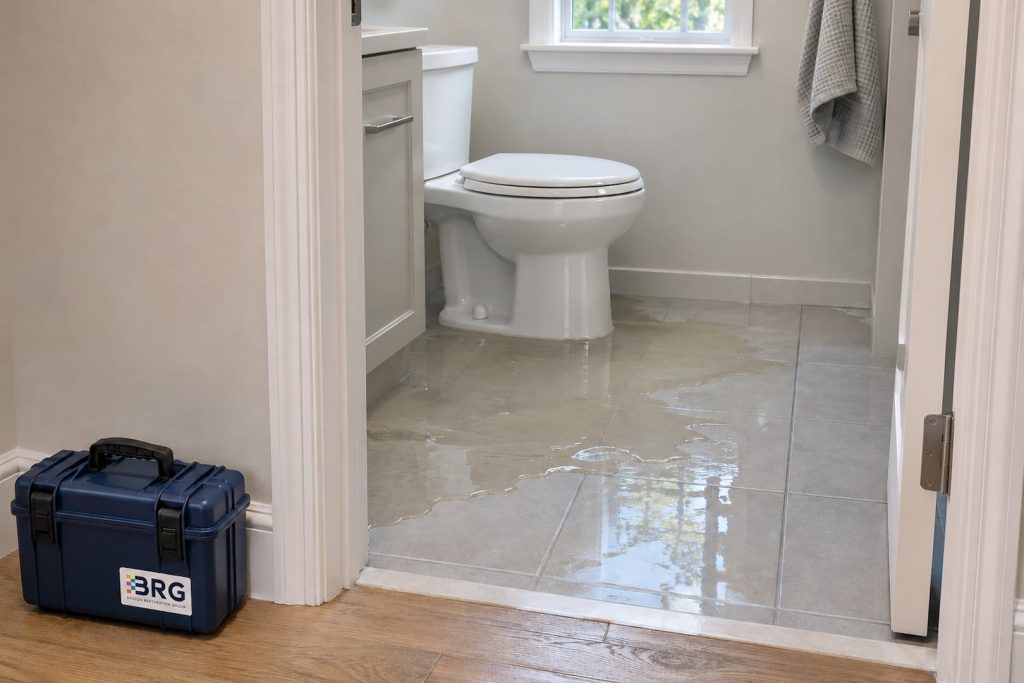
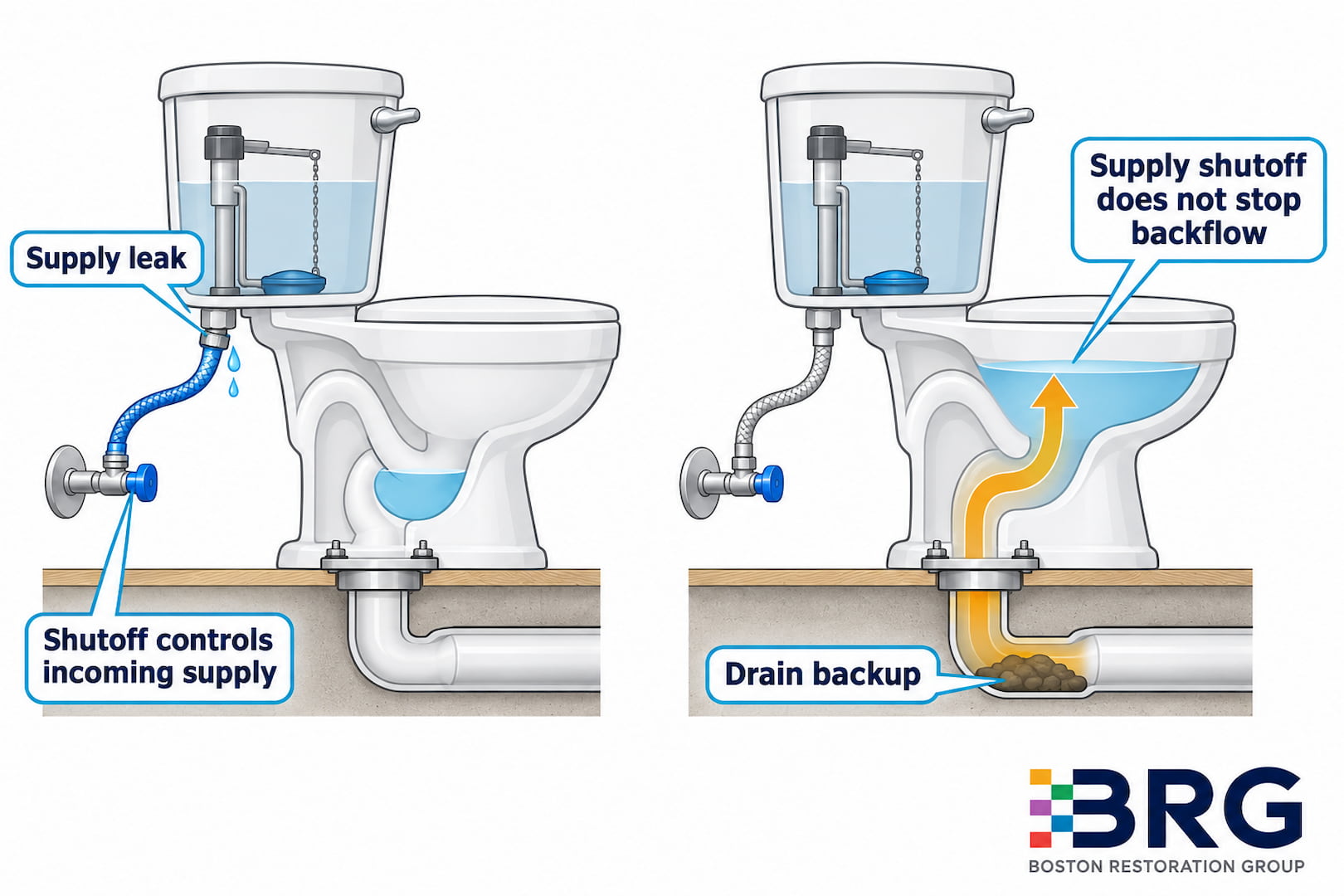
If a toilet is overflowing, stop flushing and keep people out of the water. Close the toilet’s supply valve only if you can reach it from a dry, safe position. If water is coming back through the bowl or other drains, stop using plumbing fixtures and call a plumber or drain specialist. Closing the toilet supply does not stop a sewer line that is backing up.
Cleanup depends on where the water came from and what it contacted. A supply connector leaking onto the floor is different from wastewater spilling out of the bowl. Treat waste-containing or uncertain bowl water as contaminated, even if it looks clear. A mop can remove the visible puddle while water remains beneath flooring or in the ceiling below.
First steps while the water is still moving
- Do not flush again. A second flush can add water before the obstruction is cleared. Tell everyone in the property which fixtures should not be used.
- Keep children and pets away. Close off access from a dry area and avoid tracking water through the home.
- Use a known shutoff only if safe. Do not force a corroded valve. If the local supply will not stop, a known building-main shutoff may be appropriate when you can reach it safely.
- Keep clear of electrical hazards. Do not touch wet plugs, switches, appliances, or fixtures, and do not enter water to reach a breaker panel.
- Call for source repair and damage assessment. Report whether the bowl, tank, supply connection, or several drains are involved.
- Check the room below from a safe location. Keep out from beneath sagging, bulging, cracking, or actively dripping ceilings. Do not puncture a ceiling to release water.
If water is reaching lights, electrical equipment, or an unstable ceiling, the appropriate emergency service or qualified trade must make the area safe. EPA’s cleanup safety guidance specifically warns against touching wet electrical equipment or using it while standing in water. A small bathroom does not make that hazard smaller.
Photograph the source and affected rooms if you can do so without entering the water. Note when the overflow started, when it stopped, and which fixtures were running. Do not delay source control to collect photographs.
Identify the route, not just the fixture
| Observed problem | What it may mean | Cleanup implication |
|---|---|---|
| Water spraying or dripping from the supply connector | Pressurized potable-water connection has failed | Initially cleaner source, but its route and contact still require assessment |
| Water leaking from the tank or its connections | Tank, seal, fitting, or filling issue | Confirm the source and inspect the floor; do not assume the bowl overflowed |
| Water spilling over the bowl after flushing | A blocked or restricted drain, with bowl contents involved | Treat waste-containing or uncertain discharge as contaminated |
| Water rising in the toilet while other fixtures drain | A shared drain or sewer restriction may be involved | Stop using fixtures and have the line investigated |
| Water emerging at the toilet base | A drain seal, connection, or another nearby leak may be involved | Avoid assuming it is condensation or clean water; investigate beneath the fixture |
A running toilet is not always a floor overflow. Water can pass from the tank into the bowl and continue down an otherwise working drain. Kohler’s troubleshooting guidance describes several tank and fill-valve problems that cause continuous running. When water reaches the floor, report the exact point of escape so the plumber can distinguish a fill issue from a blocked drain or failed connection.
Do not rely on color or odor to decide that bowl water is sanitary. Contamination may be present without obvious waste. Time, temperature, dirty surfaces, and hidden cavities can also change the condition of a loss that began at a potable supply. If the source is uncertain, keep the area isolated until it is assessed.
What a plumber fixes, and what cleanup still requires
The plumber or drain specialist stops the release, clears the obstruction, and checks the failed component or drainage path. That repair is essential, but it does not remove water from the floor assembly or clean affected building materials. Ask whether a controlled test has confirmed the plumbing repair before normal use resumes.
For wastewater, sewage cleanup and disinfection addresses the affected area after the source is controlled. The restoration scope can include extraction, protection of clean rooms, decisions about porous materials, cleaning, and drying. In a multi-unit building, notify management promptly so the source unit, shared systems, and rooms below can be coordinated.
For a sewer backup in Boston, Boston Water and Sewer Commission asks residents to report it to its 24-hour emergency line, 617-989-7000. Outside Boston, contact the local sewer utility when a public-system backup is suspected. A report does not establish which pipe failed or who pays; the source still needs investigation.
Tell both parties about any drain cleaner or other chemical that was added before the overflow. Do not add more products or combine chemicals in an attempt to sanitize the bowl or clear the blockage. That information changes what workers may encounter during repair and extraction.
Where bathroom water goes after the puddle disappears
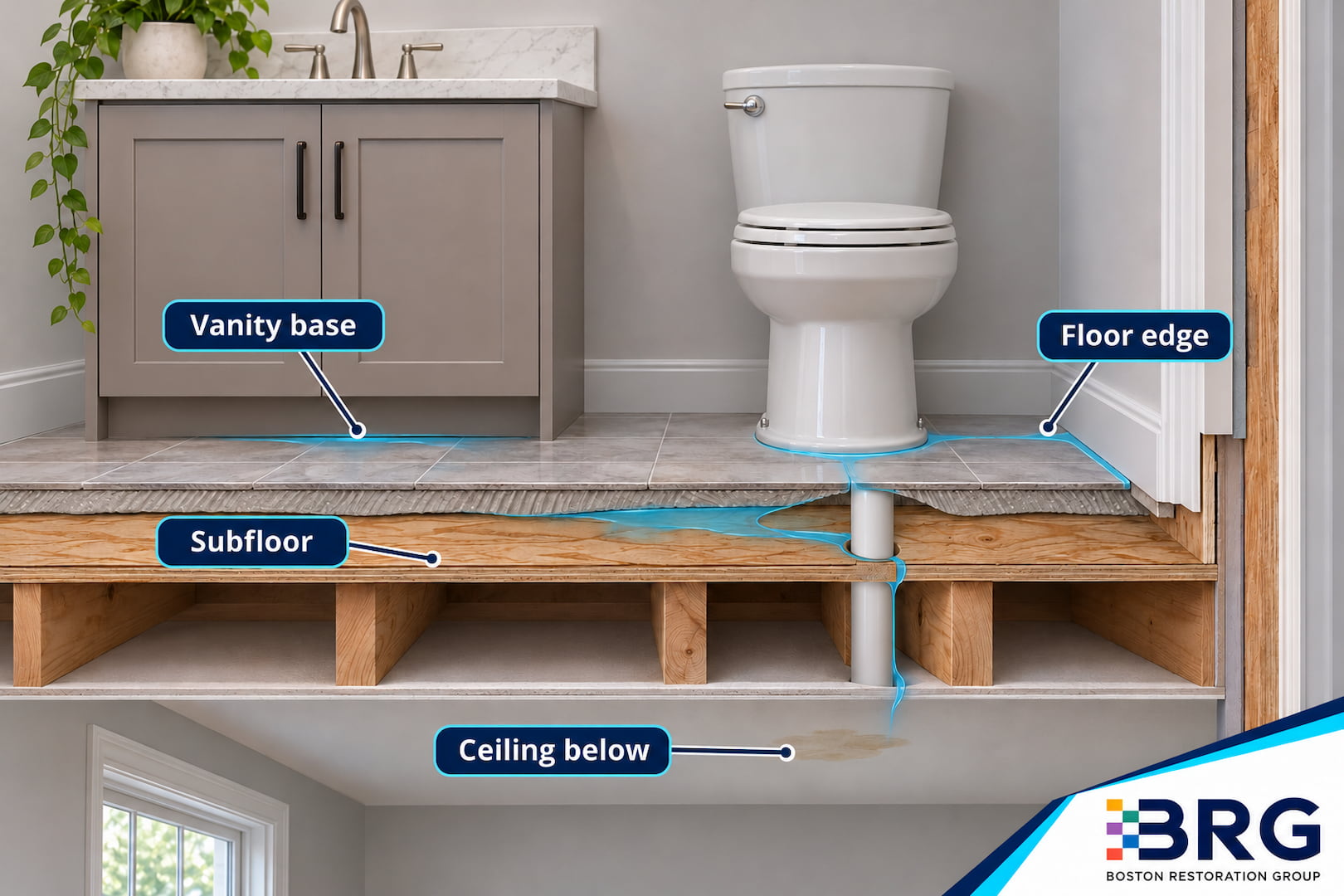
Tile and grout do not necessarily make the whole floor watertight. Water can enter at the toilet opening, room perimeter, thresholds, cracked joints, and pipe penetrations. A waterproofing layer, if present, may not protect every connection or extend across the entire room. The floor’s construction determines what needs to be checked.
Vanity toe kicks and cabinet bases can conceal a reservoir. Water may run beneath vinyl plank, soak the pad of adjacent carpet, or wick into drywall behind the baseboard. In an upstairs bathroom it can follow plumbing penetrations and framing before showing up some distance away on a ceiling.
- Check the bathroom perimeter and the doorway into adjoining rooms.
- Inspect accessible cabinet bases, closets, and the wall behind stored items.
- Include the room and ceiling below, even if the drip has stopped.
- Record dampness, staining, swelling, lifted seams, and odors without treating any one sign as a complete diagnosis.
- Ask how hidden areas will be assessed and whether selective access is needed.
A moisture meter can help map affected materials, but readings require the correct setting and interpretation. Metal, finishes, and material type can influence them. A thermal camera shows temperature differences rather than contamination or water itself. Professional water extraction and assessment should connect those observations to the actual floor and wall assembly.
Can you clean a toilet overflow yourself?
A very limited, recent supply-line leak on an accessible, nonporous surface may be manageable once the source and electrical risks are resolved. The important questions are whether the water is genuinely sanitary, whether it reached hidden layers, and whether you can confirm the area is dry. A damp bathroom mat and a wet subfloor need different decisions.
For that narrow, confirmed supply-water situation, absorb accessible surface water with towels or a mop, then clean the hard surface with a compatible detergent and clean water. Wear gloves and follow the cleaner’s directions. Remove wet movable items from the floor and dry the exposed surface. Check the doorway, cabinet edges, and baseboards before deciding the job is finished. If water entered a closed assembly, surface wiping cannot verify the layer below.
Get professional help for waste-containing bowl water, a sewer backup, an unknown source, spread into carpet or wall cavities, damage on another level, or material that is swelling or soft. Occupant health concerns and the ability to keep the work area separate also matter. Do not turn a contaminated loss into a fan-drying experiment.
Massachusetts’ home-care guidance for sewage backups emphasizes removing contamination, cleaning before disinfection, and evaluating what can be salvaged. For a wastewater overflow, wiping the floor with a disinfectant does not address dirty material beneath a vanity or water inside a ceiling.
Cleaning comes before drying contaminated materials
For a contaminated overflow, the crew first limits access and removes liquid and gross soil. Workers identify material that cannot be cleaned reliably and remove it without spreading debris into unaffected rooms. They then clean accessible surfaces that will remain and, where appropriate, apply a disinfectant according to its label.
Disinfection is not the same as removing soil. EPA explains that surfaces must be cleaned before a disinfectant is used and that many products are unsuitable for absorbent materials. Use a product labeled for the intended surface and application; the surface must stay wet for the label’s stated contact time. Do not mix products or improvise a stronger solution. Some finishes cannot tolerate a particular disinfectant, which is another reason to make material decisions before widespread application.
Air movement and dehumidification come into the plan after the contamination load and spread are controlled. Uncontrolled fans can spread residue or particles. A household vacuum is not a wastewater extractor, and equipment used in a contaminated area needs appropriate handling before it goes into a clean room.
What may need removal
| Material | What affects the decision |
|---|---|
| Glazed tile, intact glass, and suitable metal surfaces | Often cleanable when accessible and compatible with the cleaning method; joints and hidden layers still need inspection |
| Carpet and pad contacted by sewage | Ordinary installed porous materials are generally poor salvage candidates; drying alone does not decontaminate them |
| Drywall and insulation | Contamination, saturation, deterioration, and access to the cavity can require selective removal |
| Cabinet bases and composite trim | Swollen or delaminated particleboard and fiberboard may not recover even after drying |
| Wood subfloor or framing | Assess contamination, access, moisture, and physical condition before deciding on cleaning, drying, or replacement |
| Paper goods and personal items | Toilet paper, cardboard, and other contaminated absorbent goods may need disposal; high-value items can require specialty evaluation |
Do not apply the same disposal rule to every toilet-related leak. A clean supply drip promptly removed from a sound surface differs from a bowl backup that soaked carpet. Conversely, the fact that a material still looks intact does not prove it can remain after sewage contact. Ask the contractor to explain the source, exposure, and practical cleaning access behind each recommendation.
In an older home, flooring, adhesive, texture, or insulation may need assessment before demolition. Do not pull up suspect layers or cut into a ceiling simply to see whether it is wet. The access plan should account for electrical, structural, and hazardous-material concerns.
How to know the cleanup is ready for repairs
A usable bathroom needs more than a clear drain and a dry-looking tile surface. The source should be corrected, contaminated material addressed, and retained assemblies checked for drying progress. Before closing cavities or reinstalling finishes, ask which measurements and observations support that decision.
The completion record should identify the rooms inspected, material removed, surfaces cleaned, equipment used, and any areas that remain unresolved. If a subfloor remains wet or odor persists, find the cause before rebuilding. An air freshener or another coat of paint does not establish that a concealed area is ready.
Where the loss reaches walls, flooring, or another level, water damage restoration can connect the cleanup to drying and repair planning. The plumber’s repair record and the restoration record answer different questions; keep both.
Ask separately when the toilet can be used and when the bathroom can be reopened. A repaired drain may function while cleanup, an open floor, or work on the ceiling below still makes normal use inappropriate. In a shared building, confirm the restrictions with management and the crews working in each affected unit.
Document the loss without delaying necessary work
Save photographs, the plumber’s diagnosis, emergency invoices, and a room-by-room list of damaged belongings. Record when management or other affected occupants were notified. Ask your insurer what evidence it needs and how it treats the cause of this particular loss; a supply failure and a sewer backup may fall under different policy terms.
Massachusetts’ Division of Insurance recommends prompt notice and retaining records of temporary repairs. The restoration company can document conditions and work performed, but it cannot guarantee coverage or decide who is legally responsible for damage between units.
Prevent another overflow after the repair
Ask the plumber what caused the event before choosing a prevention step. A blocked toilet, a damaged supply connector, and a shared drain restriction need different corrections. Repeated gurgling, slow drainage, unexplained water at the base, or a toilet that continues running deserves attention before the next overflow.
Keep wipes and other non-toilet-paper products out of the toilet. BWSC warns that even wipes labeled flushable can clog household plumbing and public sewers. Make sure household members know where the supply valve is and whom to call. A water alarm near a vulnerable floor area may help detect a leak sooner, but it does not stop a drain backup or replace maintenance.
If the event involved reverse flow from a sewer, ask the plumber whether the building needs a backwater-valve assessment. That device acts on the drain or sewer line; it is different from the toilet’s incoming-water shutoff. Suitability, installation, and maintenance depend on the building’s plumbing and local requirements. Clearing a one-time toilet obstruction does not by itself establish a need for one.
For an overflow in Greater Boston, contact Boston Restoration Group with the source, affected rooms, and whether wastewater or a ceiling below is involved. Keep the area isolated while the plumbing repair and cleanup scope are arranged.