
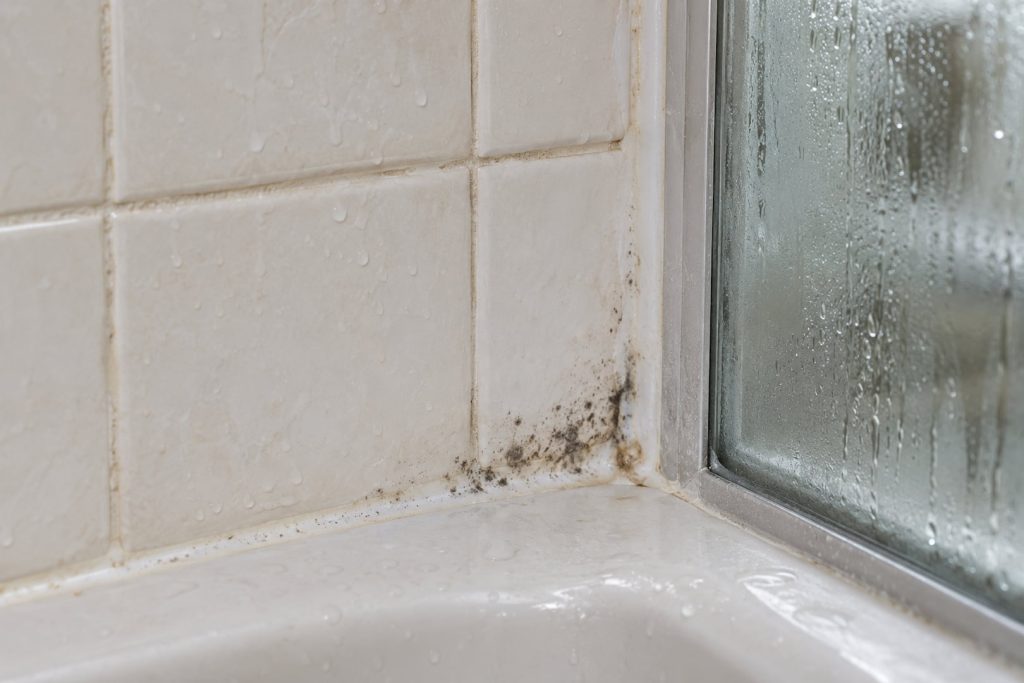
Mildew is not a separate category of harmless household dirt. The EPA describes mildew as a term for certain kinds of mold or fungus, often used for growth with a flat appearance. In everyday conversation, people may call a patch ‘mildew’ because it looks thin or sits on a shower surface. That label does not establish its species, depth, or health significance.
For a homeowner, the useful distinction is between a small, cleanable surface problem and moisture affecting a larger assembly. A bathroom tile joint and the wet drywall behind it can need very different work even when the visible spots look alike. Start with the material and the water history, then decide whether cleaning, investigation, or removal makes sense.
The familiar comparison chart needs a few corrections
Many mold-versus-mildew descriptions assign a fixed color, texture, and level of danger to each word. Real buildings are less tidy. Growth can change as it ages, collect dust, or appear different under a phone flash. Several conditions can occupy the same damp surface.
| Common claim | What you can reasonably conclude |
|---|---|
| Mildew is white; mold is black or green | Color does not reliably separate the terms or identify the organism. |
| Mildew stays on top; mold always penetrates deeply | The affected material and assembly must be assessed. Appearance alone cannot establish depth. |
| Mildew is harmless | A casual name is not a health assessment. Damp growth should be addressed appropriately. |
| A fuzzy patch must be mold | Texture can be a useful observation, but dust, fibers, salts, and damaged finishes can confuse identification. |
| If a cleaner removes the color, the problem is fixed | The moisture source and condition beneath the surface still need checking. |
| You need a species test before taking action | Visible growth and a known moisture problem often provide enough reason to address the building condition. |
These limits do not mean every suspicious spot requires expensive testing. They mean the first decision should not depend on a color chart. A clear description such as ‘dark specks on painted drywall below a leaking window’ gives an inspector more useful information than ‘toxic black mold’ or ‘just mildew.’
Does mildew turn into mold?
Not as a separate stage of a household growth problem. Mildew is already a word used for certain molds or fungal growth. A patch may expand or change appearance while moisture persists, but there is no reliable visual point at which harmless mildew becomes dangerous mold. Waiting for a change in color or texture delays the more useful task of checking what is wet.
The shared mechanism matters more than the label: spores are present in ordinary surroundings, and suitable damp surfaces allow growth. On a shower, soap residue and frequent wetting can sustain a surface problem. On paper-faced wallboard, the material itself and a concealed wet layer may be involved. The location of the water determines what must change.
Look at the surface without disturbing it
Use ordinary room light and photographs to record what you can safely see. Include a wider view showing the wall, window, plumbing fixture, or floor around the patch. Then take a closer view with a familiar object nearby for scale. Do not scrape the spot just to check whether it is powdery.
Notice changes in the substrate: peeling paint, swollen trim, loose wallpaper, a soft cabinet base, or a new ceiling stain. Those findings can make the material decision more urgent than the question of which name to use. A clean-looking wall beside the patch may also sit along the same water path.
Odor adds context, but it does not identify a species or map the full affected area. A musty closet may contain damp cardboard, an old upholstered item, a wet exterior wall, or several sources. A drain or other odor can be mistaken for a mold problem. Record where the smell is strongest and when it changes rather than applying fragrance to mask it.
Where the patch appears changes the investigation
Shower tile, grout, and caulk
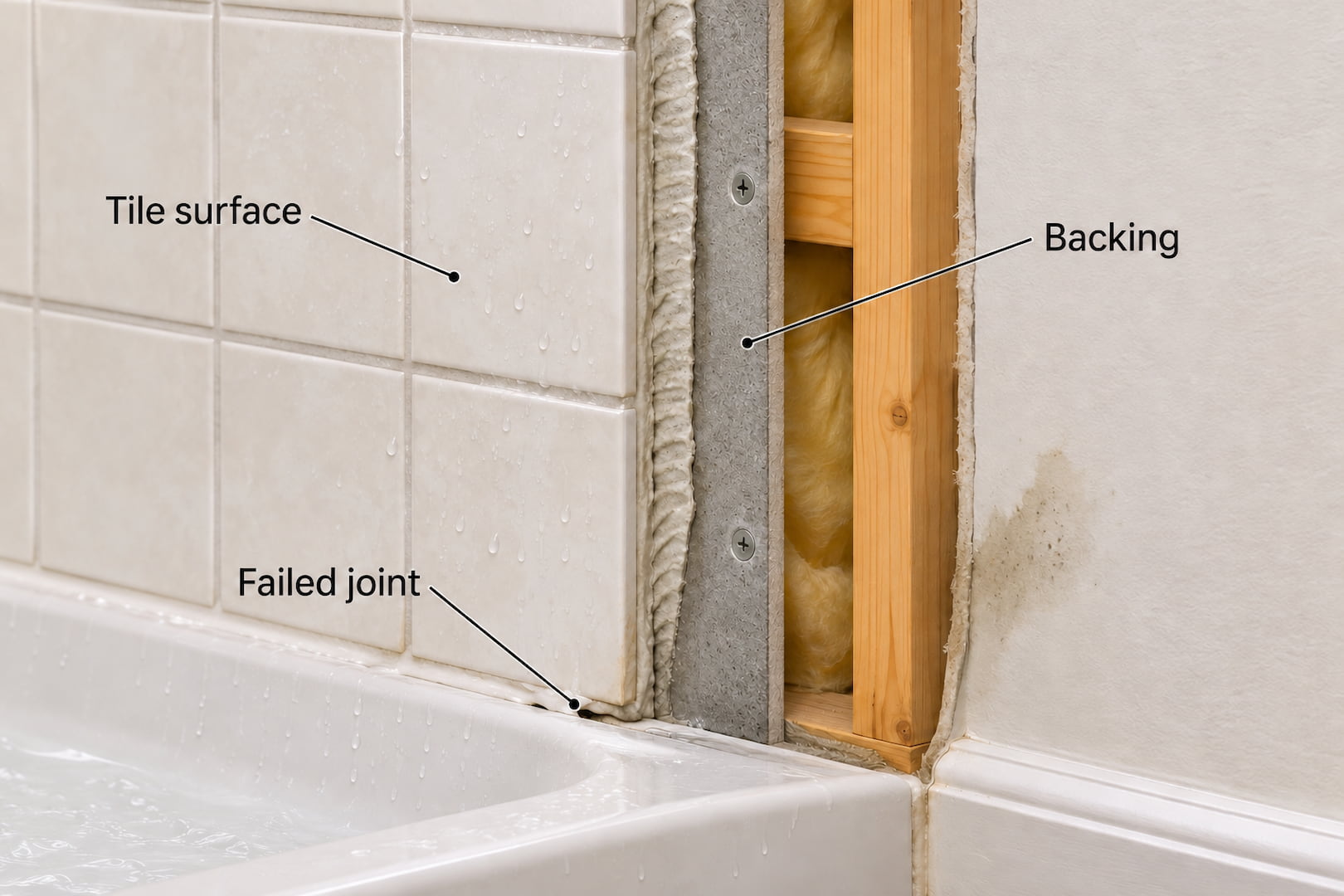
Growth on a washable shower surface may be related to frequent wetting, soap residue, and slow drying. The joints deserve a closer look. Missing grout, detached caulk, soft adjacent trim, or staining on the ceiling below can point beyond a routine surface-cleaning task. Recaulking over an unresolved damp joint can hide useful evidence.
Windows and exterior corners
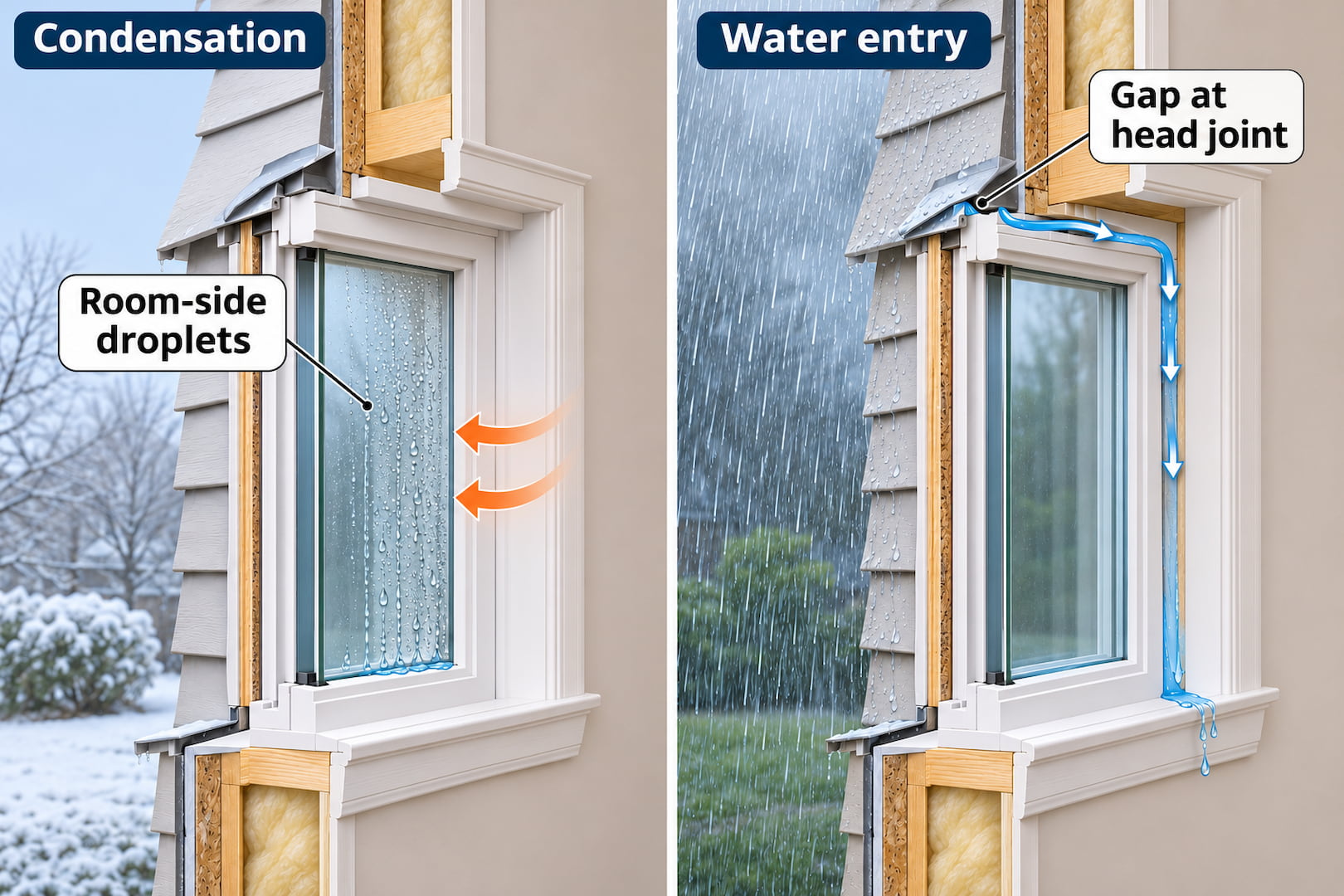
A cold window can collect condensation even without a roof or plumbing leak. Note whether the glass, frame, or wall becomes wet during cold weather and whether curtains or furniture restrict air movement nearby. Water appearing after wind-driven rain suggests a different investigation. In an older Greater Boston home, those two patterns can occur at the same window at different times.
Cabinets and furniture
An apparently small spot at a cabinet’s front edge may be the visible part of a wet base. Inspect accessible undersides and nearby plumbing without pulling apart the cabinet. For furniture, distinguish a durable finished face from an unfinished back, fabric lining, veneer, or composite core. Cleaning one face does not tell you whether the rest can be retained.
Basement masonry and stored belongings
White deposits on masonry can be mineral salts rather than mold. Dust, paint deterioration, and residue are other possible lookalikes. Do not choose treatment from color alone. Even if the deposit is not fungal growth, water moving through the wall can still damage nearby wood, cardboard, or furnishings.
When staining or odor keeps returning, a mold inspection with moisture assessment can help separate a surface issue from a building problem. The useful result is a supported next step, not simply a label for the patch.
When the same room has several suspect spots, make a simple location list rather than treating them as unrelated cleaning jobs. A mark under the sink, a swollen cabinet corner, and staining on the room below may share one water path. Spots at several cold exterior corners may suggest a broader condensation pattern. These are working clues, not diagnoses; keep the original observations so an inspector can test the explanation.
In a rental or managed building, report the condition in writing with dated photographs and a clear location. Describe active dripping, affected finishes, and access needs. A maintenance team can act on those details without first resolving the mold-versus-mildew terminology. Keep a record of source repairs and repeat observations, especially if a surface has been cleaned several times but becomes damp again.
What changes the cleaning decision
Material condition comes first. Intact, accessible, compatible hard surfaces may be candidates for cleaning and drying. Porous or damaged material may need removal when its affected thickness cannot be cleaned reliably. A finish can also limit access: growth at the edge of wallpaper may extend to the paper backing or wall beneath it.
The EPA’s basic cleanup guidance emphasizes correcting water problems, cleaning appropriate hard surfaces, and considering removal of moldy porous materials. It also advises against painting or caulking over mold. Calling the growth mildew does not create an exception to those material decisions.
Extent matters, but the visible measurement is only part of it. Several small patches connected by one leaking wall may represent a larger affected assembly. Limited access, sewage, suspected HVAC contamination, or a household member’s medical concerns can also make professional assessment sensible before disturbance.
For a small suitable hard-surface patch, cleaning means physically removing the growth with a compatible detergent-and-water method and drying the surface. Wear gloves, eye protection, and a properly fitted N95 for mold particles as described in the EPA’s household guidance. Its roughly 10-square-foot guideline is one screening factor, not permission to disturb any smaller patch. Do not sand a painted wall or pull off wallpaper to test whether the growth is superficial.
- Document the surface and surrounding damage before cleaning when it is safe.
- Correct the moisture condition and confirm who is responsible for that repair.
- Choose a cleaning or removal method that suits the affected material and its hidden layers.
- Keep cleanup residue from spreading into clean rooms and furnishings.
- Dry retained material and leave it accessible until the condition can be checked.
- Revisit the area after normal room use and the weather conditions that previously caused wetting.
For a leak affecting floors, wall cavities, or insulation, water damage restoration addresses the drying and material questions that remain after the leak stops. Surface cleaning and structural drying solve different parts of the same loss.
Health cannot be judged by the word on the bottle
A product described as a mildew remover does not establish that the growth it treats is medically insignificant. Nor does a dark patch establish that a home is dangerous to every occupant. The CDC’s NIOSH guidance notes that color does not determine whether mold is more or less dangerous and that there are no health-based indoor-air mold standards.
Avoid unnecessary contact and disturbance while the area is being assessed. People with health concerns should discuss their circumstances with a healthcare professional rather than ask a contractor to diagnose symptoms from a photograph. A property inspection can document damp materials and visible conditions; it cannot establish the medical cause of a cough or rash.
Chemical exposure is a separate concern. Read cleaner labels, use the required precautions, and never mix bleach with another cleaner. A room that smells strongly of a cleaning product has not thereby become ready for normal use. The product directions and the actual work-zone conditions still apply.
Does testing distinguish mold from mildew?
A qualified laboratory may characterize material in a properly collected sample. That does not mean a sample is needed simply to choose between two everyday words. If visible growth sits on wet drywall, the owner still needs to correct moisture and determine the affected boundary regardless of what the laboratory calls the organism.
Sampling can be useful when it answers a specific unresolved question, such as whether an unusual deposit contains fungal structures. Explain that question before ordering a test. An air sample taken in the center of the room cannot by itself tell you whether the back of a wall panel is affected.
The inspection should also consider what a result would change. If both possible outcomes lead to investigating the same damp cabinet base, it may be more useful to inspect that base first. Testing should support the building decision rather than delay an obvious source repair.
Match prevention to the moisture source
Measure room humidity with a hygrometer if recurring dampness is hard to explain. EPA recommends keeping relative humidity below 60 percent when possible, ideally around 30–50 percent. Those are general moisture-control targets, not a certificate that a wall is dry. A cold window can still collect condensation, and a plumbing leak can wet a cabinet even when the room reading looks ordinary.
- For shower-related wetting, remove surface water and use an exhaust fan that vents outdoors. Check whether joints and adjacent finishes dry between uses.
- For cold-weather window condensation, review indoor moisture sources and the cold surface. Keep curtains and furniture from trapping a damp pocket; persistent condensation may need a building assessment.
- For rain-linked staining, investigate the exterior water path. Repeatedly wiping the inside trim cannot repair a leaking joint or flashing detail.
- For a humid basement, control room moisture while checking seepage and plumbing. Keep absorbent stored items off damp surfaces and leave access for inspection.
The EPA’s moisture-control guidance separates water entry from moisture produced indoors. That distinction helps avoid a common cycle: cleaning more often while the same leak, condensation, or slow-drying joint remains.
How to tell whether the problem is actually improving
Compare conditions over time, using the same locations. Is the leak repaired? Does condensation still form? Are retained materials dry under ordinary use? Has visible growth returned? A series of dated observations is more useful than one photograph taken immediately after wiping.
Keep source-repair details with the cleaning record. If a contractor opens part of an assembly, record what was found and what remains inaccessible. When a surface stays clean but the nearby wall continues to soften or a musty odor persists, reopen the investigation instead of repeating the same treatment.
Do not require a building to contain zero spores as the definition of success. The EPA’s explanation of how mold grows indoors makes clear that controlling moisture is central; eliminating all airborne spores is not a practical household goal. Completion should focus on the actual damage, cleaning, and moisture problem.
Get help with the condition behind the label
Boston Restoration Group provides mold removal and remediation for affected building materials in Greater Boston. You do not need to identify the species or decide whether a patch is mildew before getting in touch. Describe the room, surface, approximate extent, moisture history, and any prior cleaning so the next step can match the property.