
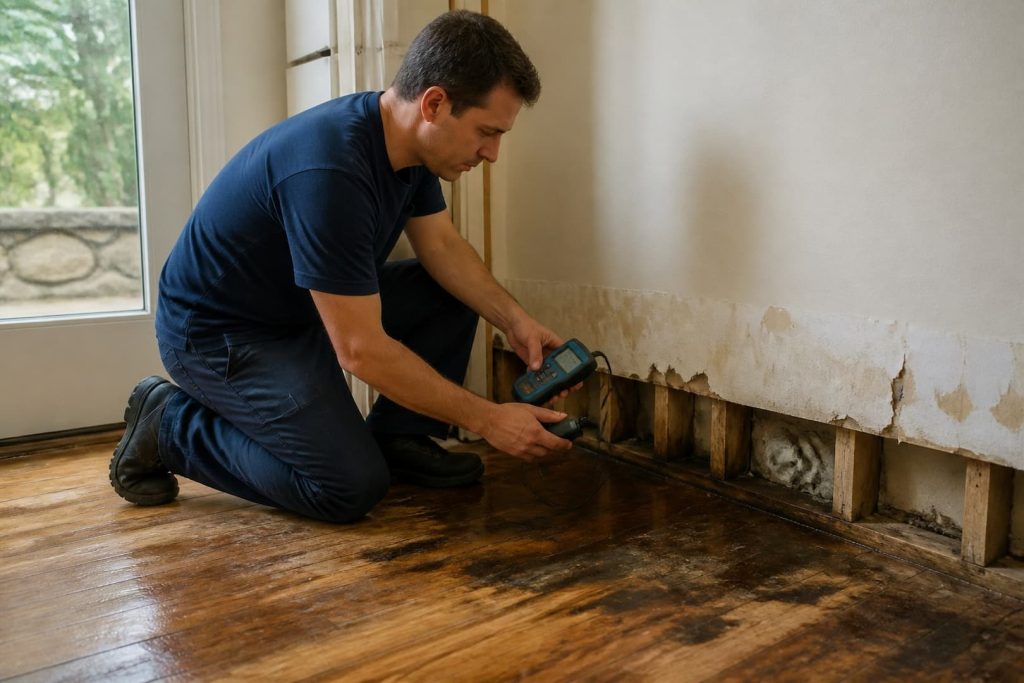
Do not re-enter a fire-damaged kitchen until the fire department or responsible authority permits it. A fire that looks limited to a pan or oven can affect wiring, gas connections, cabinets, the range hood, ductwork, ceiling cavities and structural members. Suppression water and extinguisher powder create a second cleanup problem.
Once entry is cleared, resist the urge to wipe a test patch. Oily cooking soot, dry smoke, protein residue and extinguisher agent respond differently. Rubbing the wrong surface can drive residue into paint, wood grain, grout, plastic or fabric and make the restoration more difficult.
First actions after clearance
- Confirm utility status. Do not restore gas, electricity, appliances or HVAC until the responsible trade clears them.
- Protect access. Keep children, pets and unassigned occupants out of damaged rooms.
- Photograph before cleaning. Capture the source area, cabinets, ceiling, appliances, contents, adjoining rooms and water path.
- Notify the insurer. Ask about emergency mitigation, food, contents, temporary housing and preferred documentation.
- Address standing water. Fire suppression can wet floors, walls, insulation and the level below.
- Prevent cross-contamination. Do not carry uncovered soot-covered items through clean rooms.
- Obtain a restoration scope. Identify residue type, affected surfaces, contents and reconstruction boundaries.
What may be in the residue
| Residue | Common characteristics | Cleaning implication |
|---|---|---|
| Cooking-oil soot | Sticky, smeary, concentrated near source and hood | Degreasing and repeated controlled cleaning; avoid dry rubbing |
| Dry smoke | Fine particles from hotter, faster burning materials | HEPA removal and surface-specific dry/wet methods |
| Protein residue | Thin, often nearly invisible film with strong odor | Broad surface cleaning may be needed beyond visible soot |
| Wet smoke | Sticky, pungent residue from cooler smoldering materials | Difficult penetration and odor; material testing is important |
| Extinguisher agent | Powder or wet chemical depending on unit/system | Follow agent and equipment guidance; can be corrosive |
| Suppression water | May carry soot, debris and chemicals through assemblies | Extract, classify, clean and dry as a combined loss |
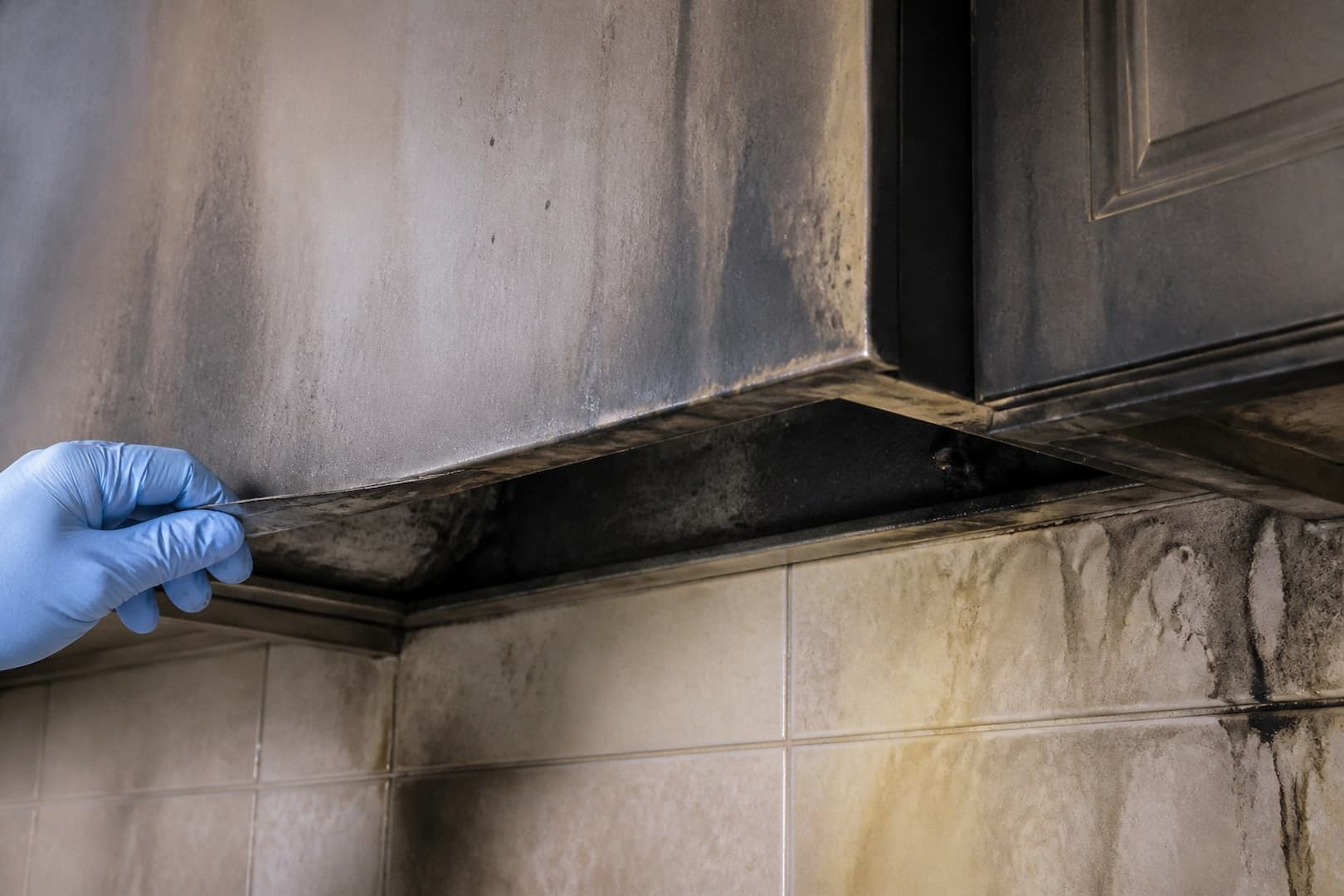
Residue can be acidic or corrosive, especially when combined with humidity. Metal finishes, electronics and appliance components may deteriorate after the fire. Prioritize stabilization based on material sensitivity rather than cleaning the most visible wall first.
Food and medicine decisions
Discard food directly exposed to heat, smoke, soot, firefighting chemicals or unsafe temperatures. Open packages and items in permeable packaging are poor candidates. Heat can also affect sealed containers, and residue can contaminate lids and threads. Follow public-health, insurer and manufacturer guidance rather than tasting or relying on smell.
Do not use medications exposed to heat, smoke, soot or water until a pharmacist or healthcare professional advises. Photograph and list discarded food and medicine when the claim may cover them.
Appliances and utilities
A refrigerator may keep food cold during an outage for a limited time only if unopened, but fire heat, smoke or power interruption changes the decision. Ranges, microwaves, dishwashers and small appliances need qualified evaluation when heat, water or residue reached electrical, gas or insulation components. Do not plug in an item to see whether it works.
The hood and connected duct may hold grease and soot. A kitchen exhaust is not a household HVAC return, but fire residue can still enter adjacent air pathways through open doors, stack effect and the central system. An HVAC professional should evaluate affected components before operation.
Suppression water under the kitchen
Water can run under cabinets, floating floors and appliances, then follow wall and floor penetrations to the level below. A dry countertop says nothing about the subfloor. Wet particleboard cabinets, drywall, insulation and flooring may need selective access or removal.
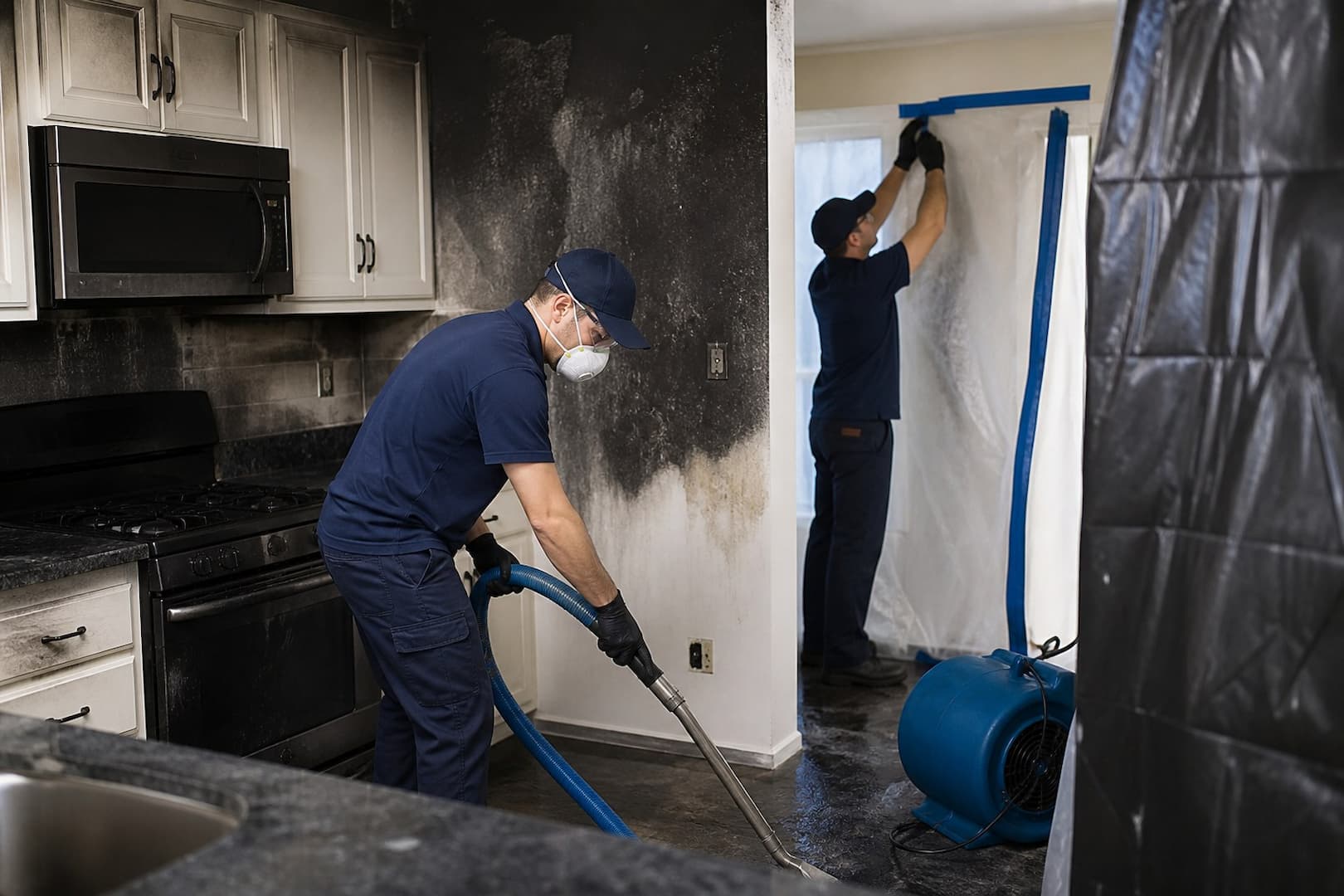
Fire and smoke restoration coordinates this combined loss: water extraction and drying occur alongside soot controls so airflow does not distribute loose residue. Electrical clearance comes before equipment is energized.
How professional cleaning is planned
- Identify and document the fire source, residue patterns and affected rooms.
- Establish clean/dirty pathways and protect unaffected finishes.
- HEPA-vacuum loose particulate where the material and condition allow.
- Test cleaning methods in inconspicuous areas before broad application.
- Clean from lighter to heavier impact while controlling wastewater and towels.
- Handle cabinets, stone, metal, glass, painted surfaces and unfinished wood with material-specific methods.
- Separate restorable contents, specialty-cleaning candidates and non-salvageable items.
- Use odor treatment only after source residue and wet material are removed.
- Verify utilities, cleanliness, dryness and reconstruction scope before return.
What not to do
- Do not enter before official clearance.
- Do not turn on the furnace, air conditioner, range hood or fans to clear odor.
- Do not wash walls with random household products or mix chemicals.
- Do not send soot-covered textiles through an ordinary washer before specialty guidance.
- Do not apply fragrance or ozone as a substitute for source cleaning.
- Do not discard high-value items before photographing and discussing specialty restoration.
- Do not paint over soot until cleaning, sealing specifications and dryness are established.
Claim documentation
Keep the fire report number, cause information when released, utility notices, photographs, food and contents inventory, emergency invoices, hotel and meal receipts, and contractor scopes. Ask whether building, contents, code upgrades, debris, water damage and additional living expenses have separate requirements.
Kitchen-fire questions
Can I clean light soot myself?
Only after clearance, utility safety and insurer guidance, and only where the residue and surface are understood. A small test with the wrong method can set a larger stain.
Is food safe if the package was closed?
Not automatically. Packaging, heat, smoke and chemical exposure matter. Follow public-health guidance and discard when safety cannot be established.
When can the kitchen be used again?
After utilities and appliances are cleared, food-contact surfaces are clean, water-damaged materials are addressed, essential ventilation works and the responsible parties release the area.
Treat the kitchen as a combined fire, smoke, food, and water loss
Even a small stovetop fire can spread residue through the hood, upper cabinets, open shelving, HVAC pathways, and adjoining rooms. Fire-department water or extinguisher powder adds another soil. The building may also have cut wiring, damaged gas connections, and wet flooring. Wait for official re-entry and utility clearance. Do not reconnect appliances or use a range hood because the flames are out.
| Loss component | Immediate question | Specialist |
|---|---|---|
| Cooking-oil soot | How far did oily residue travel? | Fire-restoration team |
| Extinguisher powder | What chemical and which surfaces/equipment were exposed? | Restorer and equipment manufacturer |
| Water below cabinets | Did it reach subfloor, wall, or level below? | Water-mitigation team |
| Heat-damaged wiring/outlets | Can circuits be energized? | Electrician |
| Gas appliance/line | Are valve, connector, and appliance safe? | Licensed gas/plumbing professional |
| Food and medicine | Was packaging exposed to heat, smoke, chemicals, or water? | Public-health guidance; discard conservatively |
Food decisions should be conservative
Smoke, heat, extinguisher residue, and firefighting water can enter packaging or settle on preparation surfaces. Discard exposed food according to public-health and insurer guidance, including items in permeable packaging and questionable refrigerator contents after power loss. Do not taste food to decide. Photograph and inventory before disposal when safe, but do not hold spoiled food indoors waiting for an adjuster.
Clean and inspect dishes, cookware, utensils, and small appliances by material and manufacturer instruction. Cracked ceramics, melted plastics, scorched coatings, and equipment with residue inside controls may not be suitable to retain. A restorer can sort categories; appliance technicians or manufacturers make equipment decisions.
Cabinet boxes hide smoke and water at their edges
Soot settles on top of upper cabinets, inside hinge recesses, beneath drawers, and behind toe-kicks. Fire-suppression water enters particleboard edges and floor seams. Doors may clean while boxes swell or retain odor. Remove components in a documented sequence so adjusters and cabinet contractors can see what failed. Stone countertops may need temporary support if damaged boxes are removed.
The under-cabinet water guide explains the same concealed floor and cabinet paths. In a fire loss, add soot control before using air movers or opening cavities.
Ventilation after a kitchen fire should be controlled
Opening windows may reduce immediate odor after authorities permit entry, but whole-house fans or the range hood can move residue into clean rooms or mechanical components. Inspect and isolate pathways first. Ventilate in a direction that does not expose neighbors or occupied areas, and replace temporary open-window conditions with a documented cleaning and HVAC plan.
Cleaning tests prevent a room-wide mistake
Identify residue and test a small representative area. Oily protein smoke, dry soot, extinguisher powder, and water stains respond differently. Start with the least aggressive method suited to the surface. Washing dry soot into flat paint or unfinished wood can deepen staining. Abrasive scrubbing can remove cabinet sheen and appliance markings.
- Photograph residue patterns before cleaning
- Protect clean rooms and HVAC openings
- HEPA-vacuum compatible loose particulate without smearing
- Test cleaner and dwell time on each finish
- Clean from cleaner zones toward heavier contamination
- Address hidden edges, hardware, and contents
- Seal or repaint only after cleaning and dry-surface acceptance
Fire and smoke restoration should record these tests. The article on smoke odor removal explains why deodorization comes after source cleaning.
Reconstruction begins with utilities and assemblies
Before installing cabinets or finishes, confirm electrical and gas repairs, hood exhaust, structural condition, wall and floor dryness, and cleaning acceptance. Replace fire-stopping and penetrations disturbed during access. Keep appliance, cabinet, countertop, flooring, and painting scopes coordinated; the sequence can otherwise damage new work or conceal wet subfloor.
Classify the event before classifying the residue
A cooking flare-up, self-cleaning oven event, appliance electrical fire, grease fire, cabinet fire, and fire that entered a hood or wall cavity require different investigations. Record the appliance, fuel, cookware, suppression method, alarm or sprinkler activation, fire-department actions, and every surface where flame, heat, smoke, water, or extinguisher agent traveled. Do not reconnect or discard the suspected appliance until the responsible investigator, insurer, electrician, gas fitter, or manufacturer releases it.
| Event clue | Hidden concern | Specialist question |
|---|---|---|
| Fire at pan or cooktop | Heat to hood, cabinets, backsplash, wiring, gas connection | Did heat or flame enter adjacent assemblies? |
| Oven or appliance fire | Internal wiring, insulation, controls, receptacle | Can equipment be tested or must it be retained? |
| Flame entered hood | Grease duct, filters, cabinet void, wall/roof termination | How far did residue and heat travel? |
| Extinguisher discharged | Dry/wet chemical in crevices, electronics, food zone | Which agent and cleanup method apply? |
| Sprinkler or hose water | Wet ceiling, cabinets, floor, electrical systems | What combined-loss controls are required? |
Keep food safety outside the restoration guesswork
Discard exposed food according to public-health and insurer guidance when heat, smoke, soot, water, or extinguisher agent may have reached it. Containers can fail at lids, cardboard seams, plastic films, and refrigerator seals even when the food looks normal. Do not taste food to test it. A public-health authority or qualified food-safety professional should answer commercial-kitchen or regulated inventory questions.
Clean dishes and food-contact surfaces only with methods and products appropriate to the material and residue. Porous cutting boards, open packages, spices, oils, paper goods, and small appliances with inaccessible interiors deserve conservative decisions. Photograph and inventory before disposal when safe and relevant to the claim.
Read soot and smoke by combustion conditions
| Residue pattern | Common behavior | Cleaning implication |
|---|---|---|
| Dry, powdery smoke | Can spread and embed under pressure | HEPA capture and dry methods may precede wet cleaning |
| Oily cooking/protein film | Thin, sticky, sometimes nearly invisible | Degreasing tests and oblique-light inspection |
| Wet smoke from smoldering plastics/rubber | Strong odor, smeary, penetrating | Material compatibility and possible removal/sealing |
| Extinguisher powder | Fine particles enter hinges, appliances, seams | Agent identification and controlled capture |
| Water plus soot | Creates runs, mud-like deposits, corrosion | Combined water extraction and residue control |
These are working descriptions, not laboratory categories. The restorer should test each representative finish rather than use one sponge or detergent throughout the room. Stainless steel, painted cabinets, stone, grout, glass, plastic, unfinished cabinet interiors, and electronics can react differently to the same residue.
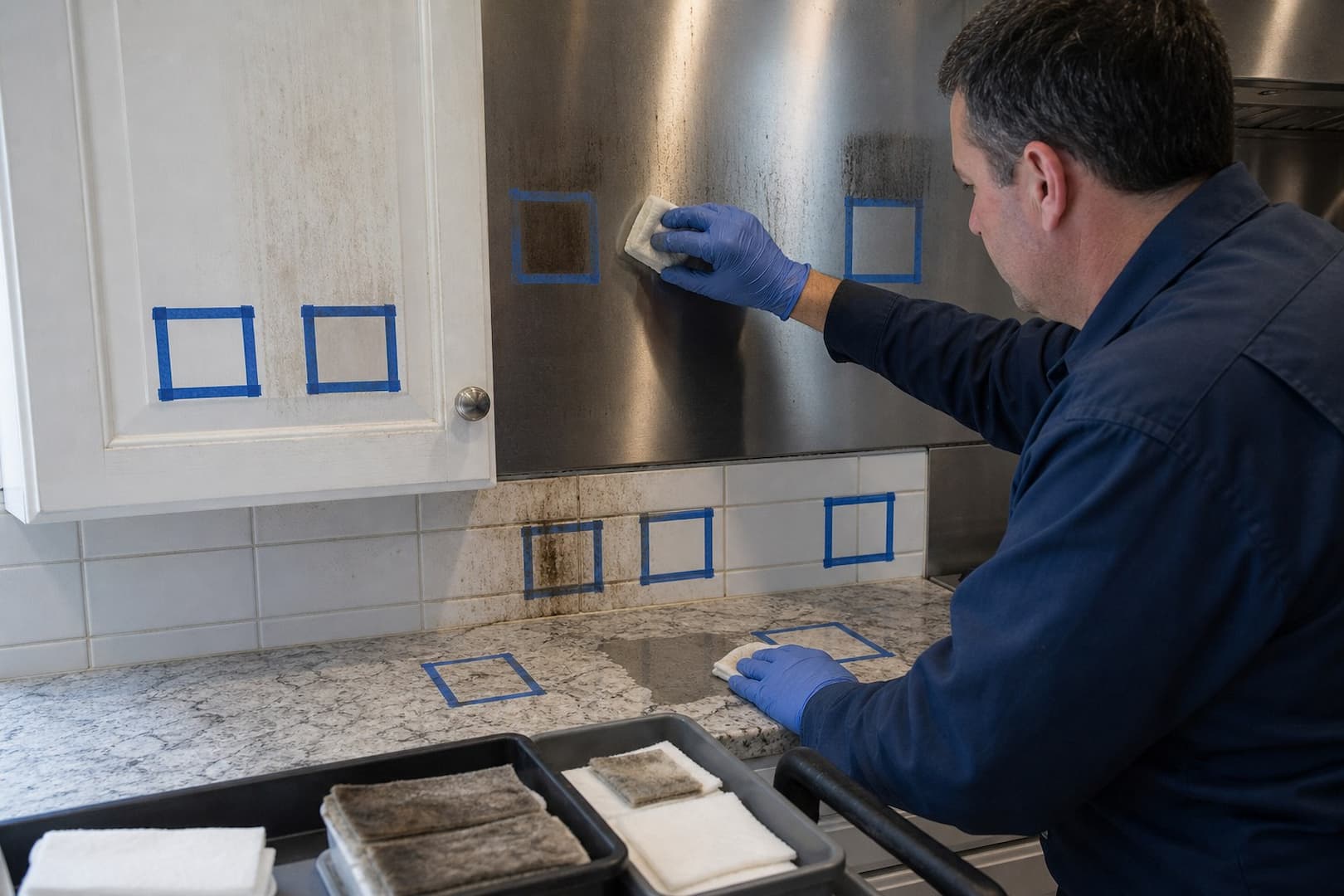
Inspect the hood, duct, cabinets, and wall cavity
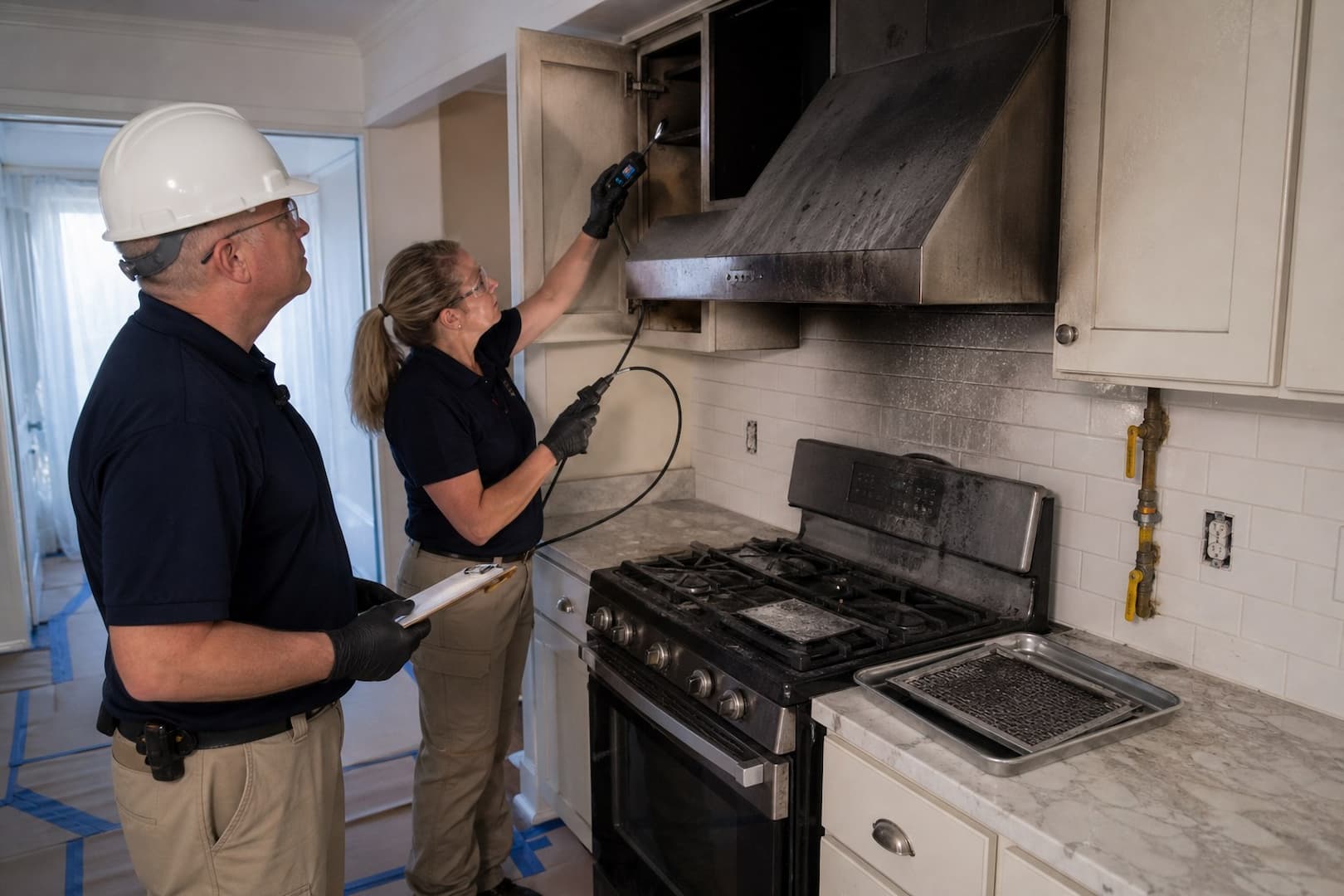
Remove hood filters only after utilities and evidence are addressed. Grease and soot can collect in the blower, housing, duct, roof or wall termination, and the cabinet above. Heat can affect flexible duct, wiring, fasteners, fire blocking, insulation, and finishes outside the visible burn mark. A hood or duct specialist may be required, especially in a commercial kitchen.
Cabinet face frames can survive while unfinished box interiors or composite cores absorb oily residue and suppression water. Inspect shelf-pin holes, hinges, toe-kicks, crown voids, wall fasteners, and countertop seams. Stone can transmit heat and bridge damaged boxes, so cabinet removal may require support and coordination.
Handle utilities and appliances as separate assets
- Electrical: affected receptacles, circuits, lights, hood, appliances, and wiring require qualified evaluation
- Gas: valves, connectors, appliance controls, combustion, and pressure tests stay with the licensed gas/plumbing trade
- Ventilation: hood, blower, duct, make-up air, and fire suppression require appropriate specialists
- Water: sprinkler, hose, or plumbing water creates a drying scope
- Refrigeration: food disposition and appliance power history should be documented
- Structure: char, section loss, cabinet attachment, and wall/ceiling damage may need contractor or engineering review
Set a room-by-room contamination boundary
Smoke can leave the kitchen through HVAC, door gaps, stairwells, open plans, and pressure pathways. Inspect adjacent rooms, cabinets, closets, return grilles, and the level above before confining cleaning to the origin. Protect confirmed clean areas and establish worker and debris routes. Do not run the central system simply to clear odor.
Use directional light, white-cloth transfer tests appropriate to the finish, odor mapping after source removal, and photographs at consistent angles. Avoid aggressive testing on delicate coatings. For a widespread loss, create a surface inventory by room and material so acceptance is not based on a quick walkthrough.
Sequence cleaning, drying, and deodorization
- Release and document the scene. Preserve origin evidence and failed equipment.
- Stabilize utilities and structure. Coordinate electrical, gas, fire, and water hazards.
- Remove unsalvageable source material. Control debris and cross-contamination.
- Capture loose particulate. Use methods suited to the residue and surface.
- Clean with tested chemistry. Work systematically and manage rinse water.
- Dry wet assemblies. Verify cabinets, walls, floor, and ceiling layers.
- Reassess odor and staining. Deodorize or seal only after source removal and cleaning.
- Verify and rebuild. Restore utilities and food-contact areas through the responsible parties.
Define completion by function
A kitchen is not ready because it smells better. Confirm that fire and origin investigations are complete, utilities and appliances have documented dispositions, transferable soot is removed, food-contact surfaces are addressed, wet materials meet moisture criteria, HVAC and hood systems are accepted, and cabinets or structure are stable. Any encapsulating coating must be compatible and applied only to cleaned, dry, suitable material.
Keep photographs, inventories, cleaning tests, product records, equipment reports, contents decisions, and clearances. A thorough file helps distinguish what was cleaned, what was replaced, and why–and keeps a cosmetic finish from concealing an unresolved utility or residue problem.
Sources and further reading
- U.S. Fire Administration: After the Fire — Returning to Normal
- American Red Cross: Cleaning Up After a Fire
- American Red Cross: Disaster Cleanup and Repair for Your Home
- Massachusetts Division of Insurance: Frequently Asked Questions Following a Disaster
After the flames are out, the residue remains
Boston Restoration Group can document affected rooms, stabilize water and soot conditions, clean salvageable structure and contents, manage odor and coordinate the path to reconstruction.