
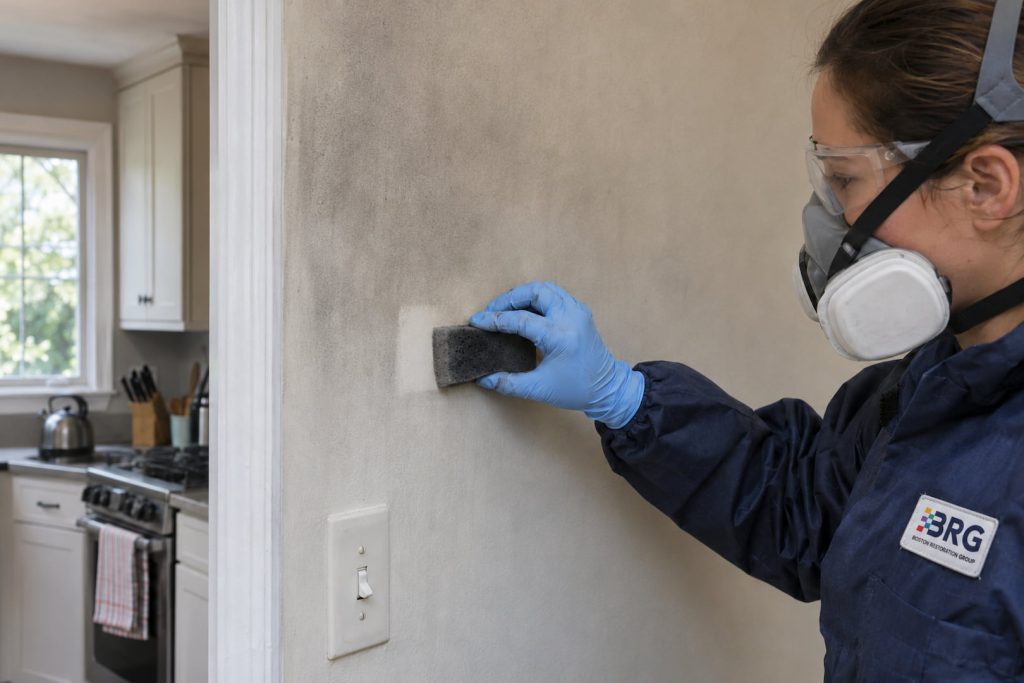
To clean soot off a wall, first identify the source, confirm that the area is safe, and test a method that suits the residue and the finish. Loose, dry soot may respond to a dry soot sponge. Greasy smoke residue often needs a compatible cleaning product and a different technique. Starting with a wet cloth can turn a light deposit into a smear that is harder to remove.
A small candle mark on sound paint is a different job from walls coated after a room fire or furnace puffback. Widespread deposits, strong odors, heat damage, wet walls, or uncertain combustion sources call for professional assessment. The aim is to remove residue while preserving a serviceable surface, then decide whether repainting or replacement is needed.
Find out why the soot is there before cleaning it
If the mark appeared above a candle, stop using the candle in that location and inspect nearby surfaces. If soot is appearing without an obvious source, look for a pattern from a safe position: deposits around a heating register, above a fireplace, or across several rooms can point to a different problem. Dark wall marks can also be dust deposition or another material. Appearance alone does not identify the cause.
An active fire, smoke, gas odor, or carbon-monoxide alarm requires leaving the area and contacting emergency services. Do not troubleshoot a combustion appliance or continue running a furnace suspected of spreading soot. The appropriate heating technician or other qualified trade must address the source before cosmetic cleaning makes sense.
After a building fire, wait for the fire department to permit entry. Permission to enter does not mean every room, electrical circuit, or surface is ready for household cleaning. The U.S. Fire Administration’s recovery guide also recommends arranging written estimates and speaking with the insurer before committing to restoration work.
Match the residue to the surface
The word soot covers deposits that behave differently. A powdery layer can transfer at the lightest touch. An oily film may spread when rubbed and resist a dry sponge. Some cooking-fire residue has little visible blackening even though the odor persists. A successful test in one room does not automatically establish the method for the next.
| What you find | Why the method changes | Useful next step |
|---|---|---|
| Light, dry deposit on intact paint | Water or rubbing may drive particles into the finish | Test an appropriate dry soot sponge in an inconspicuous area |
| Sticky or greasy residue | Dry wiping may smear the deposit rather than lift it | Have a compatible detergent method tested |
| Flat paint, wallpaper, or delicate decoration | The finish may stain, abrade, lose color, or release at seams | Stop if the test changes the finish; seek specialty advice |
| Blistered paint, char, soft drywall, or loose plaster | Cleaning cannot restore heat damage or lost material strength | Assess removal or repair before decorating |
| Widespread soot or residue inside cavities | Visible wall surfaces are only part of the affected area | Request a fire-restoration scope that follows the smoke path |
Wall condition matters as much as paint type. Even washable paint may fail if heat weakened its bond or water softened the paper beneath it. On textured walls, soot can lodge in recesses that a flat sponge cannot reach. Do not keep increasing pressure to force a method to work.
What you can do while arranging an assessment
Keep children and pets out of affected rooms. Avoid touching stained walls, sitting on soiled upholstery, or moving dirty items through clean rooms. Photograph deposits and damaged finishes from a safe position before cleaning a test area. Those records help the restorer and insurer understand the original condition.
Do not sweep soot, blow it off surfaces, or use an ordinary household vacuum. Disturbing a fine deposit can spread it onto belongings and into other rooms. A professional may use suitable HEPA-filtered equipment and controlled methods; having a vacuum with a filter does not by itself make the whole machine or technique suitable for fire residue.
Leave suspected contaminated HVAC equipment off until the relevant professional assesses it. Opening windows or using fans can also change where residue travels. Ventilation after a small, contained candle mark and ventilation in a fire-damaged building are different decisions. For a broader loss, include airflow and clean-area protection in the cleanup plan.
For a small, dry soot mark: begin with a controlled test
Limited cleaning may be reasonable when the source is known and stopped, the wall is sound, access is safe, and the deposit is small. Wear gloves and eye protection appropriate to the task and product. Anyone with health concerns about soot exposure should avoid the work and get advice relevant to their circumstances. Household protective equipment is not a substitute for assessing a fire-damaged room.
Have the dry soot sponge, a clean protective covering for the floor, and a bag for used materials ready before touching the mark. Keep a fresh sponge face available. If the test needs repeated scrubbing or a stronger product to make any progress, pause instead of turning a small patch into a larger cleaning experiment.
- Protect the area below. Keep the work confined so loose particles do not fall onto clean furnishings or carpet.
- Choose a small, inconspicuous test area. Check that paint, paper, or plaster is not loose, blistered, damp, or crumbling.
- Use a product intended for dry soot removal. Follow its directions. A dry-cleaning soot sponge is different from an abrasive eraser or a damp kitchen sponge.
- Work gently with a clean sponge face. Follow the product’s application directions and avoid repeated hard scrubbing. Move to a fresh face when soot accumulates; renew or replace it as the instructions direct.
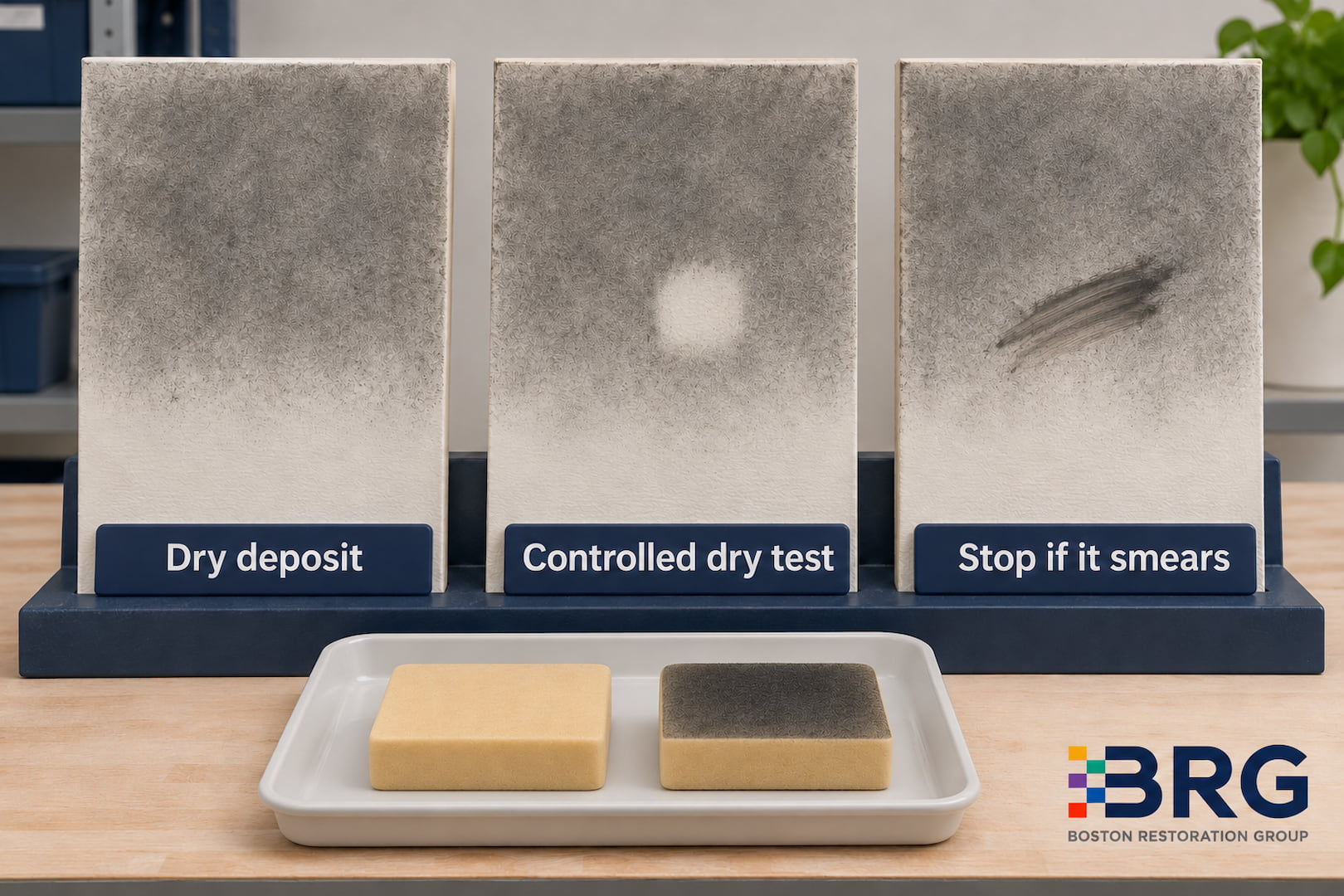
- Inspect the result before expanding the area. Stop if the mark smears, the paint transfers, the sheen changes, or the wall surface breaks down.
For example, Legend Brands describes its soot sponge as a dry-use product. That does not mean every wall tolerates it. Product suitability and a successful test must both be established. Wetting a sponge intended for dry cleaning changes the method and can defeat the reason for choosing it.
Keep the test modest. A small clean patch is useful evidence, but it does not prove that a whole fire-damaged room needs only a sponge. If the underlying wall is wet, heat-damaged, or affected on the back, surface cleaning alone will leave part of the loss untouched.
Inspect the patch from an angle as well as straight on. A lighter mark may hide a polished patch in flat paint or a newly rough surface. A remaining stain with no loose residue is a different problem from soot that still transfers. Record the test location and product so the next person working on the wall knows what has already been tried.
When the deposit needs wet cleaning
Greasy smoke films can require a cleaner selected for the residue and the substrate. The product label should identify the surfaces it suits, dilution if applicable, protective equipment, ventilation, dwell time, and whether rinsing is required. Follow that product’s instructions rather than combining several online recipes.
Do not mix cleaners, bleach, ammonia, acids, or solvents. More chemical strength is not a reliable solution to an incompatible method. A product that removes grease from tile may damage paint, natural stone, metal, or a cabinet coating. Test each relevant material separately and protect adjoining finishes.
On a wall approved for wet cleaning, control the amount of liquid and work in manageable sections. Keep solution away from outlets, switches, damaged seams, and open cavities. Do not soak drywall or let dirty runoff streak across a surface that has already been cleaned. If the coating loses color or becomes tacky, stop and reassess the method.
Different restoration products have different instructions. Some require rinsing; others do not when used as directed. The manufacturer’s instructions for a smoke-residue wall cleaner illustrate why a universal detergent recipe is unreliable. A restorer should explain the method chosen for your finish and the result of the test.
Do not switch to bleach, vinegar, or an abrasive eraser simply because a stain remains. None establishes that the surface is ready to repaint. Bleach is not a substitute for removing smoke residue, and a cleaner that changes paint color can make a stain appear lighter while damaging the finish. Return to the test result: is the obstacle loose soot, an oily film, residual staining, or a damaged coating?
Why rubbing harder often costs more
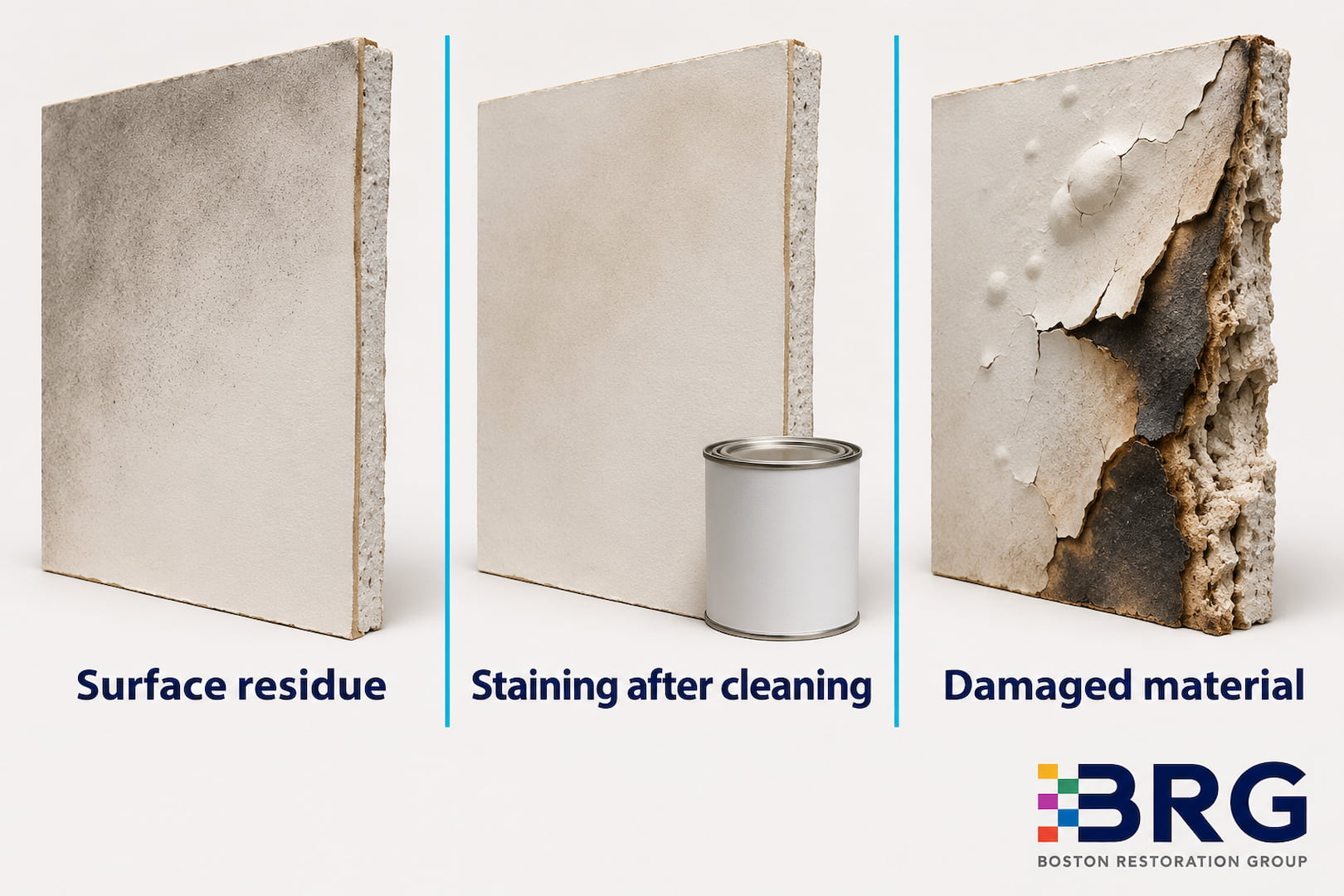
A soot stain can remain after the loose particles are gone. Aggressive rubbing may then remove paint rather than remove the remaining discoloration. A shiny patch on a flat wall, exposed drywall paper, or a worn decorative finish creates another repair task even if the dark mark becomes lighter.
Abrasive erasers and sanding are especially poor default choices when the surface and coating history are unknown. In older homes, disturbing paint can introduce lead hazards. EPA’s lead renovation guidance explains why work on pre-1978 painted surfaces needs appropriate precautions; Massachusetts administers its own authorized program. Suspect textures or other materials may need separate assessment before disturbance.
Stop the test before it becomes a repair. With valuable wallpaper, murals, ornamental plaster, or historic finishes, a conservator or specialist may be the right person to evaluate cleaning. Replacing a wall finish can be straightforward; replacing an original decorative surface may not be.
Can you paint over soot?
Painting directly over a dirty, greasy, wet, or damaged wall is unlikely to give a dependable result. Residue can interfere with adhesion or leave stains and odors that return through the finish. First establish that cleaning is complete enough for the intended coating and that the substrate is dry and sound.
After cleaning, the painter may specify a compatible stain-blocking primer or specialty sealer. KILZ’s restoration-primer instructions, for example, require thorough cleaning and repair before priming fire-damaged surfaces. A product’s smoke-stain or odor-blocking claim does not remove that preparation step. Ask which coating system will be used and what preparation, drying, or cure conditions it requires.
Replacement becomes more likely when drywall paper is charred or deteriorated, plaster has lost its bond, insulation holds contamination, or a surface cannot be cleaned without destroying it. Those decisions should follow the material’s condition and access needs. The fact that one wall can be repainted does not mean every affected assembly can remain.
A clean-looking wall can still sit in a smoky room
Smoke can reach the tops of trim, the backs of cabinets, closets, soft furnishings, and other surfaces beyond the obvious stain. If odor remains after the wall is cleaned, investigate those reservoirs before adding fragrance or another coat of paint. The American Red Cross notes that smoke odor and soot can be difficult to remove and may need professional restoration.
BRG’s odor-removal service starts with the source and affected materials. An odor treatment cannot compensate for oily residue left in a cabinet or smoke-affected material sealed inside a cavity. Ask which materials have been inspected and which remain inaccessible.
If firefighters used water or the event involved a sprinkler discharge, the room may also need water damage assessment and drying. Repainting should wait until retained materials are ready, even when the soot-cleaning work finishes first.
What to ask a fire-restoration contractor
- Which rooms and surfaces show residue, including areas away from the visible fire damage?
- What did the cleaning tests show about the paint, wallpaper, trim, and other finishes?
- Which materials can remain, and why are others being removed?
- How will unaffected rooms and belongings be protected?
- Does the scope include hidden surfaces, odor sources, drying, and later repainting?
- What condition will the contractor document before handing the room over for repairs?
For soot that extends beyond a small, known surface mark, Boston Restoration Group can assess the affected materials and explain the cleaning and repair scope. Request fire and smoke damage restoration in Greater Boston and describe the source, rooms involved, visible residue, and any remaining odor or moisture.