
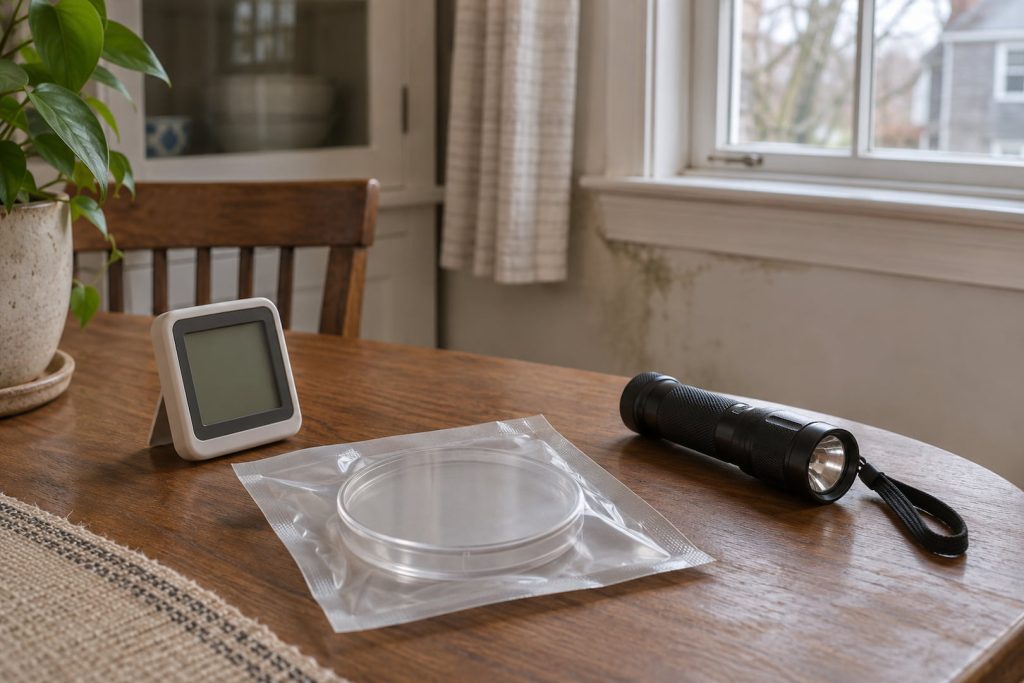
Home mold test kits can detect mold in the material they collect, but they usually cannot answer the question homeowners care about: whether a building has a moisture-related growth problem, where it is, and what needs to be repaired. A positive culture dish does not diagnose the house. A negative result does not clear every wall cavity.
Before buying a kit, write down what you would do differently after each possible result. If you can already see growth on a damp wall, the moisture and material need attention either way. If an unexplained odor is the concern, finding its source generally requires a building investigation rather than a dish left in the room.
Different kits answer different sample questions
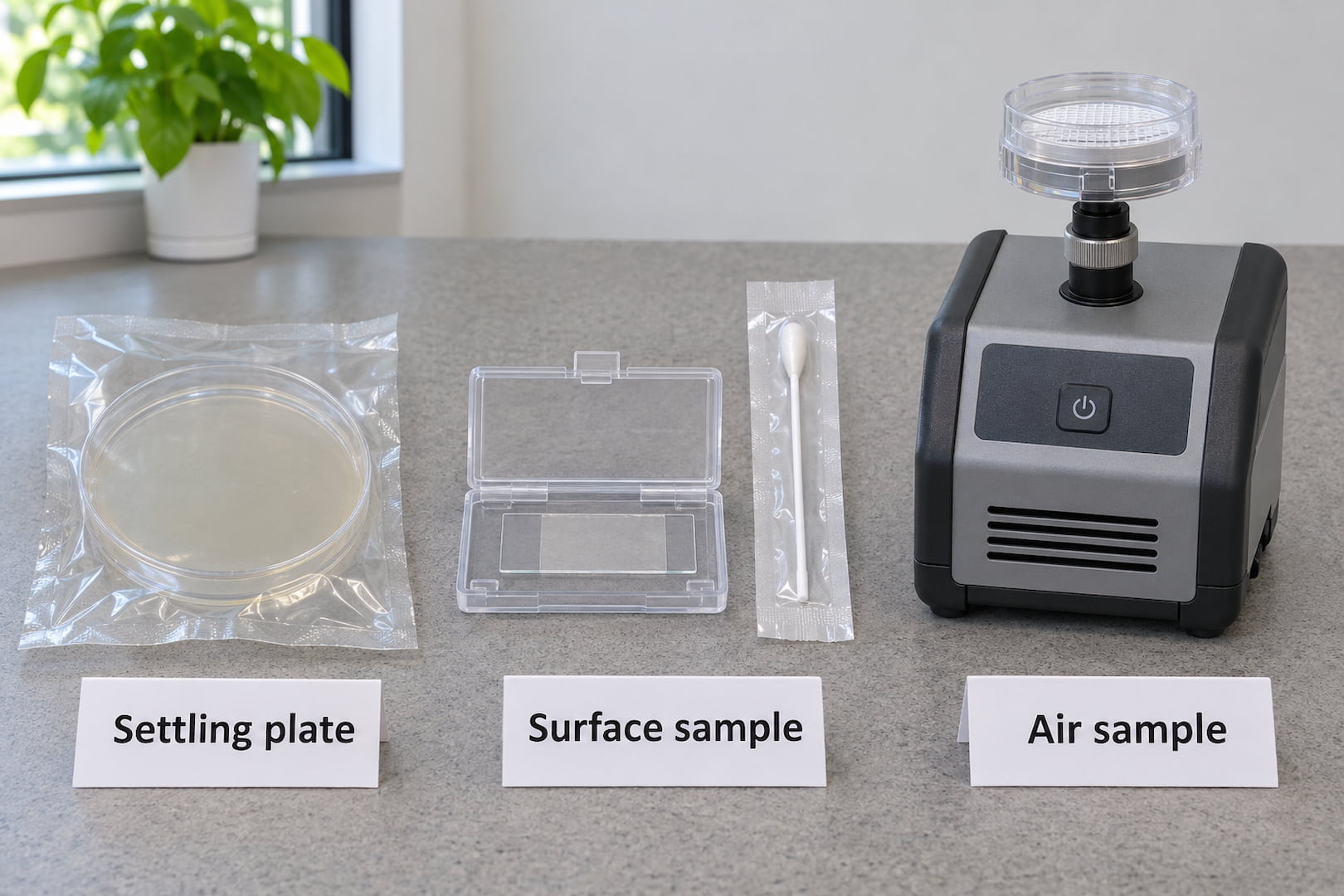
The words ‘mold test’ cover several collection and analysis methods. Some kits grow organisms on a nutrient medium; others send a surface or dust sample to a laboratory. A professional air sample may use a pump and a defined collection method. Those results are not interchangeable, even when every report uses the word mold.
| Method | What it collects or examines | Main limitation for a homeowner |
|---|---|---|
| Settling plate or culture dish | Particles that settle onto a growth medium during exposure | Growth reflects what reached the dish and could grow under its conditions; it does not locate a building source. |
| Surface swab or tape sample | Material from a selected reachable spot | The result describes that sample, not the entire room or hidden assembly. |
| Pump-based air sampling | Airborne material collected at a location over a specified period | A time-limited measurement needs a defined protocol and inspection context. |
| Dust sample or DNA-based analysis | Selected fungal material in collected dust | The result depends on the sampled dust and method; it is not automatically a present-tense health assessment. |
| Moisture meter or humidity monitor | Material moisture response or room-air humidity | These are building-condition tools, not mold identification tests. |
Ask the seller what the package price includes. Collection supplies, laboratory analysis, shipping, additional samples, and interpretation may be separate charges. A detailed-looking laboratory page can still leave the practical building questions unanswered if nobody evaluated the source or selected samples to address it.
If analysis is included, identify the laboratory and its relevant accreditation rather than relying on the words laboratory tested. AIHA Laboratory Accreditation Programs’ environmental microbiology program, for example, covers defined analytical work on air, surface, and bulk samples. Accreditation concerns the laboratory’s capability for its scope of testing. It does not approve your collection location, certify a house as safe, or turn a kit seller’s interpretation into a building inspection.
Why a petri dish often grows mold
Spores occur in ordinary indoor and outdoor environments. A culture dish supplies conditions that encourage organisms capable of growing on its medium. The University of Connecticut’s guidance on do-it-yourself mold plates explains why growth in a dish can give a misleading impression of a building problem and cannot identify the source of those spores.
The dish does not tell you whether particles came from outdoors, dust, belongings, or growth in a building assembly. It also favors organisms that grow under that test’s conditions. Counting the colonies or comparing their colors is therefore not a reliable way to rank rooms from safest to most dangerous.
Do not open a grown culture to smell it, scrape it, or identify it by touch. Follow the kit’s handling and disposal instructions. If you already purchased one, keep the result with its collection details, but do not let the dish replace an inspection of the actual concern.
What positive and negative results leave unresolved
A positive result means the method detected something within its scope. It does not automatically prove active indoor growth, establish the size of a cleanup, or identify a medical risk to an occupant. A surface sample from visible growth may confirm the character of that spot while saying little about the back of the wall.
A negative result has limits too. The sample may not represent a concealed area, intermittent condition, different room, or another time of day. A report should describe those limits instead of turning an absence in one sample into an assurance about the whole house.
The CDC’s NIOSH mold guidance cautions that short-term air measurements may not represent exposure and cannot be interpreted as health-risk thresholds. A household member’s symptoms belong with a healthcare professional. Environmental testing does not diagnose the cause of those symptoms.
A product advertised as a black mold test deserves the same scrutiny. Ask exactly what it detects. Identifying a mold associated with toxin production is not the same as measuring mycotoxins, and either finding still needs appropriate interpretation. The Minnesota Department of Health explicitly distinguishes mold testing from mycotoxin testing. Neither a species name nor a colony’s color establishes that a particular occupant has been harmed.
Read the method before the number
Start with the sample identifier and collection location, then check the method and units. Those details tell you what the result describes. A report for a tape lift from a cabinet back cannot be compared directly with a room-air culture, even if both contain a large number or the same organism name.
| Report term | What to check before drawing a conclusion |
|---|---|
| CFU or colony-forming units | A culture result: organisms had to grow under the test conditions. It is not a count of every mold particle present. |
| Spore count | Which collection and counting method was used, over what period, and in which units? Do not treat it as interchangeable with a culture result. |
| Not detected | What was the method capable of detecting in this particular sample? The statement does not describe every concealed surface. |
| Elevated or abnormal | Which comparison or decision rule produced that label? Ask for the reasoning; it is not automatically a federal health limit. |
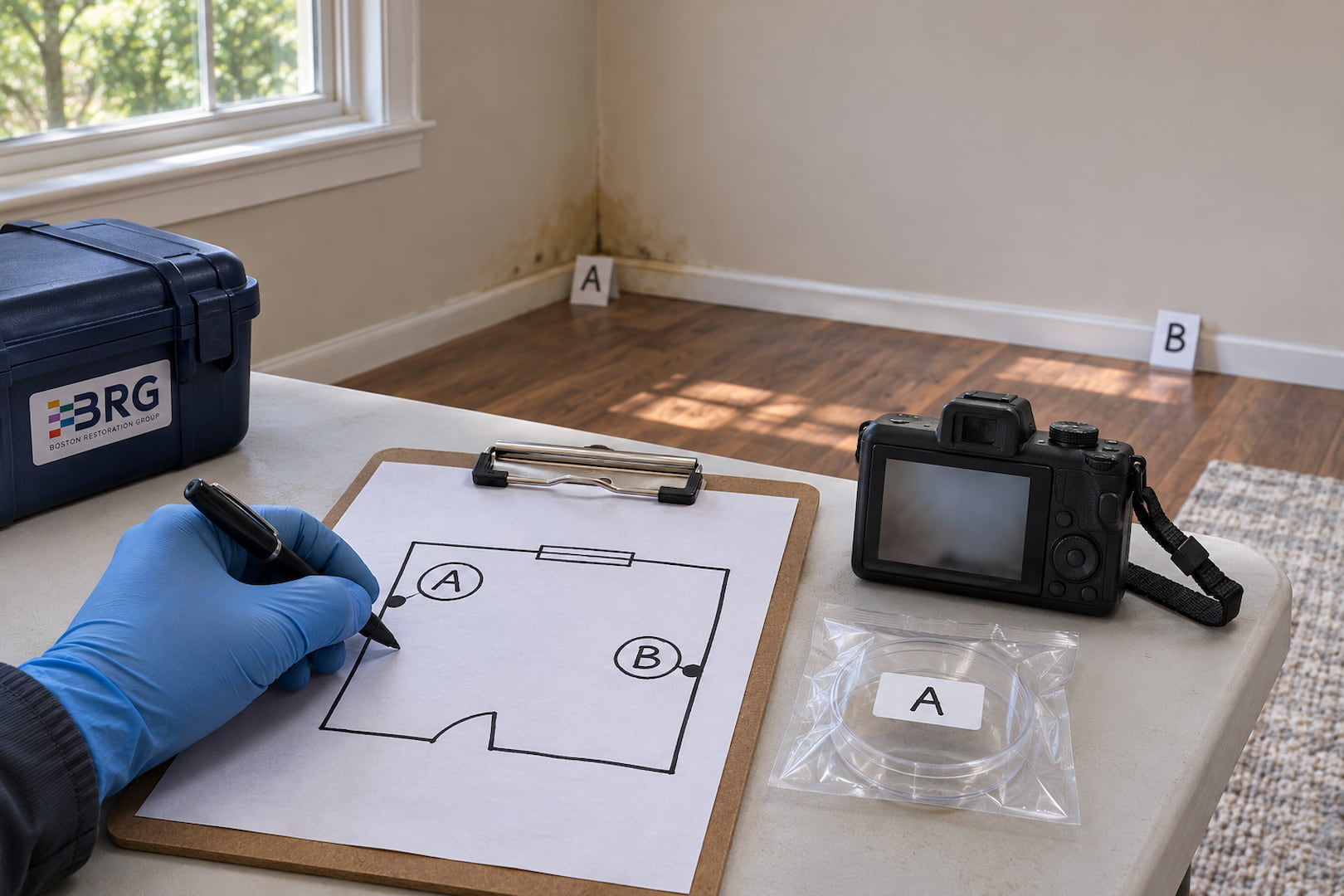
| Sample A or another identifier | Does the identifier match the collection record, location, date, and material you intended to test? |
Keep the laboratory’s qualifiers and interpretation notes with the result. A copied number without those details can lose its meaning. If a report does not identify its method or where the sample came from, ask for the missing information before using it to plan removal or challenge a completed cleanup.
Visible growth often does not need a test first
The EPA says sampling is unnecessary in most cases where visible mold is present. It also notes that there are no federal limits for indoor mold or spores against which to certify a building. The priority is to understand the material, moisture, and extent rather than wait for a species name before fixing a leak.
This does not mean every dark mark should be called mold without examination. An unusual deposit may need identification when that answer changes the proposed work. The distinction is the purpose: confirming the nature of a specific suspect material is a narrower question than testing a room to declare it safe.
For visible growth that extends into building materials, mold remediation planning can establish the affected boundary, appropriate controls, and cleaning or removal decisions. A laboratory result is one possible input, not a required first purchase for every project.
What a useful inspection does before sampling
A useful visit starts with the concern: a leak, visible patch, recurring odor, purchase question, or unfinished cleanup. The inspector reviews when it began, which rooms are involved, what repairs or cleaning occurred, and whether the condition varies with weather or building use. Those details guide where to look.
Accessible surfaces and surrounding materials come next. Moisture measurements, the construction, and safe access can help explain why a wall base or cabinet stays damp. If an opening is warranted, the plan should account for utilities, possible hazardous materials, dust control, and authorization before anything is disturbed.
No tool sees through every wall. A moisture meter does not identify organisms, and a thermal camera shows temperature patterns rather than a picture of mold. Findings should distinguish direct observation from an inference and state which areas remain inaccessible.
BRG’s mold inspection and testing service starts with that building context. Ask which unresolved question a proposed sample will answer, how the result could change the plan, and whether a separate assessor is appropriate for the assignment.
When professional sampling can be useful
Sampling may support identification of an uncertain material, a defined investigation, or agreed verification after cleanup. A transaction or dispute may also require a particular protocol and a professional who can explain its limitations. Those purposes should be established before choosing the method or number of samples.
Consider an owner deciding whether an unusual residue on a dry surface warrants removal. A targeted surface sample might help resolve that question. Compare that with an owner who has active water dripping through a moldy ceiling: source control and an assessment of affected materials remain necessary regardless of a general room-air result.
The Minnesota Department of Health’s explanation of mold testing describes sampling as a possible part of an investigation, with limitations that require skilled interpretation. Its practical emphasis is on locating growth and moisture. A larger testing package is not automatically a more useful investigation.
What about ERMI and dust-based scores?
ERMI is the Environmental Relative Moldiness Index, developed by EPA researchers. The EPA does not recommend ERMI for use outside research. A commercially offered score should not be presented as an EPA-approved pass/fail determination for a home.
Before relying on any dust-based score, ask what dust was collected, how the sampling location was chosen, what the analysis measures, and what decision rule the provider is applying. A numeric score can look precise while the proposed conclusion extends beyond what the test supports. Do not use it by itself to authorize extensive demolition or decide whether symptoms came from the building.
Why two test results may disagree
Comparisons need compatible methods and collection conditions. A culture plate, a microscope-based air sample, and a dust analysis measure different things. Even two air samples can differ if one follows vacuuming or an open-window period and the other does not. A changing number is not automatically proof that remediation succeeded or failed.
An outdoor comparison can be part of a professional protocol, but a simple indoor-to-outdoor ratio is not a universal health threshold. Ask the assessor how background conditions, the types of material detected, collection locations, and visual findings enter the interpretation. If the report reduces the entire property to one unexplained green or red result, request the reasoning and limitations before making a costly building decision.
Questions to ask before paying for testing
- What exact question remains after the visual and moisture inspection?
- Which sample method answers that question, and which locations will be included?
- What conditions must be recorded, such as HVAC operation, open windows, recent cleaning, or weather?
- What are the full charges for collection, laboratory work, interpretation, and a written report?
- Who will interpret the result, and what qualifications and relevant experience do they have?
- What can the result not tell us, and what would each possible finding change?
- Does the same company offer cleanup, and is independent assessment preferable for this situation?
A proposal should identify the work product you will receive. Laboratory data without sample locations, site notes, observations, and a reasoned recommendation can be difficult to use. Ask for a report that connects evidence to the next action and keeps assumptions visible.
If you already have a home test result
Keep the original report, collection instructions, date, room locations, and any photographs. Record whether windows were open, heating or cooling was running, cleaning occurred, or a leak was active. Do not repeat tests in slightly different places until you obtain a preferred result; that can create a confusing collection of numbers without resolving the source.
Describe the building concern separately from the test. If materials are wet after a leak, arrange water damage assessment and drying while the result is reviewed. If there is no visible source but an odor persists, ask for a targeted investigation. If the main concern is health, discuss it with a healthcare professional.
For post-remediation work, use the verification criteria agreed before cleanup. A new consumer kit is not a substitute for reviewing cleaned surfaces, material moisture, source repair, and any planned independent evaluation. Changing methods after the work can make comparisons less meaningful.
Get an answer that leads to a building decision
Boston Restoration Group can review a mold or moisture concern in Greater Boston and discuss whether inspection, targeted sampling, or remediation planning fits the situation. Send the affected rooms, visible conditions, leak or odor history, prior work, and any existing report. The first objective is to identify what still needs an answer.