
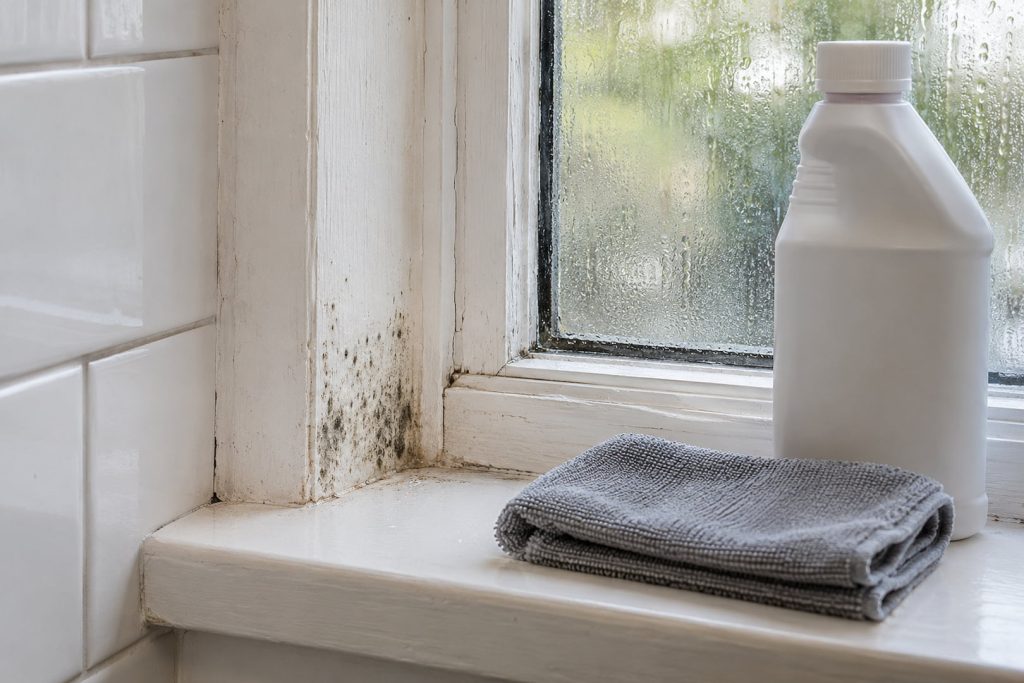
Bleach can kill susceptible mold when an appropriate product reaches it under the conditions on the label. That does not make bleach a complete treatment for a moldy wall, cabinet, or floor. Killing organisms, removing the affected material, and correcting moisture are separate tasks. A stain that fades after spraying tells you very little about the condition behind the surface.
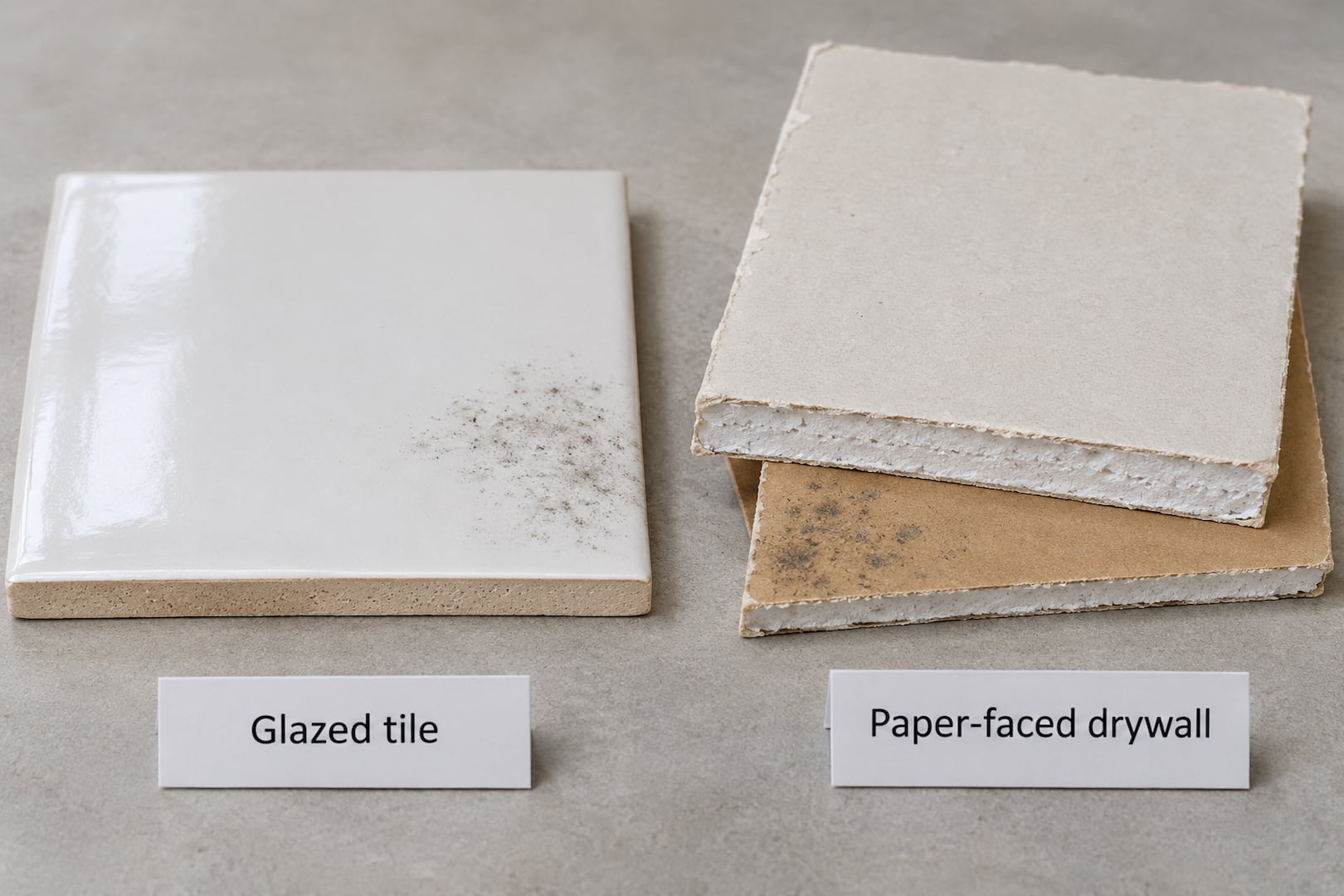
For ordinary household mold cleanup, the more useful question is whether the material can be cleaned and dried. A small patch on intact glazed tile has different options from growth in drywall paper or a swollen cabinet base. Choosing a stronger cleaner will not solve an inaccessible wet layer.
Why EPA and CDC guidance can sound different
The EPA does not recommend biocides such as chlorine bleach as a routine mold-cleanup practice. Its reasoning includes a simple distinction: dead mold still needs removal. A chemical treatment also cannot make an occupied building permanently free of spores.
The CDC’s household mold guidance includes bleach among options for hard surfaces, alongside household products or soap and water. This is not a direction to spray every moldy building material. Read the guidance for the surface and situation it addresses, then follow the particular product’s label. Neither agency’s advice makes bleaching a substitute for repairing a leak.
A contractor may select a chemical product for a defined purpose within a larger cleaning plan. Ask what that purpose is. A proposal that lists only spraying or fogging, with no explanation of affected materials, removal, drying, or source repair, leaves the main building questions unanswered.
Match the decision to the material
| Surface or assembly | Why bleach alone is insufficient | What needs evaluation |
|---|---|---|
| Intact glazed tile, glass, or other compatible hard surface | Residue and soil still need physical removal | Extent, product compatibility, joints, and complete drying |
| Grout, failed caulk, and shower edges | Growth or moisture may extend into joints or adjoining materials | Condition of the joint, backing, and recurring water entry |
| Painted drywall | Paint can conceal damaged paper or a wet cavity | Softness, bubbling, hidden faces, insulation, and the leak history |
| Unfinished wood framing | Surface appearance does not establish the condition or cleanability of the wood | Accessible faces, moisture, finish, staining, and possible decay |
| Particleboard, MDF, and cabinet bases | A cleaner cannot reverse swelling or separation | Core damage, underside access, and replacement boundaries |
| Carpet, pad, and insulation | Liquid treatment does not reliably clean the full thickness | Contamination, depth, drying access, and removal needs |
A surface may be washable while the assembly beneath it is not. Tile bonded over damaged backing, for example, can look clean after wiping even though the backing remains wet. Inspect the edge and the adjacent room before treating the visible face as the whole problem.
For wet building assemblies, water damage assessment and structural drying may need to accompany mold work. Adding cleaning liquid to material already holding water can make the drying task harder, particularly when the back of the material is enclosed.
Read past the large claim on the front of the cleaner bottle. The directions should identify the intended use, compatible surfaces, preparation, and any required contact time. A quick mist followed by an immediate wipe may not match a labeled disinfection method. Leaving a sensitive material wet longer than directed creates a different problem. Do not transfer directions from one product to another, even if both contain bleach.
Household chlorine bleach contains sodium hypochlorite, but the word bleach alone does not establish a product’s intended use. Some laundry and splashless formulations are unsuitable for disinfection. Check the specific label rather than borrowing a dilution or contact time from another bottle. A stain-removal claim also does not explain whether the material underneath can be cleaned and saved.
Think about the water path around the patch as well. If spots sit at the base of a vanity, check whether an earlier supply leak reached the cabinet underside or adjoining flooring. If spots surround a shower door, inspect the track and the wall outside it. These are observations to share with the person assessing the damage, not reasons to dismantle an assembly without a plan.
What bleaching a stain does—and does not—show
Color is a poor completion test. Discoloration may lighten before the affected surface has been adequately cleaned. Conversely, some discoloration can remain after appropriate cleaning. Neither result, viewed by itself, tells you whether a wall is ready to close or a wood member is sound.
Keep three observations separate: visible growth or residue, cosmetic staining, and physical damage. A technician may be able to clean a firm wood surface that retains an old stain. A soft, crumbling cabinet panel can need replacement even when a cleaner removes its dark spots. Those are different decisions, and a photograph of the final color cannot resolve both.
Do not paint over a suspect area to find out whether it returns. New paint conceals the condition and can complicate later inspection. Keep the area visible until the moisture and material decisions are settled; save before-cleaning photos if it is safe to take them.
Before using any cleaner
- Identify the surface and the likely water source. Note whether the area followed a leak, condensation, flooding, or a recurring damp period.
- Check whether the visible patch is part of a larger problem. Soft finishes, a musty adjoining closet, repeated staining, or damage below the room warrant a wider assessment.
- Read the product label for the intended surface, precautions, and application method. A laundry product, bathroom stain remover, and registered disinfectant can have different uses.
- Decide who should perform the work. The extent, material disturbance, ventilation, sewage exposure, and household health concerns can make professional help appropriate.
- Plan how the surface will dry and how you will check it again. Cleaning should leave a manageable dry material, not a sealed damp cavity.
The EPA’s home cleanup guidance uses about 10 square feet as one factor in deciding whether a homeowner can handle a small job. It is guidance, not a guarantee that every smaller patch is suitable for do-it-yourself work. Sewage, extensive water damage, suspected HVAC contamination, hidden growth, and individual health concerns change the decision.
Chemical precautions that should not be improvised
Never mix bleach with another cleaner or disinfectant. That includes ammonia products, vinegar, acidic toilet cleaners, and a second product advertised for mold. Do not add bleach to a bucket that contains an unknown residue. Products used one after another on the same wet surface can also contact each other; follow label directions rather than improvising a sequence.
The CDC’s bleach safety guidance calls for ventilation, label-directed use, and appropriate protection. Keep containers labeled and away from children and pets. Stronger concentrations and longer soaking are not automatically better and can damage a finish or expose occupants to irritating vapors.
A particle-filtering mask is not a solution for chemical vapors. Do not continue spraying because you are wearing a dust mask, and do not enter a poorly ventilated closet or cavity to apply a product. If accidental mixing causes fumes, leave the area for fresh air and seek urgent help for breathing difficulty. Do not attempt to neutralize the mixture with another chemical.
If a cleaner has already been used, tell the next person who inspects or works in the area. Keep the container or take a photograph of its label. The product name, timing, and surfaces treated are more useful than saying that the room was ‘disinfected.’
A small hard-surface patch versus hidden damage
For a small patch on an intact, accessible hard surface, the EPA describes cleaning with detergent and water, followed by complete drying. That provides a practical alternative to making a stronger bleach mixture. It applies to a suitable surface-cleaning job, not sewage damage, a contaminated HVAC system, or growth extending into a wall.
- Resolve the wetting and check the surrounding material before starting. Stop if the surface is soft, separating, or connected to a larger hidden area.
- Keep other people out of the immediate work area. Use appropriate gloves, goggles without ventilation holes, and a properly fitted N95 for mold particles, following EPA precautions. An N95 does not protect against bleach vapor.
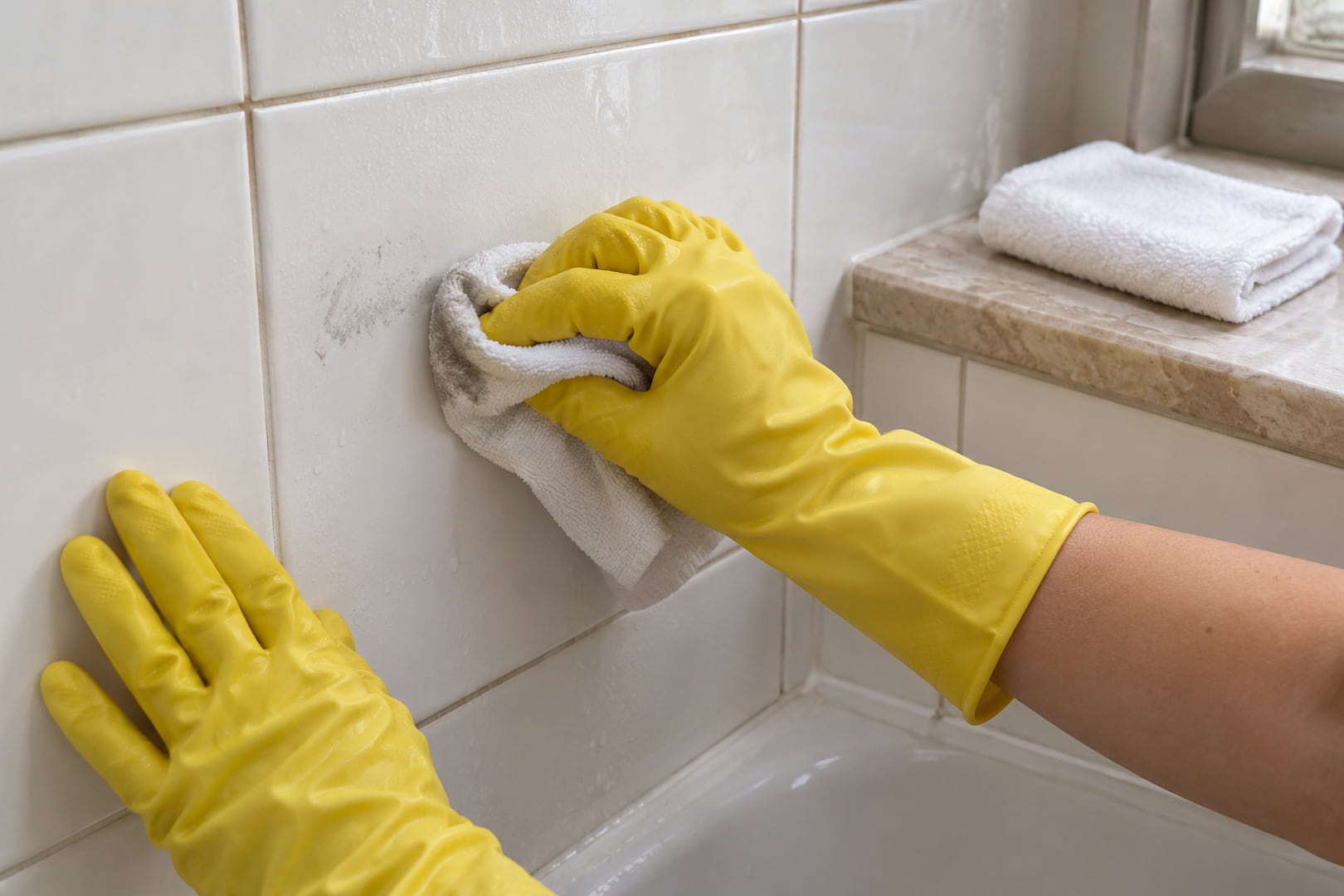
- Clean the compatible hard face with detergent and water, removing the residue with controlled wiping or scrubbing. Avoid dry brushing, power tools, or soaking the adjoining assembly.
- Follow the cleaner’s instructions for residue removal, dry the surface fully, and check the same location after ordinary use. Do not add a second chemical to the cleaning solution.
The EPA’s home mold guide describes exposure precautions as well as cleaning. If you cannot carry out that limited job without disturbing surrounding damage, leave the material in place and arrange an assessment. A cloth that picks up residue is useful evidence of removal; a bleach odor is not.
The situation changes when cleaning would require opening a wall, removing a cabinet, sanding framing, or disturbing material above a ceiling. Those actions can expose a larger affected area. Older finishes and underlying materials may also need assessment before disturbance. A spray bottle cannot replace that planning.
Arrange a mold and moisture inspection when the source or extent is unclear. Explain where the growth appears, when you first noticed it, and what cleaning has already happened. Inspection should establish the next useful action; buying a test solely to decide which cleaner to use is often unnecessary.
Why the same spot keeps returning
Repeated growth deserves a look at the conditions between cleaning sessions. Does a window stay wet overnight? Does a bathroom exhaust fan move air outdoors? Is a pipe joint still seeping inside the cabinet? Does the basement wall become damp after rain? These observations help locate the problem that a surface treatment cannot reach.
In Greater Boston homes, a winter window problem and a humid summer basement can involve different moisture paths. A room humidity reading helps describe the environment, but it does not measure every cold surface or concealed layer. Record when condensation appears and whether it changes with weather, showers, laundry, or HVAC operation.
Have the responsible trade correct the source, then check the affected materials. A plumber’s repair stops a plumbing leak; it does not establish that the cabinet bottom or wall cavity has dried. Likewise, a dehumidifier can reduce room humidity while an enclosed wet layer still needs access.
Common follow-up questions
Does bleach kill black mold?
Black color does not identify a species or determine the treatment. Evaluate the material, amount of growth, moisture, and access. A compatible product may affect exposed organisms, but dark growth in porous material still requires a cleaning or removal decision. Do not use color to label a patch harmless or dangerous.
Does bleach kill mold spores, and how long does it take?
There is no single waiting time that makes every bleach product suitable for every moldy material. Any killing claim depends on the product, target organism, surface, and labeled application conditions. Even when organisms are killed, the remaining material still needs removal. Do not extend a contact time indefinitely or assume a room has been sterilized because the spots fade.
Is vinegar a better replacement?
Switching household chemicals does not resolve a wet wall or inaccessible growth. Choose the method for the material and the intended use, and do not mix vinegar with bleach. For an uncertain or recurring building problem, spend the effort on finding moisture and defining the affected area before comparing products.
Can bleach ruin wood or paint?
A product can change color, sheen, or finish, and added water can affect an already damaged substrate. Follow manufacturer restrictions and assess compatibility before treatment. A small test area may reveal a finish reaction, but it does not prove that the full assembly is suitable for cleaning or retention.
What should a finished cleanup look like?
The record should explain the source correction, what was cleaned or removed, and the condition of retained materials. Check for remaining visible growth, cleanup debris, unresolved dampness, and recurring odor. Agree on any independent review or targeted sampling before work begins; a bleach smell is not evidence that the job is complete.
When the material needs more than surface cleaning
If growth extends into drywall, cabinetry, framing, or a concealed space, Boston Restoration Group can assess the work boundary and discuss material-specific mold remediation. Send the affected rooms, moisture history, approximate area, and any products already applied so the assessment starts with the condition actually present.