
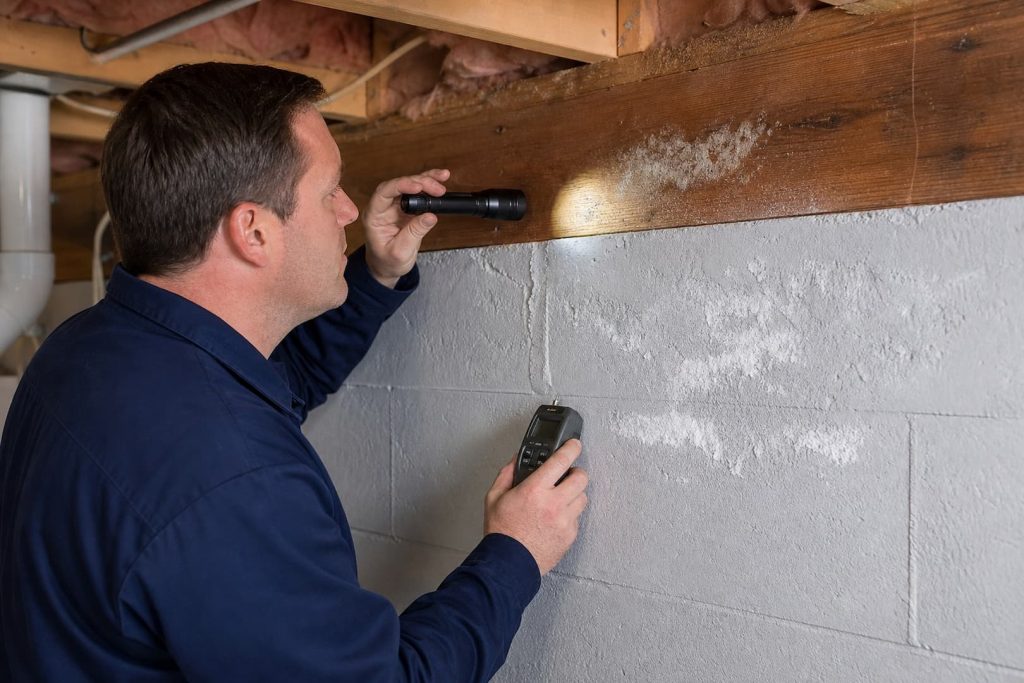
“White mold” is not a species name. It describes an appearance that several fungi can have at one stage, and it is easily confused with mineral efflorescence, drywall dust, insulation fibers, pollen, salt, adhesive residue, or a deteriorating finish. A white patch should prompt a moisture investigation, not a color-based health verdict.
The practical questions are simple: Is the material damp? Is the surface fuzzy, powdery, crystalline, or smooth? Did a leak, flood, condensation problem, or long humid period occur? Has the patch expanded or returned after cleaning? Those observations narrow the building problem, although they do not identify an organism.
White mold or a look-alike?
| Clue | Possible explanation | What to examine next |
|---|---|---|
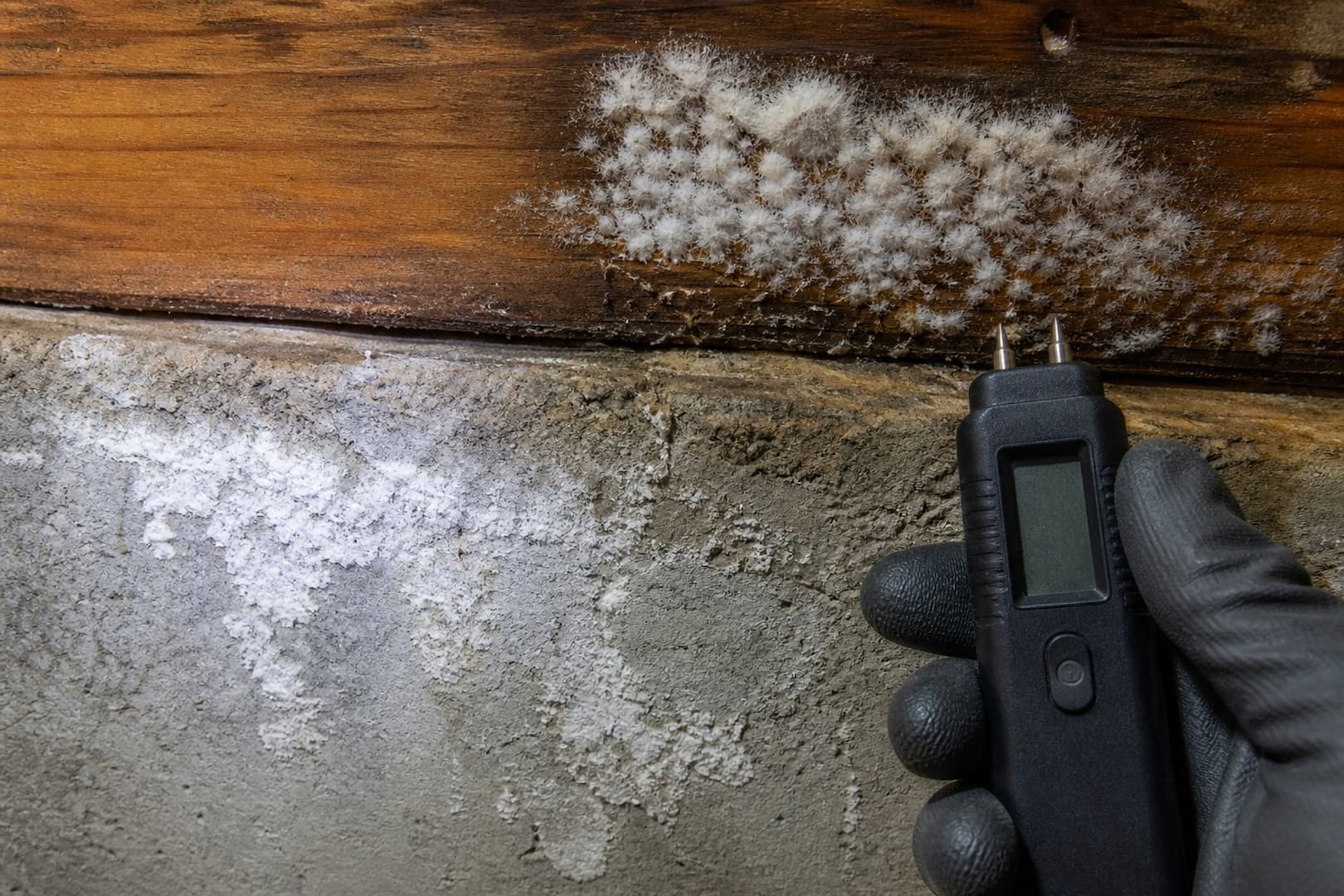
| Irregular fuzzy or cotton-like growth | Possible fungal growth | Dampness, musty odor, nearby leaks, and spread beyond the visible edge |
| Dry crystals on concrete or brick | Efflorescence from moisture moving through masonry | Foundation seepage, grading, drainage, and mineral residue |
| Even dust on horizontal surfaces | Household dust, construction residue, insulation fibers, or pollen | Whether it wipes away and returns independently of a damp zone |
| Smooth pale ring or drip mark | Water staining, paint compounds, or mineral residue | Roof, plumbing, window, or condensation source |
| Soft drywall, swollen trim, or crumbling wood | Material damage with or without mold | Stop cosmetic cleaning and assess the concealed assembly |
Efflorescence is not mold, but it still records water movement. Likewise, a smooth water stain can hide growth on the back of drywall. The front face does not reveal whether the cavity is dry. Avoid “water tests” or sniff tests presented online as definitive identification methods; disturbing an unknown patch for a home experiment adds little information.
Where pale growth commonly appears
Basement masonry often shows mineral deposits where groundwater or humid air meets a cool wall. Wood joists and furniture can support surface growth when humidity stays high. In closets, air stagnates behind contents placed against exterior walls. Bathrooms add condensation and splash water. Around windows, pale spotting may trace a cold edge, failed seal, or exterior leak. Each location calls for a different source correction.
Is white mold dangerous?
Color does not make mold more or less dangerous. The CDC says damp and moldy environments may cause no effects in some people, while others may experience a stuffy nose, sore throat, coughing, wheezing, burning eyes, or skin irritation. People with asthma or mold allergies can react more strongly. Those with immune suppression or chronic lung disease should not take part in cleanup and should discuss exposure concerns with a healthcare professional.
This article addresses moisture and materials in a building. A photo, color, odor, or consumer test kit cannot diagnose an illness.
Property damage also depends on time and material. Surface growth on sound framing does not automatically mean structural decay. Softness, deep cracking, loss of wood section, deformation, or prolonged saturation needs a closer building assessment. Paper-faced drywall, insulation, carpet pad, and fiberboard are less forgiving than sealed metal, glass, or tile.
Testing and inspection
Routine air sampling is not the default response to visible growth. The EPA and CDC do not provide a federal indoor spore limit that turns a short sample into a simple pass or fail. Testing may help when growth is suspected but concealed, parties dispute the source, documentation is needed, or a project team has a specific question. BRG’s inspection-first service explains when targeted sampling can add value.
Can you clean a small area yourself?
A limited DIY cleanup may be reasonable when the total visible area is under about 10 square feet, the water source was clean and has been fixed, the material is hard and sound, the work is accessible, and no vulnerable person will be exposed. Stop if sewage or floodwater was involved, the HVAC system may be contaminated, several rooms are affected, or cleanup would require opening cavities or disturbing older finishes.
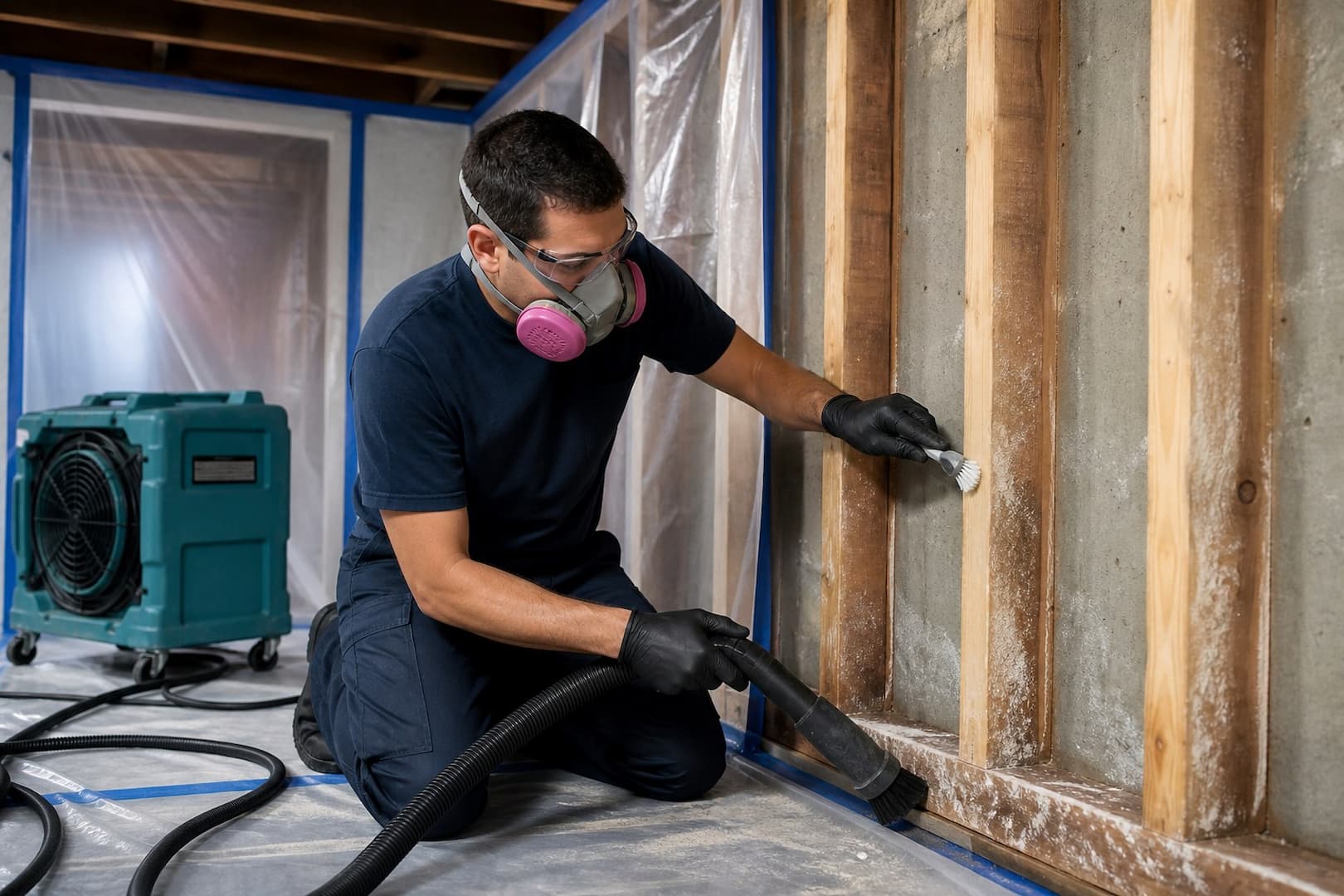
- Correct the moisture source. Do not begin by spraying the patch.
- Isolate the immediate work area. Keep people away and avoid fans that blow across growth.
- Wear gloves, sealed goggles, and at least an N95 respirator.
- Clean sound hard surfaces with detergent and water. Remove residue without sanding or dry brushing, then dry completely.
- Discard porous material that cannot be cleaned and dried. Bag it before carrying it through occupied rooms.
- Reinspect. The area should stay dry and free of visible growth or moldy odor.
Bleach is not a universal remedy and should never be mixed with ammonia or another cleaner. Follow the product label and public-health guidance for the situation. Painting over a white patch does not remove residue or solve wet material behind the coating.
Preventing a repeat problem
- Repair roof, plumbing, appliance, window, and foundation leaks promptly.
- Keep indoor humidity below 60 percent when practical; 30–50 percent is the EPA’s ideal range.
- Vent bathrooms and kitchens outdoors.
- Keep cardboard, fabric, and furniture away from damp masonry and cold exterior walls.
- Use gutters, downspout discharge, grading, drainage, and a maintained sump system to manage foundation water.
- Confirm that materials are dry before closing walls or installing new finishes.
White growth questions
Is white fuzzy growth on concrete mold?
It may be fungal growth on dust or residue, but dry crystalline material is often efflorescence. Both conditions justify a moisture check. Texture, material, humidity, and change over time are more useful than color.
Can white mold grow on metal?
Fungi do not use metal as food, but they can grow on dust, paint, insulation, or other organic residue on a damp metal surface.
Can white mold be wiped off drywall?
A tiny surface spot on sound painted drywall differs from soft or wet paper facing. If the material is swollen, crumbly, extensively affected, or wet through the cavity side, removal is usually more defensible than repeated surface cleaning.
Will an air purifier remove the problem?
Filtration may reduce some airborne particles while it runs, but it cannot remove growth from materials or repair the moisture source.
Use a simple field comparison before disturbing pale material
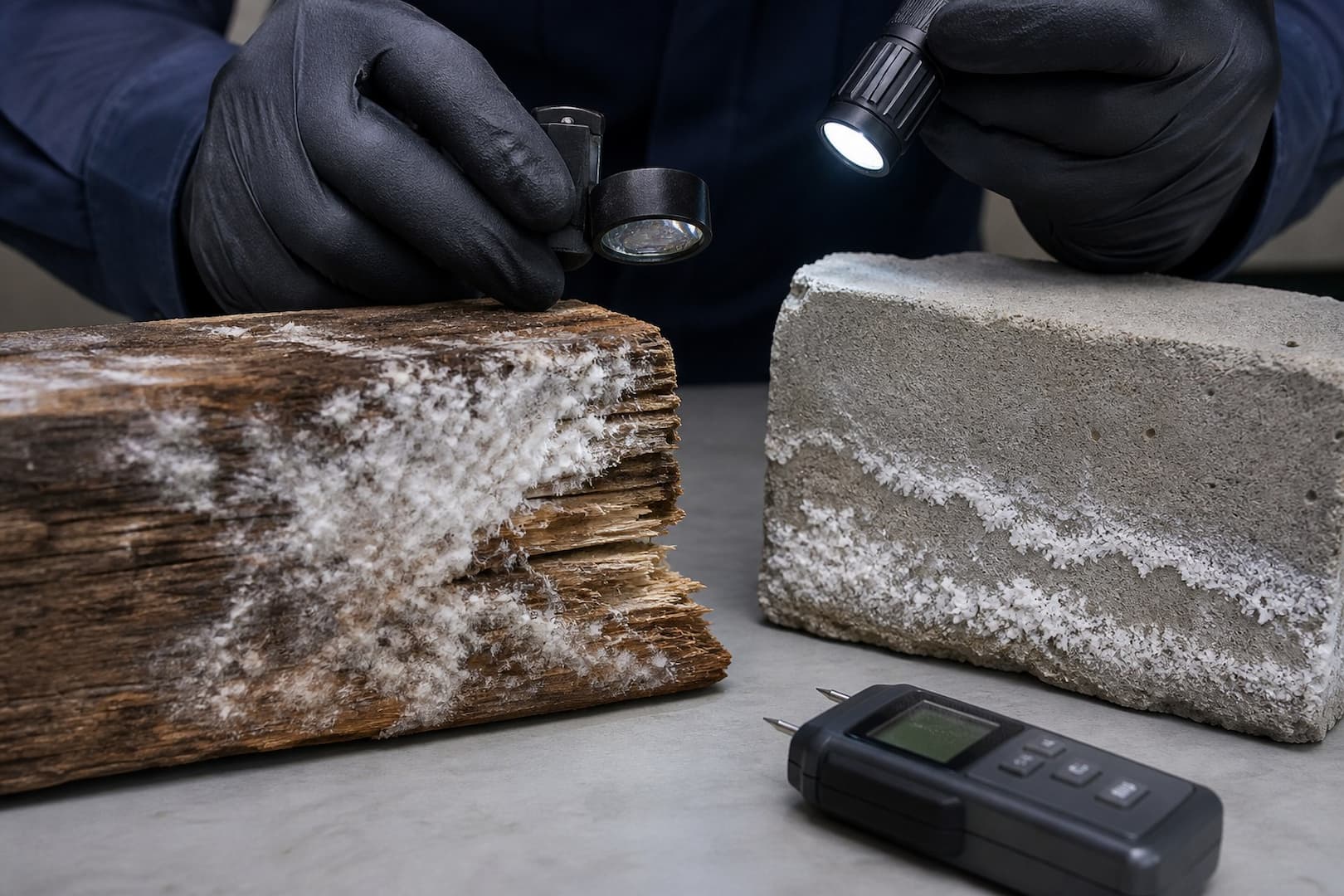
Efflorescence usually forms where water moves through masonry and leaves mineral salts as it evaporates. It may feel crystalline or powdery and can return along the same moisture path. Fungal growth needs an organic food source, which may be paint, dust, paper, wood, or residue on masonry. Adhesive, fireproofing, insulation fibers, and old coatings add more look-alikes. Do not taste, sniff closely, or dry-brush the material to identify it.
| Field clue | More consistent with mineral deposit | More consistent with fungal growth |
|---|---|---|
| Substrate | Concrete, brick, mortar | Wood, paper, dust, paint, fabric; also residue on masonry |
| Texture | Crystalline, salty-looking, hard or powdery | Fuzzy, velvety, irregular colonies; appearance varies |
| Moisture story | Water moving through masonry | Leak, condensation, humidity, or damp material |
| After dry brushing | May powder away but return with seepage | Disturbance can aerosolize fragments; not a safe test |
| What resolves uncertainty | Moisture/path assessment, material examination | Inspection and targeted sampling when it changes a decision |
Health decisions should not wait for a color name
White growth is not a single species or exposure category. CDC notes that mold can trigger allergic and respiratory effects and that people with asthma, chronic lung disease, allergies, or immune suppression may face greater risk. Keep vulnerable people out of active cleanup and ask a healthcare professional about symptoms. The contractor’s role is to control the building condition, not link a symptom to a patch from appearance.
If growth is widespread, concealed, near HVAC, associated with sewage, or caused by extensive water damage, treat it as more than a cosmetic job. EPA’s roughly 10-square-foot homeowner guideline is a planning threshold, not permission to clean an unsafe or complex area. Height, access, dust, occupant health, and the material itself can make a smaller patch unsuitable for DIY work.
Cleaning masonry does not fix water moving through it
Efflorescence and fungal growth can both return until the moisture path is corrected. Check grading, downspouts, cracks, capillary rise, condensation, plumbing, and interior humidity. Waterproof paint on the room side may blister or redirect moisture if the wall remains wet. A foundation or masonry specialist may need to diagnose the exterior and drainage, while remediation addresses affected finishes and contents.
In basements, stored cardboard and furniture can grow mold even when the masonry shows only salts. Leave an air gap, use non-porous shelving, and keep belongings off the slab. The basement mold guide covers these overlapping sources in more detail.
Choose removal or cleaning from the material condition
Sound painted wood or another accessible hard surface may be cleanable after the source is fixed. Soft drywall, contaminated insulation, fiberboard, and swollen composite wood usually need removal. Framing can often be retained if it is structurally sound, reachable, cleanable, and dryable. A focused mold assessment can define the boundary when the pale material enters a wall or ceiling cavity.
- Do not use an ordinary vacuum or dry brush on suspect growth
- Protect eyes, skin, and breathing according to public-health guidance
- Never mix bleach with ammonia, acids, or other cleaners
- Avoid soaking porous material in an attempt to disinfect it
- Document the original pattern before cleaning
- Recheck moisture after the source repair and through the triggering season
If a small cleaned area returns, that recurrence is evidence. Revisit the moisture path and the hidden side of the material instead of escalating chemical strength. A white stain that remains unchanged on dry masonry may be cosmetic; expanding fuzzy material on damp wood is a different problem.
Sources and further reading
- U.S. EPA: A Brief Guide to Mold, Moisture and Your Home
- U.S. EPA: Mold Cleanup in Your Home
- CDC: Mold — overview, health effects, prevention and cleanup
- Massachusetts DPH: Mold Cleanup, Repairs, and Excess Moisture Control
When the property needs a closer look
Boston Restoration Group can inspect the affected area, document moisture and material conditions, and explain which restoration step fits the loss. Use the BRG contact page to request service in Greater Boston.
How long does it take to professionally remove white mold?
The timeline depends on the extent of the infestation. Small cases can take a few hours, while larger jobs may require multiple days.
What’s the best way to clean white mold on tiles?
Use a mold cleaner or a vinegar and baking soda solution to scrub the affected tiles. Rinse thoroughly and dry the area to prevent recurrence.
What should I do if I find white mold on my ceiling?
White mold on ceilings is often caused by leaks or high humidity. First, fix the source of the moisture. For complete removal, clean the mold with a cleaner made just for mold or call an expert.
How can I prevent white mold on wood furniture?
Keep furniture in dry, well-ventilated spaces, avoid spills, and clean it regularly. Keeping an area with low humidity can also be done with a dehumidifier.
Does white mold cause permanent damage to hardwood floors?
If caught early, white mold on hardwood floors can often be cleaned without permanent damage. However, prolonged exposure can warp and weaken the wood, requiring replacement.
Does white mold grow faster in warm climates?
Yes, warm and humid climates accelerate mold growth. Mold growth in these environments can be slowed down by using air cooling and dehumidifiers.
Can white mold on drywall damage my home?
Yes, white mold on drywall can penetrate deeply, compromising its structural integrity. Over time, this can make the walls weaker and need expensive repairs. To avoid damage, removal must be done quickly.
How quickly does white mold spread?
White mold can start spreading within 24–48 hours of exposure to moisture. It can grow very quickly once it gets going, especially in places with a lot of dampness and not enough air flow. We need to stop its growth right away.
Can I remove white mold on drywall myself?
Small areas of mold can be cleaned with a mold-specific cleaner, but larger infestations should be handled by professionals to ensure safety and thorough removal.
What’s the difference between white mold and mildew?
Mildew is a surface fungus that’s easier to clean and less harmful than mold. On the other hand, white mold gets inside things and is very bad for your health and the building’s structure.
Can white mold damage leather furniture?
Yes, white mold can damage leather by staining and breaking down the material. Clean it with a leather-safe mold remover and condition the leather afterward.
Does insurance cover white mold removal?
Coverage depends on your insurance policy and the cause of the mold. Damage from preventable issues like leaks may not be covered, so check with your provider.
Can white mold affect pets?
Yes, mold spores can make dogs sick, causing them to sneeze, cough, or get skin irritation. Both people and animals are protected by removing the mold.
Does white mold on plants affect indoor air quality?
White mold on plants can release spores into the air, reducing indoor air quality and potentially triggering allergies. Removing moldy plants and increasing airflow are both beneficial.
How do I know if white mold has spread to hidden areas?
Signs of hidden mold include musty odors, water stains, and allergic reactions. Professional testing for mold can prove that it is present in places that can’t be seen.
Can white mold grow on furniture stored in a garage?
Yes, white mold can grow on furniture stored in garages due to high humidity and poor ventilation. Ensure furniture is stored in dry, well-ventilated conditions to prevent mold growth.
Why does white mold keep returning in my bathroom?
Recurring white mold in bathrooms is often due to persistent moisture, poor ventilation, or leaky plumbing. Addressing these underlying issues is crucial for preventing its recurrence.
Can white mold spread from one room to another?
Yes, white mold can spread through airborne spores. To prevent its spread to other locations, proper containment and removal are required.
What’s the best way to dry out a basement to prevent white mold?
Use dehumidifiers, fans, and proper insulation. Address any leaks or groundwater seepage to keep the basement dry.
Is white mold on carpet dangerous to children?
Yes, white mold on carpets can release spores that cause allergies and respiratory issues, especially in children. Cleaning or replacing the affected carpet is recommended.
Why does white mold grow under sinks?
White mold often grows under sinks due to plumbing leaks and trapped humidity. Regularly inspect for leaks and keep the area dry to prevent mold growth.
Is white mold in basements more dangerous than black mold?
Even though black mold is typically thought to be more toxic, white mold in basements can still cause serious health risks like allergies and respiratory issues. That it can weaken building materials makes it just as dangerous from a safety point of view.
Is it safe to sleep in a room with white mold?
Sleeping in a room with white mold is not safe, as prolonged exposure to mold spores can lead to health issues. Remove the mold and improve ventilation before using the room.
Does white mold cause long-term health problems?
Prolonged exposure to white mold can lead to chronic respiratory issues, allergies, and in some cases, mold-induced asthma. Removing it promptly protects your health.
What is white fluffy mold, and how does it form?
White fluffy mold is a type of fungal growth that thrives in damp, humid conditions. It forms when moisture combines with organic material like wood, drywall, or fabric, creating an ideal environment for mold spores to grow. Basements, bathrooms, and other badly ventilated areas are frequently where this kind of mold can be found.