
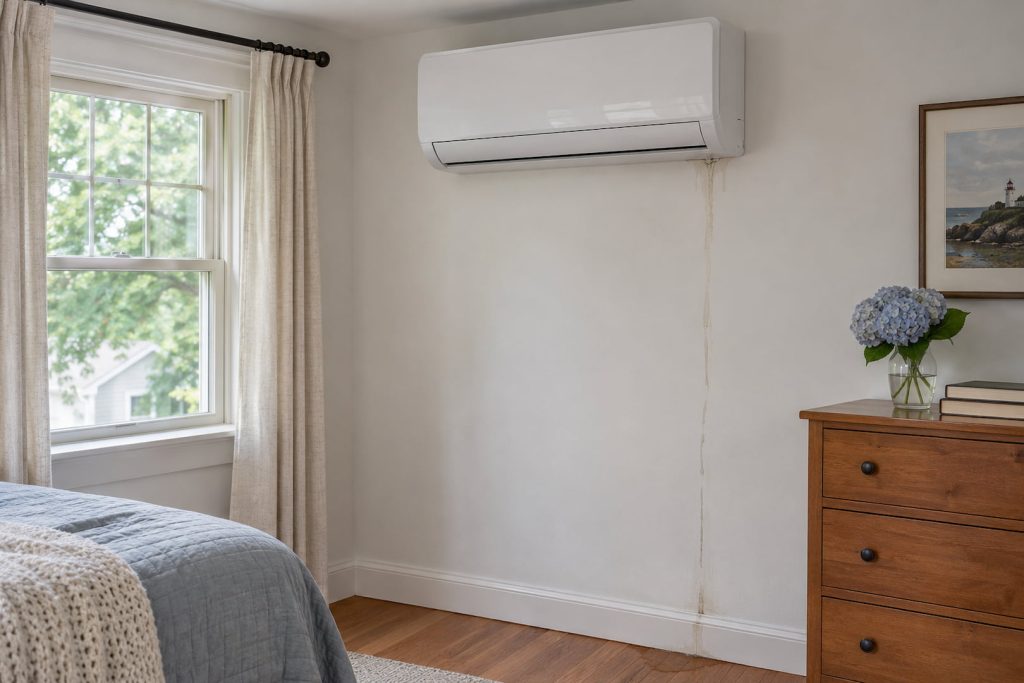
An air conditioner leaking water inside usually has a problem collecting or draining condensation. Common causes include a blocked condensate drain, a damaged pan, and ice melting from a frozen evaporator coil. Switch cooling off at a dry, safely accessible control and arrange HVAC service. If water has reached a wall, ceiling, or floor assembly, the building also needs attention.
The small puddle beside the equipment may be only the visible part of the loss. Condensate can run beneath a closet wall, soak insulation, or collect under flooring before anyone sees a ceiling stain downstairs. Fixing the AC stops new water; it does not establish that those materials are dry.
What to do when you first notice the leak
- Stop cooling from a safe, dry location. Do not open the equipment cabinet or reach across water to touch a switch, plug, or electrical panel.
- Keep people away from electrical and ceiling hazards. Stay out from under a bulging or sagging ceiling. Do not puncture it or remove a wet light fitting.
- Protect reachable, unaffected belongings. Move items from a dry edge if you can do so without entering the wet or unstable area.
- Record what you see. Photograph the water path, equipment location, and affected rooms. Note whether the cooling was running and when the stain first appeared.
- Call the appropriate help. An HVAC technician diagnoses the equipment. A restoration team evaluates water that escaped into building materials.
Water around energized equipment needs professional evaluation before cleanup. CDC’s electrical precautions for wet buildings warn against approaching electrical equipment through standing water. Although an AC leak is often much smaller than a flood, the electrical contact hazard still matters.
Towels may be enough to collect a small, safely accessible puddle on an intact surface. They do not remove water from beneath flooring or inside a ceiling. For water that has spread, professional water extraction can be paired with moisture checks rather than relying on how the floor feels to a hand.
Is this urgent, and can you keep the AC running?
Leave cooling off while the leak is assessed, even if the house still feels cool. A system can move heat successfully while its drain fails. Water reaching electrical parts, a rapidly enlarging ceiling stain, or a sagging ceiling calls for urgent help and keeping people clear of the area. A small puddle that stops growing after shutdown still needs HVAC service; continuing to empty a bucket is not a repair.
Describe the conditions when you call rather than reporting only that the AC is leaking. Water beside a basement unit and water dripping through a bedroom light fixture require different preparations. If you rent or live in a condominium, notify the building contact as well, especially when the equipment or wet ceiling serves another unit.
Where the water comes from
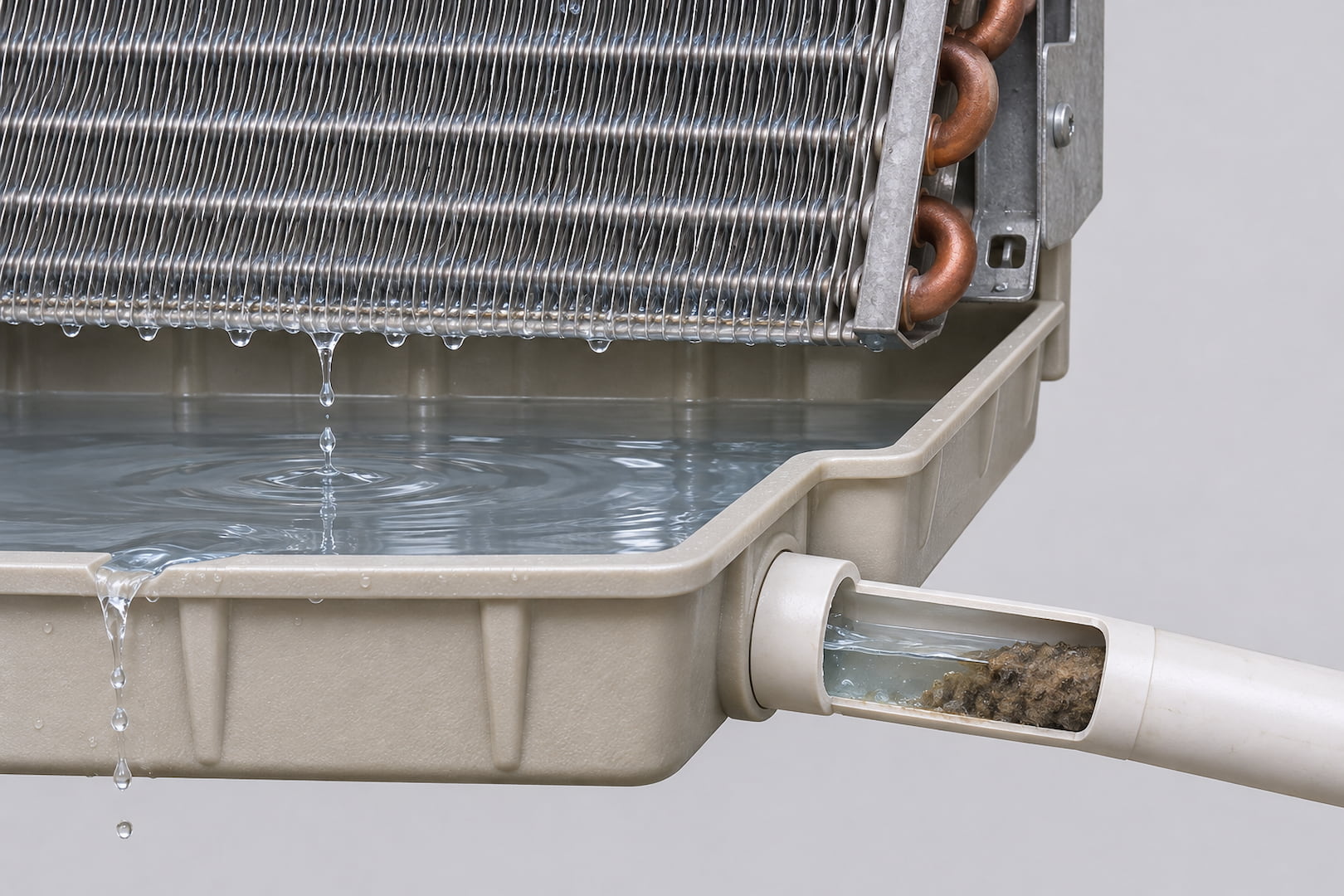
During cooling, humid indoor air passes over a cold evaporator coil. Moisture condenses on the coil and should collect in a pan before flowing through a drain or a condensate pump. A problem anywhere along that route can send water into the building instead.
Condensate is water removed from the air; refrigerant circulates in a separate circuit inside the equipment and tubing. The puddle alone does not diagnose a refrigerant leak. Low refrigerant can contribute to icing, which then produces meltwater, but an HVAC technician needs to investigate that mechanical fault. Do not buy refrigerant or request a recharge solely because water appeared.
Water discharged at a designated outdoor drain can be normal. Water escaping onto an indoor floor is different. Also distinguish the normal outdoor behavior of a heat pump in heating mode from a leak at its indoor equipment; the location and operating mode change what the technician needs to investigate.
| What you notice | Possible explanation | Useful information for the technician |
|---|---|---|
| Water at the indoor unit while cooling | Drain restriction, pan problem, connection leak, or pump failure | When it starts, whether a pump is present, and where water first appears |
| Ice or poor cooling followed by a larger leak | A frozen coil thawing; airflow or refrigerant problems may be involved | Any visible ice, recent filter changes, and cooling performance |
| Moisture on cold piping or nearby surfaces | Condensation related to insulation or local temperature and humidity | Which surface gets wet and whether it happens only during cooling |
| Leak during rain with cooling off | Rain entry near an opening or installation may be involved | Weather timing, recent installation work, and the exact wall or window location |
| Ceiling stain below an attic air handler | Water may have escaped from the equipment or a nearby source | Which room is below it and whether the ceiling has changed shape |
These clues narrow an investigation; they do not confirm a diagnosis. A ceiling under an air handler can also hide a roof or plumbing leak. Keep the source question open until someone has traced the water.
Blocked drains, damaged pans, and pump trouble
A drain can become restricted by accumulated debris. A pan can crack or corrode, and a loose connection can leak even when the rest of the line flows. Trane’s air-handler guidance identifies drain-pan, drain-line, frozen-coil, and installation problems among the conditions an HVAC technician may need to check.
Some installations depend on a pump to lift condensate to a suitable drain. A pump, float, power supply, or discharge-line problem can interrupt that route. An overflowing reservoir needs diagnosis, not repeated emptying while the AC continues to run. Do not bypass a float switch or other shutoff to keep the system cooling.
A pump and an overflow switch do different jobs. The pump moves collected water; an overflow switch signals the system to stop when it detects rising water or a leak. Trane explains these shutoff devices and notes that not every air handler has one. A sudden shutdown on a humid day may therefore be a useful warning. Resetting the system without finding why the device tripped can leave the drainage problem in place.
Avoid pouring a cleaner into an unidentified pipe or forcing a drain open with compressed air. Drain materials, traps, pumps, and manufacturer instructions differ. Ask the HVAC technician to verify the actual route and demonstrate drainage after the repair. A line that briefly accepts water is not necessarily a complete check of the system under operating conditions.
Why a frozen coil can leak after you turn the AC off
Ice on the evaporator can melt after cooling stops. That means a continuing drip does not necessarily show that the off command failed. Water already in the pan, ductwork, insulation, or ceiling may also keep moving after the source has stopped producing condensate.
Restricted airflow and refrigerant problems are possible contributors to coil icing. Carrier’s leak troubleshooting guidance advises turning the system off and having unresolved leaks checked. Replacing a dirty filter may address one maintenance issue, but it does not prove that the coil, refrigerant circuit, or drainage system is sound.
Do not chip ice off the coil, apply a heat gun, or repeatedly restart the system to see whether the problem returns. Tell the technician about icing before it disappears. A photograph taken without opening unsafe equipment can preserve a useful clue.
The equipment type changes the checks
Central AC or a heat pump with an indoor air handler
Locate the indoor equipment in your description: attic, basement, closet, or mechanical room. A leak in an attic may affect insulation and the ceiling below; a closet leak can move beneath adjoining walls. If the AC coil sits above a furnace, report any water reaching the furnace cabinet. Do not assume the heating equipment is unaffected because only cooling was running.
From a dry, accessible position, note the model number, any displayed error code, and whether the first wet spot is at the cabinet, a drain connection, or a nearby pipe. Share the filter replacement history. Leave cabinet removal, pan access, and electrical checks to the technician; a clear description is more useful than disturbing the evidence before service arrives.
Wall-mounted ductless equipment
Water can collect behind the indoor head or follow its pipe opening into the wall. The installer may need to check drain routing, connections, insulation, and any condensate pump. LG’s model-specific leakage guidance illustrates why bent hoses, drain routing, and pump arrangements need different checks. Do not remove the unit from its mounting plate to investigate a wet wall yourself.
Window and portable units
Use the exact model’s installation and drainage instructions. A window unit’s required support and drainage arrangement cannot be inferred from a different model. Do not drill a new drain hole, tilt an unsecured unit, or lean out of a window to investigate. With a portable unit, check the manual for the correct reservoir and hose arrangement after the unit is safely off.
Rain entry around a window installation can look like a condensate leak. Record whether water appears with wind-driven rain, cooling operation, or both. That distinction helps decide whether the installer also needs to inspect the window opening and exterior weather protection.
Check the building beyond the puddle
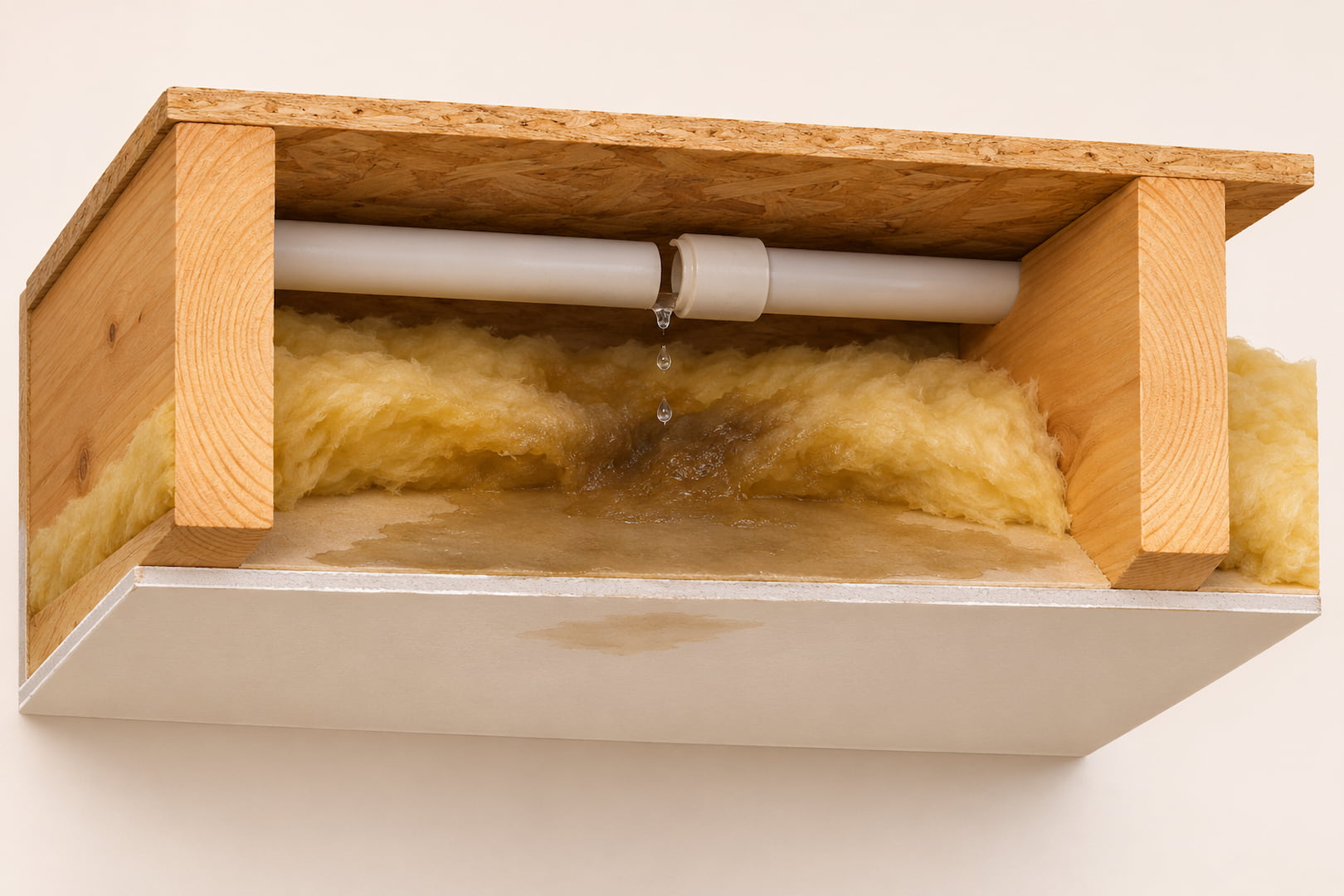
Start with the path water could have taken. A closet floor connects to wall bases and adjacent rooms. A ceiling leak may involve an insulation-filled cavity above the visible stain. A wet baseboard can mark the place water emerged rather than the point where it entered.
A restoration assessment should identify affected materials, compare suspect locations with suitable dry areas, and explain whether access is needed. A thermal image can help locate a temperature pattern, but it does not by itself prove moisture. A reading through an intact finish also has limits; the instrument and the assembly have to suit the question.
If water has entered concealed layers, structural drying and water damage restoration address the materials after the HVAC repair. The plan may include removing a damaged finish, exposing a wet layer, extracting accessible water, and monitoring retained materials. A dry painted surface alone should not decide when the wall can be repainted.
Can an AC leak cause mold?
Persistent moisture can support mold growth on or around affected building materials. A slow leak in an enclosed closet may go unnoticed longer than an obvious puddle. Musty odor, repeated staining, or visible growth should change the investigation; a stain by itself does not identify mold or tell you how long the material stayed wet.
EPA’s water-damage response table emphasizes prompt action while distinguishing materials and conditions. Its early-drying guidance is not a guarantee that mold will or will not grow at a specific hour. The age of the leak may be uncertain, and an intact finish can hide wet backing.
Do not point ordinary fans at visible mold or circulate air from a suspect contaminated HVAC system. Where growth or a lingering moisture problem is present, mold remediation may need to become part of the recovery plan. Fix the mechanical cause as well; cleaning the wall does not repair the drain.
What to ask before the AC goes back into normal service
Ask the HVAC technician to document the cause, the repair, and how the system was checked. If an overflow device is installed, confirm it was evaluated without assuming it can prevent every type of leak. Note any remaining insulation, drain-routing, or equipment issues that need another visit.
Separately, ask the restoration team what materials remain wet and whether the repaired system can operate during drying. The teams may need to coordinate temperature control and access. Normal cooling operation should not interfere with containment or other work-zone controls.
- Keep the HVAC service record with photographs of the affected rooms.
- Record which walls, ceilings, floors, or contents need drying or replacement.
- Clarify what readings or observations will support closing an opened area.
- Recheck the original leak location after normal operation resumes, using the technician’s instructions.
- Follow the equipment manufacturer’s filter, drain, and service schedule; report recurrent moisture instead of treating it as normal condensation.
Who handles the equipment and who handles the damage?
| Work needed | Who usually leads it | What to ask for |
|---|---|---|
| Trace and repair the condensate, airflow, or refrigerant fault | HVAC service provider | The identified cause and a check of operation and drainage after repair |
| Assess wet drywall, insulation, trim, or flooring | Water damage restoration team | The affected boundary, access plan, material decisions, and drying records |
| Assess wet wiring, fixtures, or an unsafe electrical component | Qualified electrical professional | Which equipment or area can be used again and what requires repair |
| Replace removed finishes after cleanup and drying | The agreed repair contractor or trade | A handoff confirming which areas are ready to close and what work remains |
Ask for separate scopes if several trades are involved. Clearing a drain, drying a ceiling cavity, and replacing the ceiling are different pieces of work. A single HVAC repair price does not tell you the cost of restoring the room, and the restoration estimate should not imply that it includes refrigerant or electrical repairs unless those services are expressly arranged.
When the leak has reached your home’s finishes
Contact the HVAC service provider for the equipment fault. For wet ceilings, floors, wall cavities, or adjoining rooms in Greater Boston, Boston Restoration Group can assess the water damage and explain the extraction, drying, or removal work needed. Share the AC location, the rooms affected, and whether the equipment has already been shut down or repaired.