
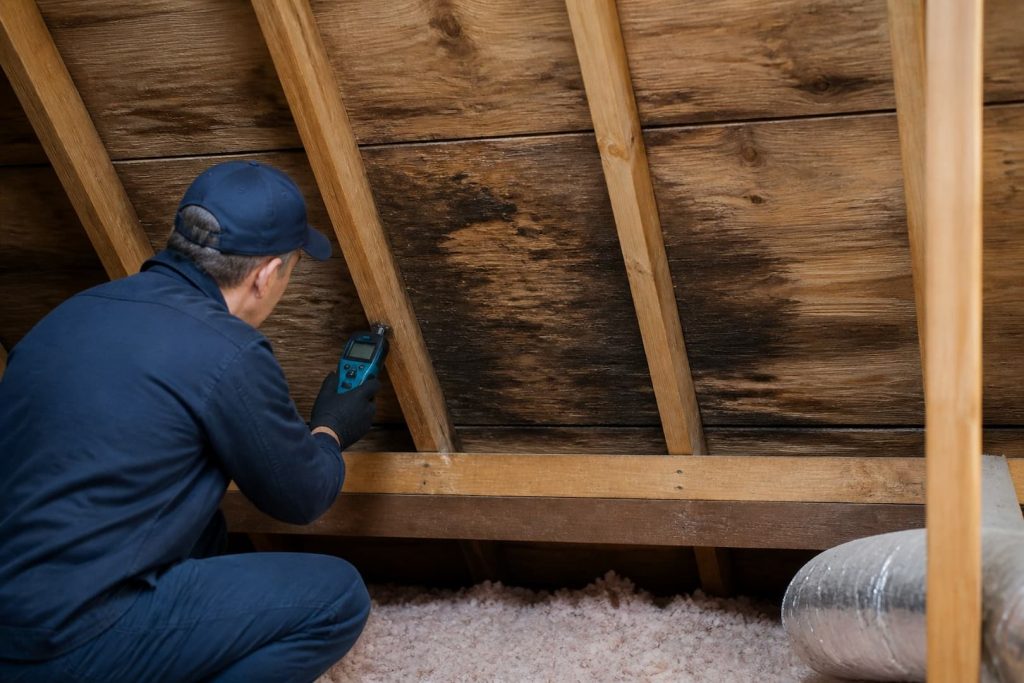
Attic mold is evidence of moisture, but the visible colony does not tell you which moisture path is responsible. Rain may enter through flashing or roofing. Warm indoor air may leak through ceiling penetrations and condense on cold roof sheathing. A bath fan may discharge into the attic. Insulation can leave cold spots, and blocked or poorly designed vents can change how the roof assembly dries.
Boston winters make the diagnosis seasonal. Frost on nail tips or sheathing after a cold spell often points to indoor-air leakage and condensation. A stain that appears during rain or thaw may trace exterior water. Both can occur in the same attic, so spraying the wood before tracing the pattern usually delays the real repair.
Read the moisture pattern before naming the fix
| Observation | More consistent with | What to verify |
|---|---|---|
| Dark staining below one roof penetration | Exterior leak | Flashing, fasteners, roof condition, and timing during rain |
| Frost or widespread dampness on cold sheathing | Indoor moisture condensing | Ceiling air leaks, indoor humidity, insulation gaps, and weather |
| Growth near a bath-fan duct | Duct leak or indoor discharge | Outdoor termination, joints, insulation, and damper |
| Wet lower roof edge in winter | Ice-dam leakage or snowmelt | Eaves, insulation, air sealing, drainage, and interior damage |
| Isolated old stain on dry wood | Past event or non-fungal discoloration | Current moisture readings and change over time |
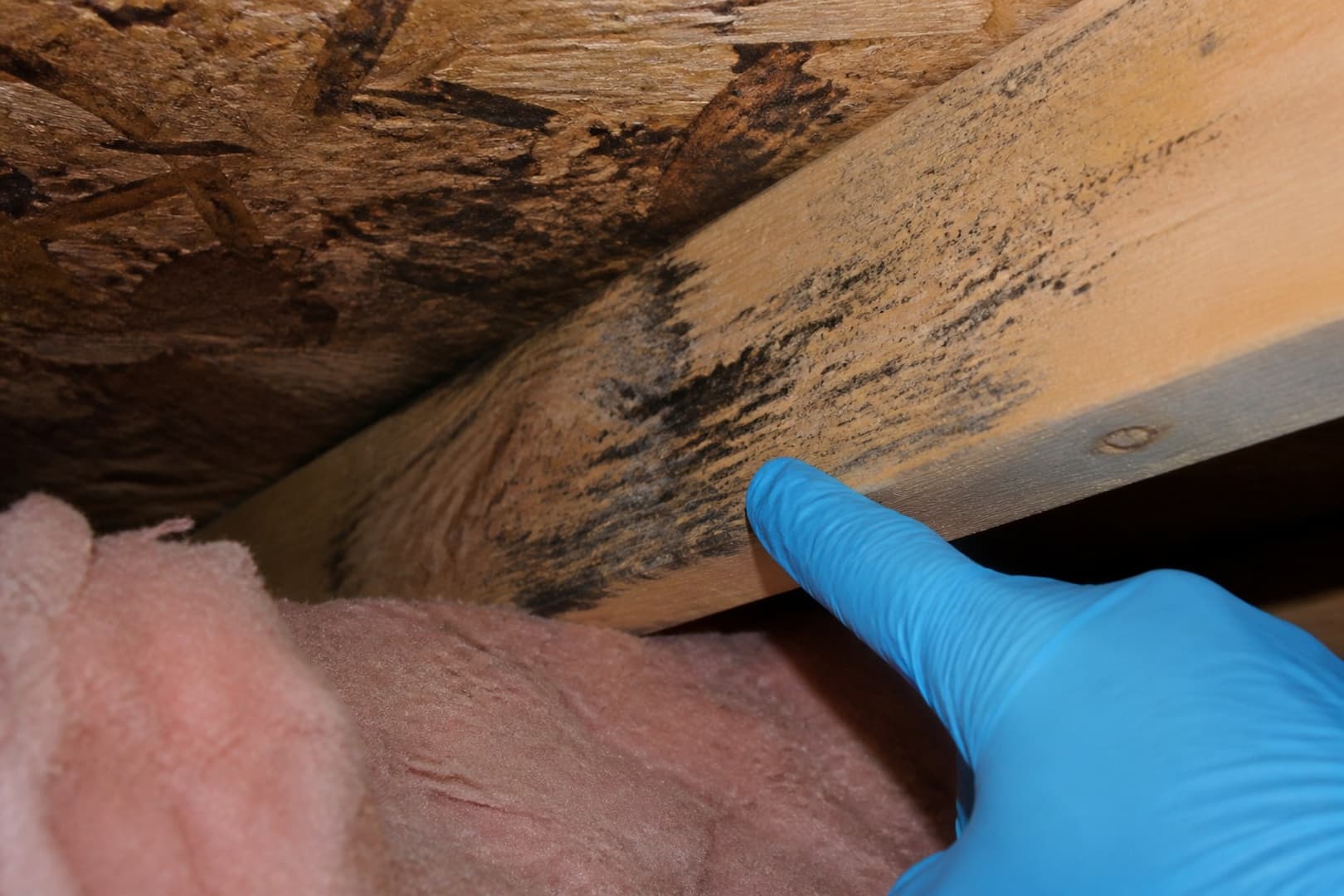
Dark sheathing is not a species identification. Wood can show old water stains, dirt, oxidation around fasteners, or fungal growth. A visual inspection can document extent and moisture clues, but color alone cannot measure risk. Routine air testing is often unnecessary when visible growth and the source decision are clear.
Inspect the attic without creating a second emergency
- Do not enter if the access is unsafe, framing is obscured, wiring is exposed, or the roof deck appears structurally damaged.
- Walk only on designed platforms or framing you can identify; ceiling drywall is not a floor.
- Do not disturb loose-fill insulation or suspect vermiculite until its material risk is understood.
- Avoid dry brushing, sanding, or blowing air across visible growth.
- Keep lights and tools clear of combustible insulation and damaged wiring.
- Photograph patterns from safe positions and record weather, indoor humidity, and recent leaks.
Older homes may contain asbestos-bearing insulation, duct materials, or other finishes, and pre-1978 painted components can trigger lead-safe work rules when disturbed. Those hazards change access and demolition even when the visible mold area seems small.
Can attic mold be cleaned without replacing the roof deck?
Sometimes. Sound roof sheathing and framing can often remain if the water source is fixed, the wood can dry, and the surface can be cleaned under an appropriate scope. Replacement becomes more likely when wood is delaminated, decayed, losing section, or structurally compromised—not simply because it is stained. A roofer or structural professional may need to judge the assembly separately from the remediation contractor.
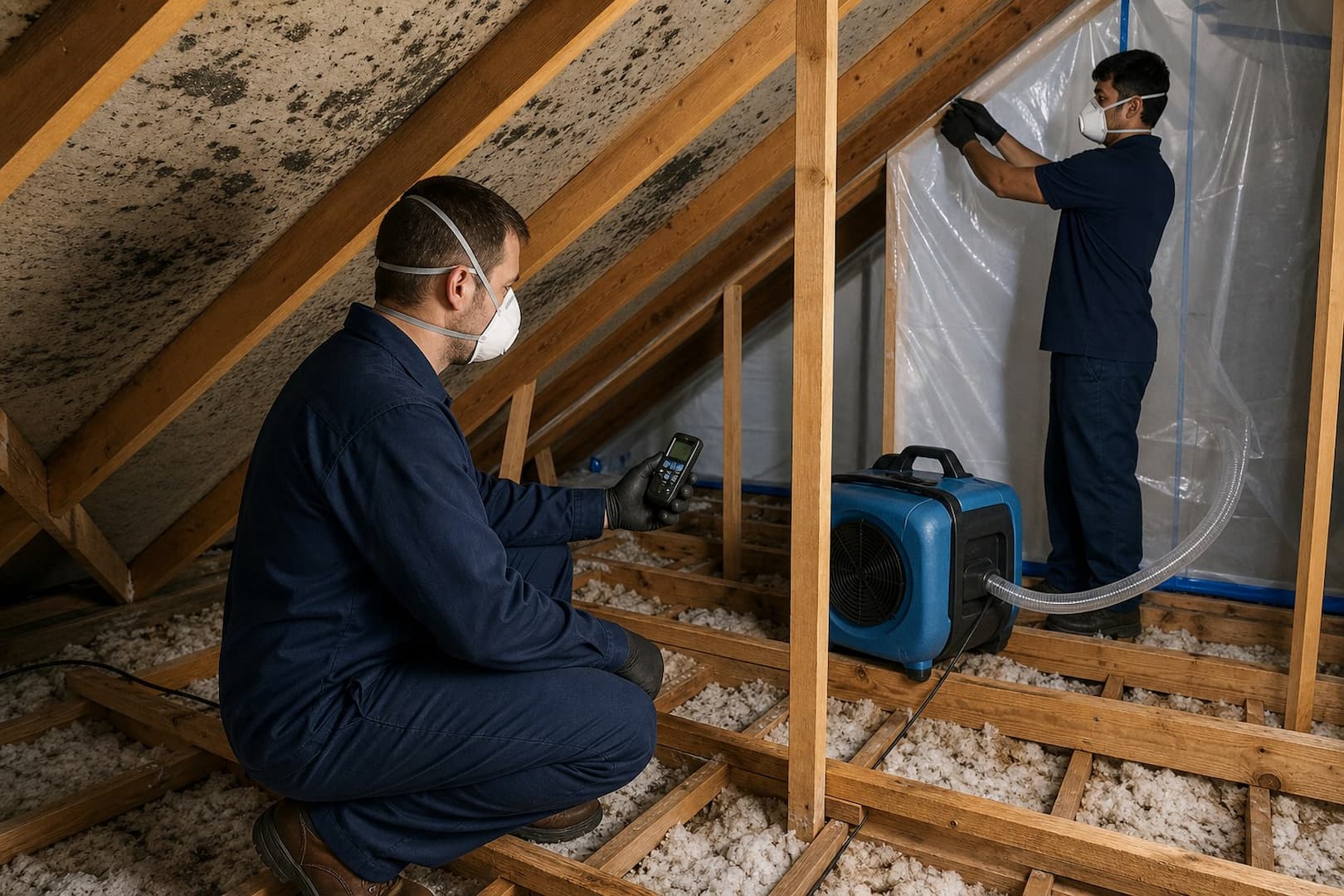
EPA’s roughly 10-square-foot homeowner benchmark is harder to apply in an attic. Access, loose insulation, overhead work, concealed extent, and the chance of spreading particles into living space can make a small patch a professional project. A larger area, multiple roof planes, or growth above occupied rooms typically calls for containment and controlled air management through professional mold remediation.
What a sound remediation scope addresses
- Define the source. Assign roofing, plumbing, air-sealing, insulation, or ventilation work to the appropriate trade.
- Set the boundary. Inspect adjoining bays, insulation, rafters, trusses, and the top of the ceiling as access permits.
- Protect occupied space. Manage the hatch, work route, containment, and air movement.
- Remove unsalvageable porous material. Wet or contaminated insulation is evaluated separately from sound wood.
- Clean remaining structure. Use methods that remove residue without needless wood damage.
- Dry and verify. Compare moisture to unaffected reference wood before covering the assembly.
- Document completion. The source correction and material condition matter more than a cosmetic “after” photograph.
Ventilation is not a universal cure
Adding vents can help some vented roof assemblies, but it does not seal a leaky attic floor, repair a roof, reconnect a bath duct, or correct an insulation defect. More ventilation can also change pressure and snow entry if installed without an assembly plan. Air sealing at ceiling penetrations often matters because it reduces the warm, moist indoor air reaching cold sheathing. The right sequence depends on how the roof was designed.
Preventing attic moisture in Greater Boston
- Vent all bath, kitchen, and dryer exhaust outdoors through suitable terminations.
- Seal accessible ceiling penetrations around wiring, plumbing, chases, hatches, and fixtures using code-appropriate materials.
- Maintain the roof, flashing, gutters, and exterior drainage.
- Keep indoor winter humidity appropriate for the home and outdoor temperature; window condensation can be an early clue.
- Do not block intended soffit-to-ridge air paths with insulation.
- Investigate ice dams as a heat-loss and water-entry problem, not just an icicle problem.
- Reinspect after a cold spell and after wind-driven rain or snowmelt.
Attic mold questions
Does attic mold mean the roof must be replaced?
No. The decision depends on roof condition, leak source, wood integrity, and whether materials can dry. Remediation and roof repair are related but separate scopes.
Can I spray mold killer from the hatch?
A spray does not remove residue, reach concealed bays, correct moisture, or protect occupied space. It may also wet the wood further. Start with inspection and source control.
Will new insulation solve attic mold?
Not if indoor air is still leaking or the roof still admits water. Wet or contaminated insulation may need removal, but replacement comes after the source and drying plan.
When is testing useful?
Testing can support a defined dispute, hidden-condition, or verification question. It is not usually needed simply to confirm that visible growth should be cleaned and moisture corrected.
Read the roof deck as a building-science record
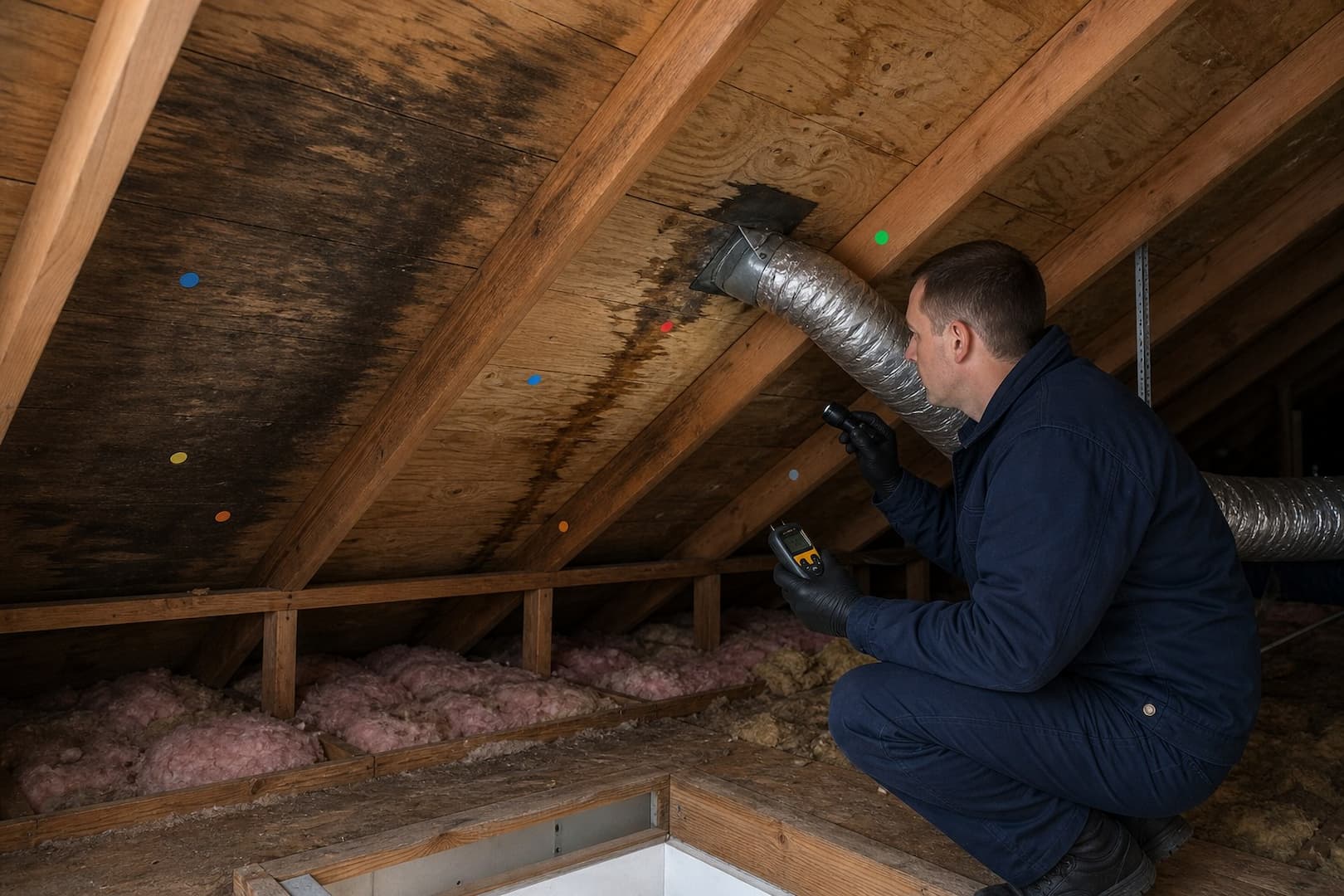
Attic growth rarely spreads in a random pattern. The roof deck often records where warm indoor air escaped, where insulation was displaced, and where cold sheathing stayed below the dew point. Darker bands around plumbing stacks, wiring holes, attic hatches, recessed lights, and partition tops point toward air leakage. A broad field on the north-facing slope may reflect lower winter surface temperatures. Staining concentrated below a bath-fan duct suggests a loose joint, a torn vapor jacket, or a termination that never reached outdoors. Those patterns do not prove the cause by themselves, but they tell the inspector where to measure and open next.
A roof leak leaves a different trail. Look for a water path below flashing, fasteners, valleys, skylights, or damaged shingles; the wettest material may sit downhill from the exterior defect. Condensation can affect thousands of nail tips and a wide plane of sheathing while the insulation below remains comparatively dry. A mixed pattern is common in older Greater Boston homes. One small roof defect does not rule out seasonal condensation elsewhere, and new shingles do not repair moist air leaking through the attic floor.
| Pattern in the attic | Evidence to collect | Likely next investigation |
|---|---|---|
| Growth around penetrations | Air gaps, frost marks, bypasses in insulation | Air-seal the ceiling plane after electrical and combustion-safety review |
| Dark roof-deck field, strongest on cold slope | Wood moisture, indoor humidity, outdoor conditions | Check ventilation balance and indoor moisture load |
| Localized trail below flashing or valley | Elevated readings along a downhill path | Roofing contractor traces and repairs the exterior entry |
| Growth near a duct | Disconnected joint, sag, condensation inside duct | Route, insulate, support, and terminate the duct outdoors |
What should happen before wood is coated or replaced
A coating can change appearance, but it cannot substitute for source correction or physical cleaning. Before encapsulation is even considered, the scope should define which surfaces are affected, how dust will be controlled, how workers will reach tight eaves, and how removed debris will leave the house. The wood must also be sound enough to retain. Soft decking, delaminated plywood, failed fasteners, or an active roof leak belongs in a repair conversation, not a paint conversation.
Cleaning methods vary with the substrate and condition. HEPA vacuuming, damp wiping, controlled abrasion, or removal may appear in a professional plan. The choice should protect the wood profile and keep settled debris from migrating into occupied rooms. Blasting every attic is not automatically thorough; aggressive work can erode soft wood and drive fine debris into insulation. Ask what the contractor will do with contaminated insulation, how adjacent storage will be handled, and what condition will count as complete.
Completion is more than a lighter-looking roof deck
The final review should reconnect the work to the original cause. Roof and duct repairs need photographs. Air-sealing locations should be documented before insulation conceals them. Wood moisture should be interpreted against outdoor conditions and unaffected reference areas rather than a single universal number. If the project specification calls for post-remediation verification, arrange the reviewer and acceptance criteria before work starts; inventing a test after cleanup invites disagreement.
Watch the attic through the season that produced the problem. On a cold morning, renewed frost or damp nail tips can expose missed air leaks. After wind-driven rain, recheck the repaired roof path. A small remote humidity sensor can help identify trends, although its reading should be compared with outdoor temperature and indoor moisture–not treated as a pass/fail alarm. For a related diagnostic framework, see the guide to distinguishing an ice dam from a roof leak.
Sources and further reading
- U.S. EPA: A Brief Guide to Mold, Moisture and Your Home
- U.S. EPA: Mold Cleanup in Your Home
- CDC: Mold — overview, health effects, prevention and cleanup
- Massachusetts DPH: Mold Cleanup, Repairs, and Excess Moisture Control
When the property needs a closer look
Boston Restoration Group can inspect the affected area, document moisture and material conditions, and explain which restoration step fits the loss. Use the BRG contact page to request service in Greater Boston.